THE CLASSIC COLLECTION✦An outlaw’s diary: the CommuneCLASSIC FREE BOOKS
An outlaw’s diary: the Commune
Cécile Tormay
THE CLASSIC COLLECTION · 1893
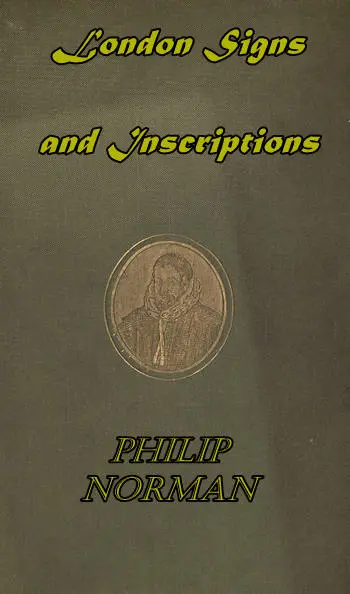
"London Signs and Inscriptions" by Philip Norman is a historical account written in the late 19th century. The book explores the unique and artistic sculptured signs that mark various buildings and places throughout London, shedding light on the city's architectural history and cultural heritage. It delves into the significance of these signs, illustrating how they represent ownership, history, and the ambiance of the urban landscape. The opening of the work introduces the fascinating world of London's signs and inscriptions, revealing their importance as markers of identity for traders, establishments, and localities in the 18th century and earlier. Philip Norman, an artist and antiquary, provides a historical context for these signs, sharing stories and connections with past traditions. He discusses specific examples, such as the sculptured sign of the Boy and Panyer and the connections of various signs to local history and trade practices, setting the stage for a detailed exploration of thousands of unique signs across the city in subsequent chapters.
Introduction adapted from the source catalogue; source summaries may be automatically generated.
Free to read · English · 54,888 words · No account needed
MAKE TIME FOR A GOOD BOOK
On by default. Untick to stop anonymous reading totals. Each page counts after 10 seconds in view. How this works.
Anonymous counting is on unless you have switched it off.
The disappearance of these open spaces, and the erection of enormously high buildings on every available spot, is, I believe, a great evil, not only from the picturesque, but from the sanitary point of view. Writers on sanitary subjects are agreed that, of dangers to health, overcrowding is one of the greatest, and that, other things being equal, the death-rate regularly increases in proportion to the density of the population. Dr. G. V. Poore[109] has recently pointed out that every new set of offices adds its quota to the sewage in the river; while ‘the absence of green plants entails a great loss of nascent oxygen or ozone which gives to air its peculiar quality of freshness.’ In his opinion, it is hardly conceivable that a high level of health can be maintained in a spot where vegetable life languishes, animal and vegetable life being complementary to each other.
Some will no doubt console themselves with the notion that, the City being now to a great extent merely a place of business, those who spend the day there (considerably more than a million, according to the last calculation) can throw off the ill effects while they are away. To this I reply that, if one includes the outlying parts, many thousands still make it their home, and that, in any case, to spend a quarter of one’s existence under most unhealthy conditions must tend to cause illness and to shorten life. In these times of popular government, the great City Guilds are more or less on their probation. If I am right, the Drapers’ Company, whatever the temptation may have been, committed a fatal mistake when they covered their garden with huge blocks of offices, a mistake which can never be atoned for by any amount of charitable donation. Their example has been quickly followed, and soon, I fear, hardly one breathing-space will remain in the City except the ground about St. Paul’s and the Tower, and here and there a bit of a disused graveyard hemmed in by lofty offices and warehouses.
Adam and Eve, Newgate Street, sign, 121
Addle Street; derivation of name, 47
Aggas’s, Ralph, map, 139
Aldermanbury, sign in, 94
Alleyne, Sir Thomas, Lord Mayor, 209
Altitude, highest in City, 7
Ancaster, Duke of, 153
Anchor, signs, 106
Angel Alley, 221
Angel, Islington, 180, 182
Ape, carving of, 46
Aquarium Tavern, 166
Artillery Street, Bishopsgate Without, 167
Ashburnham, Lord, 35
Ashby-Sterry, J., 158
Ashwell’s Place, site of, 179
Austin Friars, 220
house in, 220
Axe and Bottle Yard, 136
Bacon, Francis, 134
Bagnigge House, 192, 195, 196
Bagnigge Wells, 191-196
Bagnio Court, 20
Baker and Basket, sign, 6
Baltassar, one of the Three Kings, 32
Barrington, Hon. D., on arms of Inner Temple, 132
Bartholomew Close, 137
Basing House, 202
Bath Street, 20
Battle Bridge, 198
Your reading position is saved on this browser. Take it to another device with a library code. Reading pages adapt to text, rather than matching a printed edition.
BEHIND THE BOOK
This eBook is for the use of anyone anywhere in the United States and most other parts of the world at no cost and with almost no restrictions whatsoever. You may copy it, give it away or re-use it under the terms of the Project Gutenberg License included with this eBook or online at www.gutenberg.org. If you are not located in the United States, you will have to check the laws of the country where you are located before using this eBook. Read the source licence.
The original source file, including credits and licence, is retained by this library. Request an original-format copy at no charge. Please include the book title and Project Gutenberg identifier #53105.
KEEP YOUR CURIOSITY GOING
Cécile Tormay

Moritz Busch
John L. Ransom
Frances Wright
Cécile Tormay

Mabel Potter Daggett