THE CLASSIC COLLECTION✦An outlaw’s diary: the CommuneCLASSIC FREE BOOKS
An outlaw’s diary: the Commune
Cécile Tormay
THE CLASSIC COLLECTION · 1893
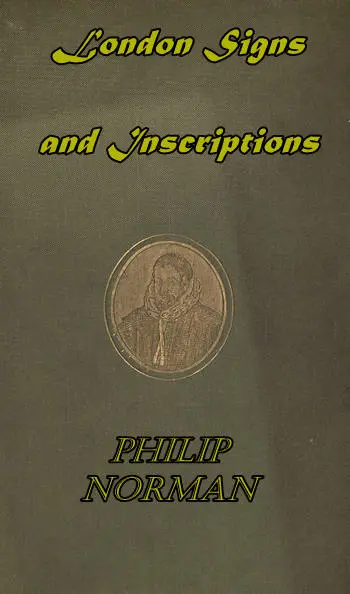
"London Signs and Inscriptions" by Philip Norman is a historical account written in the late 19th century. The book explores the unique and artistic sculptured signs that mark various buildings and places throughout London, shedding light on the city's architectural history and cultural heritage. It delves into the significance of these signs, illustrating how they represent ownership, history, and the ambiance of the urban landscape. The opening of the work introduces the fascinating world of London's signs and inscriptions, revealing their importance as markers of identity for traders, establishments, and localities in the 18th century and earlier. Philip Norman, an artist and antiquary, provides a historical context for these signs, sharing stories and connections with past traditions. He discusses specific examples, such as the sculptured sign of the Boy and Panyer and the connections of various signs to local history and trade practices, setting the stage for a detailed exploration of thousands of unique signs across the city in subsequent chapters.
Introduction adapted from the source catalogue; source summaries may be automatically generated.
Free to read · English · 54,888 words · No account needed
MAKE TIME FOR A GOOD BOOK
On by default. Untick to stop anonymous reading totals. Each page counts after 10 seconds in view. How this works.
Anonymous counting is on unless you have switched it off.
Austin Friars, another region in the heart of the City perhaps as interesting as that which I have just described, is, like it, rapidly being transformed. Not long ago it still maintained a distinctive character. Something of monastic calm seemed to linger about the old home and grounds of the begging friars, crowned by part of their church, which since Edward VI.’s time has been handed over to the Dutch congregation of London. Outside, in Broad Street, there was the roar and confusion of a mighty traffic; within the sacred precinct there was peace: wheeled vehicles seldom entered the very foot passengers, I have thought, used to slacken their pace, and relax for a moment the grim, determined look which, as a rule, characterizes the man whose mind is bent on business.
Passing round what remains of the old church, one may still see a house--No. 10--which is an excellent example of the real Queen Anne style; to judge from the date on a rainpipe, it was probably completed in the year 1704. The porch has a flight of steps; ascending this, one finds before one a spacious staircase panelled throughout, and especially noticeable on account of its fine painted ceiling, one of the last to be met with in a City mansion. No. 11 forms part of the same block of buildings.
Retracing our steps, we see standing back somewhat from the main roadway, to the right of a new passage just opened into what is called, in mockery, Drapers’ Gardens, a tall new structure occupying the site of another old brick mansion the associations of which were very remarkable. The house in question, No. 21, Austin Friars, had been built during the latter part of the seventeenth century, possibly even before the Great Fire, which did not extend so far north; it seems to be marked in Ogilby’s map of 1677. About the early possessors, Richard Young and others, nothing is known of any special interest. In the year 1705 it came into the hands of Herman Olmius, merchant, whose name occurs in the ‘Little London Directory’ for 1677, where he is described as of Angel Alley, Bishopsgate Street Without. He was descended from an ancient family of Arlon, in the duchy of Luxemburg, and was naturalized by Act of Parliament, 29th Charles II. Here he lived and carried on his business, and here, having made and inherited a large fortune, he died in the year 1718. His will shows that he was a member, not of the Dutch congregation of the neighbouring church in Austin Friars, but of the French Church in Threadneedle Street, to which he left £150 for the benefit of the poor. At the time of his death he possessed four other houses in Austin Friars, ‘with yards, gardens, and appurtenances,’ a shop called the Crane in the Poultry, and another with the sign of the Plough in Bucklersbury. He also had much real property in Essex and elsewhere. Herman was the son of Johannes Ludovicus or John Lewis Olmius, and of his wife Margareta Gerverdine. He married Judith, daughter and heiress of John Drigue, who also appears to have been living in Angel Court or Alley in 1677, and who had also married an heiress, the daughter of John Billers. Herman Olmius and his wife Judith had no less than ten children, but only two of them left offspring. These were his younger daughter Margaret, wife of Adrian Lernoult, who had predeceased him, and to whose descendants the City property was bequeathed; and John Olmius,[104] born in 1670. This gentleman became High Sheriff of Essex in 1707, a justice of the peace, and Deputy-Lieutenant of the county. He died December 20, 1731, being then Deputy-Governor of the Bank of England. His wife was Elizabeth, daughter and sole heiress of Thomas Clarke, a descendant of the Clarkes of St. Ives, Huntingdon, and probably her husband’s cousin. Their son, also named John, was many years member of Parliament, and received an Irish peerage under the title of Lord Waltham. He married Anne, daughter of Sir William Billers, Lord Mayor in 1733, and left a son and a daughter. The former died without issue in 1787, when the family became extinct in the male line; the latter having married John Luttrell, who was brother of the Duchess of Cumberland,[105] and who became third Earl of Carhampton, had a daughter, Frances Maria, from whom is descended Sir Simeon Henry Stuart, Bart. The Olmius family possessed much land in Essex, and a large country seat at Boreham, now used as a convent. At the Saracen’s Head Hotel, Chelmsford, their fleeting dignity is still represented by two fine hall-chairs emblazoned with the Olmius crest, namely a demi-Moor in armour between laurel branches, surmounted by a baron’s coronet. My friend Mr. Francis Galton would doubtless tell us that the failure of the family in the male line resulted naturally from marriage with heiresses and from intermarriage. Its rapid rise had also, no doubt, been in part owing to the former cause.
Your reading position is saved on this browser. Take it to another device with a library code. Reading pages adapt to text, rather than matching a printed edition.
BEHIND THE BOOK
This eBook is for the use of anyone anywhere in the United States and most other parts of the world at no cost and with almost no restrictions whatsoever. You may copy it, give it away or re-use it under the terms of the Project Gutenberg License included with this eBook or online at www.gutenberg.org. If you are not located in the United States, you will have to check the laws of the country where you are located before using this eBook. Read the source licence.
The original source file, including credits and licence, is retained by this library. Request an original-format copy at no charge. Please include the book title and Project Gutenberg identifier #53105.
KEEP YOUR CURIOSITY GOING
Cécile Tormay

Moritz Busch
John L. Ransom
Frances Wright
Cécile Tormay

Mabel Potter Daggett