THE CLASSIC COLLECTION✦An outlaw’s diary: the CommuneCLASSIC FREE BOOKS
An outlaw’s diary: the Commune
Cécile Tormay
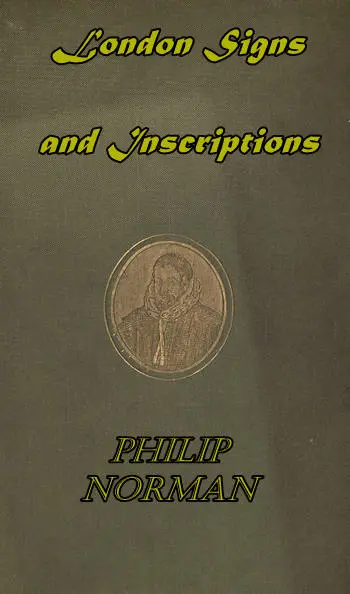
THE CLASSIC COLLECTION · 1893
"London Signs and Inscriptions" by Philip Norman is a historical account written in the late 19th century. The book explores the unique and artistic sculptured signs that mark various buildings and places throughout London, shedding light on the city's architectural history and cultural heritage. It delves into the significance of these signs, illustrating how they represent ownership, history, and the ambiance of the urban landscape. The opening of the work introduces the fascinating world of London's signs and inscriptions, revealing their importance as markers of identity for traders, establishments, and localities in the 18th century and earlier. Philip Norman, an artist and antiquary, provides a historical context for these signs, sharing stories and connections with past traditions. He discusses specific examples, such as the sculptured sign of the Boy and Panyer and the connections of various signs to local history and trade practices, setting the stage for a detailed exploration of thousands of unique signs across the city in subsequent chapters.
Introduction adapted from the source catalogue; source summaries may be automatically generated.
Free to read · English · 54,888 words · No account needed
MAKE TIME FOR A GOOD BOOK
On by default. Untick to stop anonymous reading totals. Each page counts after 10 seconds in view. How this works.
Anonymous counting is on unless you have switched it off.
Having looked up the history of the Lawrence family, and its connection with this parish, I think I can show that the initials on the pilaster of Nos. 8 and 9, Great St. Helen’s were not those of Sir John Lawrence and his wife Abigail, but of his uncle Adam and his uncle’s wife. The Lawrences, like many other eminent mercantile families, were originally Dutch or Flemish. The name was spelt in various ways, as Laurens, Laureijns, Laurents, etc., until, when its possessors became thoroughly anglicized, it took the English form. Le Neve, the herald, says that a Marcus Lawrence, from Flanders, who had married Gertrude Huesen, came and settled in London. He had, among other children, a son Abraham and a son Adam. The latter was baptized at the Dutch Church, Austin Friars, September 8, 1584;[94] and one may fairly assume that it was he who there married, May 28, 1610, Judith Van den Brugghe, of Norwich, where there was then a strong settlement of people from the Low Countries. He was appointed deacon of the Dutch Church in 1628, and became an elder in 1632. Eleven years later he had taken up his residence in Great St. Helen’s, as we learn from an entry in the parish register,[95] which suggests the forlorn condition of the homeless poor in those days. On the 23rd of April, 1643, ‘a female infant, found dead at the dore of Mr. Adam Lawrence, merchant, was buried in the churchyard’ there. What house he was then living in I am not able to determine; but in the year 1646 the house just now destroyed was doubtless either built or altered for his own residence, and on it was placed an inscription, according to the custom of the country whence he sprang.
I have previously pointed out that in inscriptions of this kind the initial of the husband’s Christian name is almost invariably on the left, the wife’s on the right, and that of the surname above. The letters in question would therefore have stood for ‘Adam and Judith Lawrence.’ In 1650 came the inevitable ending to their long married life. On the 9th of April it is recorded that Judith ‘Laurents’[96] was buried in the church of Great St. Helen’s. Adam died in October, 1657. His will describes him as a merchant, and he seems to have been a very prosperous one. He desires to be buried near his wife, in Great St. Helen’s, and leaves £100 to the poor of the Dutch congregation in Austin Friars, and £100 towards the maintenance of the ministry there; also similar legacies for the parish of Great St. Helen’s, and £100 to the poor children of Christ’s Hospital. Amongst numerous nephews, he singles out for special favour John, who seems to have been a son of his brother Abraham. To him he leaves several houses and gardens in the parish, amongst others his ‘now dwelling-house, with the yards, garden edifices, appurtenances, and hereditaments whatsoever thereunto belonging.’ This, no doubt, was Nos. 8 and 9, Great St. Helen’s, unless after his wife’s death he had shifted into another residence. Adam also left to his nephew John his share in the ‘sister’s thread trade,’ whatever that may mean, which he had in partnership with Abraham Cullen,[97] the elder, and Philip Van Cassole; and £1,500 to Abigail, his nephew’s wife, who died in 1681, and whose monument still exists in Great St. Helen’s Church, where it is recorded that she was ‘the tender mother of ten children. The nine first, being all daughters, she suckled at her own breasts; they all lived to be of age. Her last, a son, died an infant. Shee lived a married wife 39 years, 23 whereof she was an exemplary matron of this Cittie,[98] dying in the 59th year of her age.’ This lady was eldest daughter of Abraham Cullen, who appears to have been nearly related to the Lawrence family. One paragraph of Adam’s will is worth quoting, because it seems to indicate that pretentious public funerals were then not uncommon in the City, and that he, at any rate, was free from a taste for vulgar display. He says: ‘Lastly, my desire is that my funerall be decently performed without anie pompe or ceremonie of mourners, and that my corps be carried from my own dwelling house, not troubling any publique hall.’
Your reading position is saved on this browser. Take it to another device with a library code. Reading pages adapt to text, rather than matching a printed edition.
BEHIND THE BOOK
This eBook is for the use of anyone anywhere in the United States and most other parts of the world at no cost and with almost no restrictions whatsoever. You may copy it, give it away or re-use it under the terms of the Project Gutenberg License included with this eBook or online at www.gutenberg.org. If you are not located in the United States, you will have to check the laws of the country where you are located before using this eBook. Read the source licence.
The original source file, including credits and licence, is retained by this library. Request an original-format copy at no charge. Please include the book title and Project Gutenberg identifier #53105.
KEEP YOUR CURIOSITY GOING
Cécile Tormay

Moritz Busch
John L. Ransom
Frances Wright
Cécile Tormay

Mabel Potter Daggett