THE CLASSIC COLLECTION✦Accepting the universeCLASSIC FREE BOOKS
Accepting the universe
John Burroughs
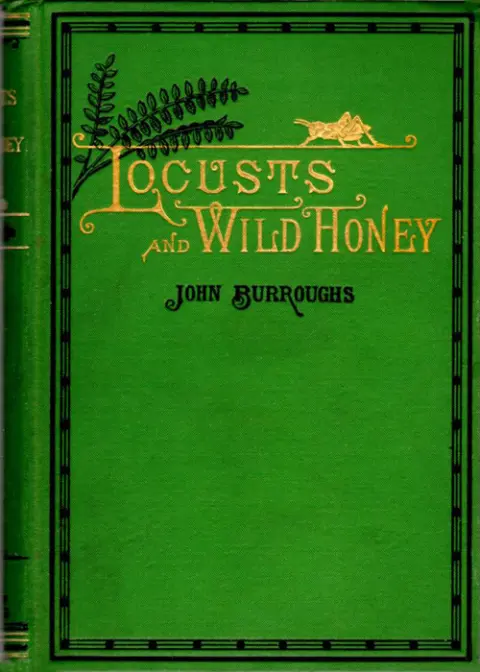
THE CLASSIC COLLECTION · 1879
"Locusts and Wild Honey" by John Burroughs is a collection of nature essays written in the late 19th century. The work reflects Burroughs' keen observations of the natural world, particularly focusing on bees and their intricate behaviors, as well as the beauty and richness of the environment around him. The author’s lyrical prose invites readers to appreciate the subtleties and wonders of nature, aiming to foster a deeper connection with the wild. The opening of the book sets the tone with Burroughs' observations of honeybees as they emerge from hibernation in spring, exploring the activity surrounding their hives. He describes in detail how bees collect pollen and nectar from various seasonal blooms, emphasizing the relationship between the bees and their environment. Burroughs avidly portrays the processes of honey-making and hive dynamics, providing insights into the colony's social structure, the nurturing roles played by worker bees, and the life cycle of the queen bee. Through vivid imagery and thoughtful reflections, the author transports readers into the world of bees, illustrating the delicate balance of nature and the hidden complexities of these industrious creatures.
Introduction adapted from the source catalogue; source summaries may be automatically generated.
Free to read · English · 61,708 words · No account needed
MAKE TIME FOR A GOOD BOOK
On by default. Untick to stop anonymous reading totals. Each page counts after 10 seconds in view. How this works.
Anonymous counting is on unless you have switched it off.
As darkness came on, the rumbling increased, and the mountains and the woods and the still air were such good conductors of sound that the ear was vividly impressed. One seemed to feel the enormous convolutions of the clouds in the deep and jarring tones of the thunder. The coming of night in the woods is alone peculiarly impressive, and it is doubly so when out of the darkness comes such a voice as this. But we fed the fire the more industriously, and piled the logs high, and kept the gathering gloom at bay by as large a circle of light as we could command. The lake was a pool of ink and as still as if congealed; not a movement or a sound, save now and then a terrific volley from the cloud batteries now fast approaching. By nine o'clock little puffs of wind began to steal through the woods and tease and toy with our fire. Shortly after, an enormous electric bombshell exploded in the treetops over our heads, and the ball was fairly opened. Then followed three hours, with only two brief intermissions, of as lively elemental music and as copious an outpouring of rain as it was ever my lot to witness. It was a regular meteorological carnival, and the revelers were drunk with the wild sport. The apparent nearness of the clouds and the electric explosions was something remarkable. Every discharge seemed to be in the branches immediately overhead and made us involuntarily cower, as if the next moment the great limbs of the trees, or the trees themselves, would come crashing down. The mountain upon which we were encamped appeared to be the focus of three distinct but converging storms. The last two seemed to come into collision immediately over our camp-fire, and to contend for the right of way, until the heavens were ready to fall and both antagonists were literally spent. We stood in groups about the struggling fire, and when the cannonade became too terrible would withdraw into the cover of the darkness, as if to be a less conspicuous mark for the bolts; or did we fear that the fire, with its currents, might attract the lightning? At any rate, some other spot than the one where we happened to be standing seemed desirable when those onsets of the contending elements were the most furious. Something that one could not catch in his hat was liable to drop almost anywhere any minute. The alarm and consternation of the wives communicated itself to the husbands, and they looked solemn and concerned. The air was filled with falling water. The sound upon the myriad leaves and branches was like the roar of a cataract. We put our backs up against the great trees, only to catch a brook on our shoulders or in the backs of our necks. Still the storm waxed. The fire was beaten down lower and lower. It surrendered one post after another, like a besieged city, and finally made only a feeble resistance from beneath a pile of charred logs and branches in the centre. Our garments yielded to the encroachments of the rain in about the same manner. I believe my necktie held out the longest, and carried a few dry threads safely through. Our cunningly devised and bedecked table, which the housekeepers had so doted on and which was ready spread for breakfast, was washed as by the hose of a fire-engine,--only the bare poles remained,--and the couch of springing boughs, that was to make Sleep jealous and o'er-fond, became a bed fit only for amphibians. Still the loosened floods came down; still the great cloud-mortars bellowed and exploded their missiles in the treetops above us. But all nervousness finally passed away, and we became dogged and resigned. Our minds became water-soaked; our thoughts were heavy and bedraggled. We were past the point of joking at one another's expense. The witticisms failed to kindle,--indeed, failed to go, like the matches in our pockets. About midnight the rain slackened, and by one o'clock ceased entirely. How the rest of the night was passed beneath the dripping trees and upon the saturated ground, I have only the dimmest remembrance. All is watery and opaque; the fog settles down and obscures the scene. But I suspect I tried the "wet pack" without being a convert to hydropathy. When the morning dawned, the wives begged to be taken home, convinced that the charms of camping-out were greatly overrated. We, who had tasted this cup before, knew they had read at least a part of the legend of the wary trout without knowing it.
Your reading position is saved on this browser. Take it to another device with a library code. Reading pages adapt to text, rather than matching a printed edition.
BEHIND THE BOOK
This eBook is for the use of anyone anywhere in the United States and most other parts of the world at no cost and with almost no restrictions whatsoever. You may copy it, give it away or re-use it under the terms of the Project Gutenberg License included with this eBook or online at www.gutenberg.org. If you are not located in the United States, you will have to check the laws of the country where you are located before using this eBook. Read the source licence.
The original source file, including credits and licence, is retained by this library. Request an original-format copy at no charge. Please include the book title and Project Gutenberg identifier #6355.
KEEP YOUR CURIOSITY GOING

David Patterson (Spirit) Hatch

David Patterson (Spirit) Hatch

David Patterson (Spirit) Hatch
Cécile Tormay

Moritz Busch
John L. Ransom