THE CLASSIC COLLECTION✦Accepting the universeCLASSIC FREE BOOKS
Accepting the universe
John Burroughs
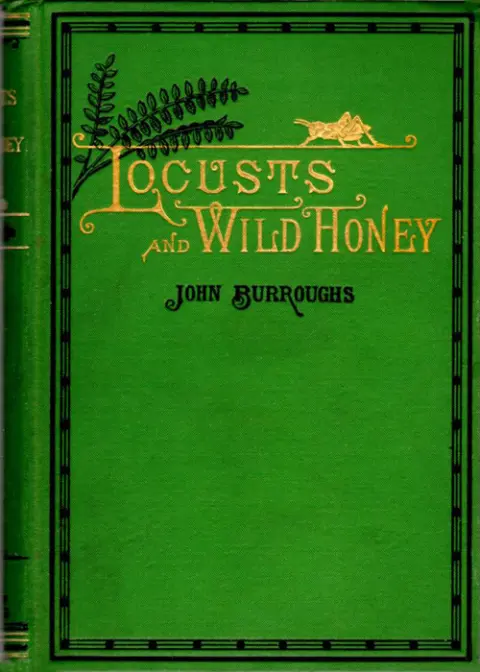
THE CLASSIC COLLECTION · 1879
"Locusts and Wild Honey" by John Burroughs is a collection of nature essays written in the late 19th century. The work reflects Burroughs' keen observations of the natural world, particularly focusing on bees and their intricate behaviors, as well as the beauty and richness of the environment around him. The author’s lyrical prose invites readers to appreciate the subtleties and wonders of nature, aiming to foster a deeper connection with the wild. The opening of the book sets the tone with Burroughs' observations of honeybees as they emerge from hibernation in spring, exploring the activity surrounding their hives. He describes in detail how bees collect pollen and nectar from various seasonal blooms, emphasizing the relationship between the bees and their environment. Burroughs avidly portrays the processes of honey-making and hive dynamics, providing insights into the colony's social structure, the nurturing roles played by worker bees, and the life cycle of the queen bee. Through vivid imagery and thoughtful reflections, the author transports readers into the world of bees, illustrating the delicate balance of nature and the hidden complexities of these industrious creatures.
Introduction adapted from the source catalogue; source summaries may be automatically generated.
Free to read · English · 61,708 words · No account needed
MAKE TIME FOR A GOOD BOOK
On by default. Untick to stop anonymous reading totals. Each page counts after 10 seconds in view. How this works.
Anonymous counting is on unless you have switched it off.
This bird was, of course, the first to leave the nest. For two days before that event he kept his position in the opening most of the time and sent forth his strong voice incessantly. The old ones abstained from feeding him almost entirely, no doubt to encourage his exit. As I stood looking at him one afternoon and noting his progress, he suddenly reached a resolution,--seconded, I have no doubt, from the rear,--and launched forth upon his untried wings. They served him well, and carried him about fifty yards up-hill the first heat. The second day after, the next in size and spirit left in the same manner; then another, till only one remained. The parent birds ceased their visits to him, and for one day he called and called till our ears were tired of the sound. His was the faintest heart of all. Then he had none to encourage him from behind. He left the nest and clung to the outer bole of the tree, and yelped and piped for an hour longer; then he committed himself to his wings and went his way like the rest.
A young farmer in the western part of New York, who has a sharp, discriminating eye, sends me some interesting notes about a tame high-hole he once had.
"Did you ever notice," says he, "that the high-hole never eats anything that he cannot pick up with his tongue? At least this was the case with a young one I took from the nest and tamed. He could thrust out his tongue two or three inches, and it was amusing to see his efforts to eat currants from the hand. He would run out his tongue and try to stick it to the currant; failing in that, he would bend his tongue around it like a hook and try to raise it by a sudden jerk. But he never succeeded, the round fruit would roll and slip away every time. He never seemed to think of taking it in his beak. His tongue was in constant use to find out the nature of everything he saw; a nail-hole in a board or any similar hole was carefully explored. If he was held near the face he would soon be attracted by the eye and thrust his tongue into it. In this way he gained the respect of a number of half-grown cats that were around the house. I wished to make them familiar to each other, so there would be less danger of their killing him. So I would take them both on my knee, when the bird would soon notice the kitten's eyes, and, leveling his bill as carefully as a marksman levels his rifle, he would remain so a minute, when he would dart his tongue into the cat's eye. This was held by the cats to be very mysterious: being struck in the eye by something invisible to them. They soon acquired such a terror of him that they would avoid him and run away whenever they saw his bill turned in their direction. He never would swallow a grasshopper even when it was placed in his throat; he would shake himself until he had thrown it out of his mouth. His 'best hold' was ants. He never was surprised at anything, and never was afraid of anything. He would drive the turkey gobbler and the rooster. He would advance upon them holding one wing up as high as possible, as if to strike with it, and shuffle along the ground toward them, scolding all the while in a harsh voice. I feared at first that they might kill him, but I soon found that he was able to take care of himself. I would turn over stones and dig into ant-hills for him, and he would lick up the ants so fast that a stream of them seemed going into his mouth unceasingly. I kept him till late in the fall, when he disappeared, probably going south, and I never saw him again." My correspondent also sends me some interesting observations about the cuckoo. He says a large gooseberry-bush standing in the border of an old hedge-row, in the midst of open fields, and not far from his house, was occupied by a pair of cuckoos for two seasons in succession, and, after an interval of a year, for two seasons more. This gave him a good chance to observe them. He says the mother bird lays a single egg, and sits upon it a number of days before laying the second, so that he has seen one young bird nearly grown, a second just hatched, and a whole egg, all in the nest at once. "So far as I have seen, this is the settled practice,--the young leaving the nest one at a time to the number of six or eight. The young have quite the look of the young of the dove in many respects. When nearly grown they are covered with long blue pin-feathers as long as darning-needles, without a bit of plumage on them. They part on the back and hang down on each side by their own weight. With its curious feathers and misshapen body, the young bird is anything but handsome. They never open their mouths when approached, as many young birds do, but sit perfectly still, hardly moving when touched." He also notes the unnatural indifference of the mother bird when her nest and young are approached. She makes no sound, but sits quietly on a near branch in apparent perfect unconcern.
Your reading position is saved on this browser. Take it to another device with a library code. Reading pages adapt to text, rather than matching a printed edition.
BEHIND THE BOOK
This eBook is for the use of anyone anywhere in the United States and most other parts of the world at no cost and with almost no restrictions whatsoever. You may copy it, give it away or re-use it under the terms of the Project Gutenberg License included with this eBook or online at www.gutenberg.org. If you are not located in the United States, you will have to check the laws of the country where you are located before using this eBook. Read the source licence.
The original source file, including credits and licence, is retained by this library. Request an original-format copy at no charge. Please include the book title and Project Gutenberg identifier #6355.
KEEP YOUR CURIOSITY GOING

David Patterson (Spirit) Hatch

David Patterson (Spirit) Hatch

David Patterson (Spirit) Hatch
Cécile Tormay

Moritz Busch
John L. Ransom