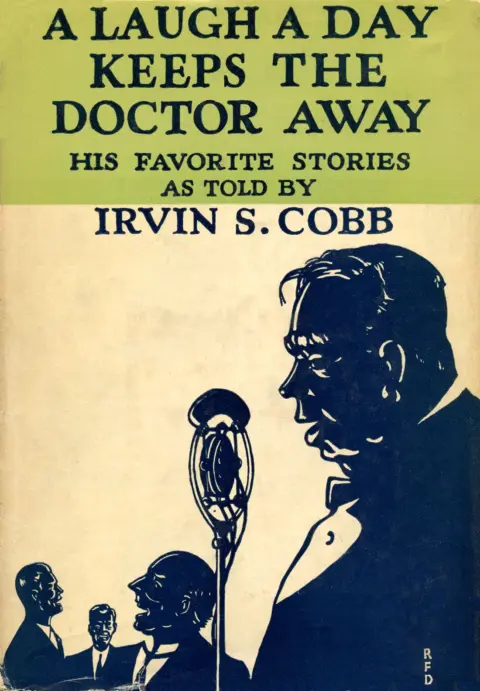
A laugh a day keeps the doctor away
Irvin S. (Irvin Shrewsbury) Cobb
THE CLASSIC COLLECTION · 1916
"Local Color" by Irvin S. Cobb is a work of fiction written in the early 20th century. The story opens with the enigmatic disappearance of Felix Looms, an obscure author yearning for material to write an authentic novel on prison life. Taking matters into his own hands, Looms decides to go to prison intentionally, effectively shedding his previous identity as he transforms into James Williams, a petty criminal. The book delves into the intricacies of human character and the institutions of society, particularly the prison system. The beginning of "Local Color" introduces readers to Felix Looms, who escapes from his mundane existence as a writer in pursuit of first-hand experience with crime and confinement. Shortly after his planned departure, he orchestrates his own arrest for pickpocketing and is sentenced to Sing Sing prison. As he settles into his new life behind bars, Looms grapples with the transformation his character undergoes, from a self-effacing author to a participant in the very world he seeks to critique. The opening chapters set the stage for an exploration of the psychological and social realities of prison life and the stark contrasts between his previous and current identities.
Introduction adapted from the source catalogue; source summaries may be automatically generated.
Free to read · English · 106,026 words · No account needed
MAKE TIME FOR A GOOD BOOK
On by default. Untick to stop anonymous reading totals. Each page counts after 10 seconds in view. How this works.
Anonymous counting is on unless you have switched it off.
She held in one hand a flimsy, blue-backed sheaf; it was her part in this play. Having that wisdom in her calling which comes of long experience, she would read from it until automatically she had acquired it without prolonged mental effort; would let her trained and docile memory sop up the speeches by processes of absorption. Miss Cherry carried no manuscript; she didn't need it. She had been sitting up nights, studying her lines. For she, the poor thing, was newly escaped from a dramatic school. Mrs. Morehead wanted to make a living. Miss Cherry wanted to make a hit.
These two began the opening scene of the act and, between them, carried it forward. Miss Cherry as the daughter, was playing it in rehearsal, exactly as she expected to play it before an audience, putting in gestures, inflections, short catches of the breath, emotional gasps--all the illusions, all the business of the part. On the other hand, Mrs. Morehead appeared to have but one ambition in her present employment and that was to get it over with as speedily as possible. After this contrasted fashion, then, they progressed to a certain dramatic juncture:
"But, mother," said Miss Cherry, her arms extended in a
carefully-thought-out attitude of girlish bewilderment, "what am I to
do?"
Mrs. Morehead glanced down, refreshing her memory by a glance into the
blue booklet.
"My child," she said, "leave it to destiny."
She said this in the tone of a person of rather indifferent appetite, ordering toast and tea for breakfast.
A pause ensued here.
"My child," repeated Mrs. Morehead, glancing over her shoulder
impatiently, but speaking still in the same voice, "leave it to
destiny."
"Well, well----" snapped the man at the little table, "that's the cue, 'leave it to destiny.' Come on, McVey? Come a-w-n, McVey? Where's McVey?" He raised his voice fretfully.
A nervous, thin man hurried down the stage.
"Oh, there you are. Go ahead, McVey. You're keeping everybody waiting. Didn't I tell you you'd have to read the grandfather's part to-day?"
"No, sir, you didn't," said McVey, aggrieved.
"Well, anyhow, I meant to," said his superior.
"But I'm reading Miss Gifford's part this morning," said McVey, who was the assistant stage manager. "She had to go to see about her costumes."
"You'll have to read 'em both, then," ordered the special director. "Anyhow, the parts don't conflict--they're not on the stage together during this act. Do the best you can. Now let's go back and take those last two sides over again."
Your reading position is saved on this browser. Take it to another device with a library code. Reading pages adapt to text, rather than matching a printed edition.
Irvin S. (Irvin Shrewsbury) Cobb
Irvin S. (Irvin Shrewsbury) Cobb
Irvin S. (Irvin Shrewsbury) Cobb
Irvin S. (Irvin Shrewsbury) Cobb
BEHIND THE BOOK
This eBook is for the use of anyone anywhere in the United States and most other parts of the world at no cost and with almost no restrictions whatsoever. You may copy it, give it away or re-use it under the terms of the Project Gutenberg License included with this eBook or online at www.gutenberg.org. If you are not located in the United States, you will have to check the laws of the country where you are located before using this eBook. Read the source licence.
The original source file, including credits and licence, is retained by this library. Request an original-format copy at no charge. Please include the book title and Project Gutenberg identifier #41297.
KEEP YOUR CURIOSITY GOING
Coulson Kernahan

Maurice Baring
Frances Wright
Cécile Tormay

Frederic Jesup Stimson

W. H. P. (William Henry Pope) Jarvis