
Last letters from the living dead man
David Patterson (Spirit) Hatch
THE CLASSIC COLLECTION · 1900
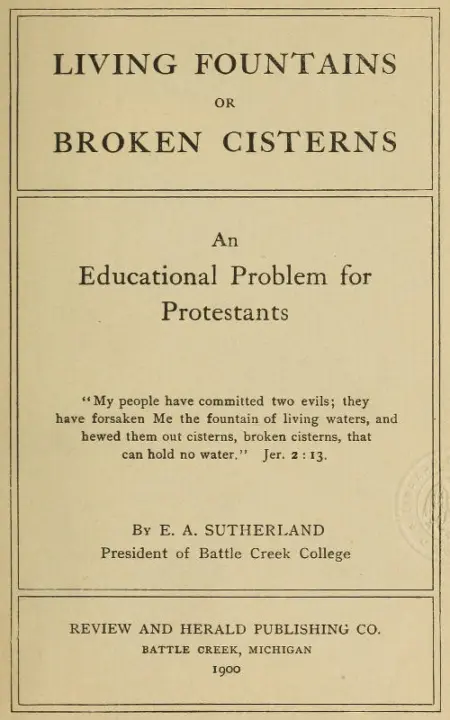
"Living Fountains or Broken Cisterns: An Educational Problem for Protestants" by E. A. Sutherland is an educational treatise written in the late 19th century. The work explores the historical relationship between Protestantism, education, and societal advancement, arguing that the decline of true education has contributed to the weakening of Protestant churches and American democracy. The book emphasizes the necessity of a proper education for the youth rooted in biblical principles, positing that such an education is essential for the revival of Protestantism and the maintenance of civic virtue. The opening of the book introduces the core argument that education is fundamentally intertwined with religion and societal health. Sutherland discusses the historical implications of educational systems, tracing the roots back to biblical times, including the Edenic school and the teachings of figures such as Abraham and Christ. He asserts that wisdom and understanding come from a divine source and are best cultivated through faith-based education. The introduction sets the stage for a detailed examination of various educational paradigms, highlighting the consequences of straying from Godly principles in educational practices.
Introduction adapted from the source catalogue; source summaries may be automatically generated.
Free to read · English · 82,682 words · No account needed
MAKE TIME FOR A GOOD BOOK
On by default. Untick to stop anonymous reading totals. Each page counts after 10 seconds in view. How this works.
Anonymous counting is on unless you have switched it off.
Nature, result of studying if God is not taken into account, 52, 53;
the first study of Christ, 121;
taught from by Christ, 134, 314;
Luther on study of, 234;
study of in modern schools, 327;
study of prevents “cramming,” 352;
its study based on doubt, 354;
study of not to supersede the Bible, 387.
Noah a teacher of righteousness, 46, 47.
Origen, his birth and education, 169;
his reasons for studying philosophy, 169, 170;
represents mixture of pagan and Christian ideas, 170;
his system of education, 170-175;
a higher critic, 172.
Pagans, education of, 92-116;
education of was self-worship, 93;
classics in education of, 109-112;
their attitude toward Christian education, 147.
Papacy, human origin of, 36, 44, 154-162;
produced by mixture of educational systems, 72, 73;
as seen in school of Clement, 163-167;
to be overthrown only by Christian education, 183;
its tyranny over thought, 184;
primary schools of, 185;
emphasized memory work, 186, 187;
taught Latin, 186;
text-books of, 188;
studies in schools of, 188;
geography as taught in schools of, 190;
manner of meeting opposition, 199;
medicine as taught by, 199;
suppresses Arabian schools, 203;
grants degrees, 208;
why it wishes to control education, 211, 212;
secret of its power, 214;
relation to Arabian learning, 219;
dropped in education, 238;
a return to, 258, 269;
aided in United States by Jesuit schools, 285;
its influence as seen in Harvard, 303, 310;
principles of in William and Mary College, 301;
tendency to revert to, 308;
union of with Christian principles, 309;
degrees a mark of, 334;
consists in union of church and state, 335;
mechanical teaching a mark of, 344;
“cramming” one of its methods, 347;
doubt a characteristic of, 355.
Pelagianism, its origin, 181.
Penance, its origin, 181.
Pestalozzi, 326;
defines education, 380.
Philosophy, origin of false, 45;
false, 98, 104;
personified by Plato, 110.
Physics, 27, 28.
Physicians, treatment during Dark Ages, 195-197.
Physical degeneracy the result of sin, 38, 39.
Physical plane as opposed to spiritual, 43, 44, 69, 83-85, 385.
Physiology, in Jewish schools, 79;
during Dark Ages, 198;
the central science, 399, 402.
Plato, his work as an educator, 101-111;
result of adopting his philosophy in a Christian school, 150-152;
Origen studied, 170;
personifies heathen philosophy, 170.
Platonism the source of higher criticism, 173.
Poetry in Jewish schools, 80.
Preface, 1.
Prenatal influence, instructions concerning, 76.
Preparatory schools, those of Melancthon, 242;
of Jesuits, 276;
during Revolutionary period, 306;
standard for set by colleges, 320;
should follow church school, 405.
Protestantism favorable to education, 225;
effect on education, 251;
fails to see importance of education, 255;
result of her failure to educate, 264;
intrusts her children to Jesuits, 277;
Jesuits seek to destroy, 283;
papal or Christian education for? 286;
born of Reformation, 288;
killed by Jesuit schools, 290-337;
in American schools, 292;
weakens with coming of false education, 308;
must educate her children, 407-415.
Public schools of Julian, 148-150;
in the United States, 317-319.
Puritans, their attitude toward education, 294;
leave England, 292;
in New England, 296.
Ratich on Latin, 343.
Reason supplants faith, 18, 33, 41, 97, 168, 171, 174, 182, 385;
accepted by Cain, 43;
rejected warning of the flood, 47;
result of exalting, 362-364.
Your reading position is saved on this browser. Take it to another device with a library code. Reading pages adapt to text, rather than matching a printed edition.
BEHIND THE BOOK
This eBook is for the use of anyone anywhere in the United States and most other parts of the world at no cost and with almost no restrictions whatsoever. You may copy it, give it away or re-use it under the terms of the Project Gutenberg License included with this eBook or online at www.gutenberg.org. If you are not located in the United States, you will have to check the laws of the country where you are located before using this eBook. Read the source licence.
The original source file, including credits and licence, is retained by this library. Request an original-format copy at no charge. Please include the book title and Project Gutenberg identifier #61640.
KEEP YOUR CURIOSITY GOING
David Patterson (Spirit) Hatch

David Patterson (Spirit) Hatch

David Patterson (Spirit) Hatch
Cécile Tormay

Moritz Busch
John L. Ransom