
Last letters from the living dead man
David Patterson (Spirit) Hatch
THE CLASSIC COLLECTION · 1900
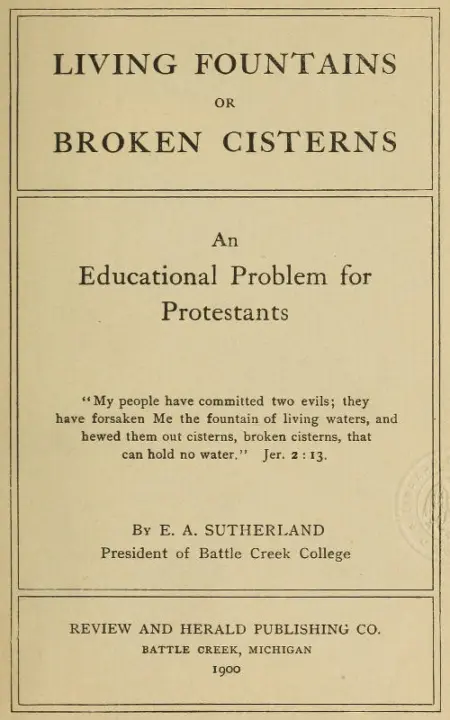
"Living Fountains or Broken Cisterns: An Educational Problem for Protestants" by E. A. Sutherland is an educational treatise written in the late 19th century. The work explores the historical relationship between Protestantism, education, and societal advancement, arguing that the decline of true education has contributed to the weakening of Protestant churches and American democracy. The book emphasizes the necessity of a proper education for the youth rooted in biblical principles, positing that such an education is essential for the revival of Protestantism and the maintenance of civic virtue. The opening of the book introduces the core argument that education is fundamentally intertwined with religion and societal health. Sutherland discusses the historical implications of educational systems, tracing the roots back to biblical times, including the Edenic school and the teachings of figures such as Abraham and Christ. He asserts that wisdom and understanding come from a divine source and are best cultivated through faith-based education. The introduction sets the stage for a detailed examination of various educational paradigms, highlighting the consequences of straying from Godly principles in educational practices.
Introduction adapted from the source catalogue; source summaries may be automatically generated.
Free to read · English · 82,682 words · No account needed
MAKE TIME FOR A GOOD BOOK
On by default. Untick to stop anonymous reading totals. Each page counts after 10 seconds in view. How this works.
Anonymous counting is on unless you have switched it off.
Catholic schools in America, 335;
see also “papacy.”
Character developed in worldly school, 44;
of students during Middle Ages, 204, 210;
of students in modern universities, 210;
of students after Reformation, 263;
the object of education, 232, 382;
valued by John Locke, 345-347.
Christian education, a search for wisdom, 14;
relation of to Reformation, 3, 4;
based on faith, 39, 397;
almost wiped out before the flood, 49, 50;
its meaning to early Christians, 140;
feared by the pagans, 147;
God’s three calls to, 168;
failure of Reformers to carry forward, 246;
how lost, 255;
versus papal, 286;
unites with papal ideas, 309;
effect on churches of neglecting, 328;
principles of, etc., 339-415;
never without a representative on earth, 341;
opposed to “cramming system,” 351;
based on faith, 354;
emphasizes practical, 367;
a spiritual education, 381-384;
emphasizes principles, 393-396;
manual training a part of, 402;
a system of, 403-407;
see also “education.”
Christ, birth of, 120;
early education of, 121;
spiritual education of, 122;
recognizes his life work, 123;
with the rabbis, 124;
his attitude toward manual training, 125;
preparation for his work, 126;
as a teacher, 127;
lived what he taught, 128;
educational principles of, 130-132;
his pupils, 132;
teachers in the country, 134;
his text-books, 135;
emphasized the practical, 135;
result of his educational system, 136-138;
commits the work of education to the church, 138-140;
the representative of true education, 170;
author of Christian education, 340;
taught from nature, 373, 374.
Church schools of Jews, 76;
of early Christians, 146;
should follow home school, 405.
Cities, origin of, 45;
effect of life in on children, 46;
Enoch chose not to live in, 46;
Abraham called from, 55;
life in, contrasted with country life, 64, 66, 146, 373, 379;
avoided by Christ, 134.
Classics in education, 109-113, 342, 343;
study of prior to Reformation, 216-218;
in Harvard, 303;
demanded by the universities, 307;
fruit of in America, 313;
John Locke on, 345.
Clement, school of, 163-167;
the first higher critic, 164;
meets opposition, 166;
gives up his faith, 167.
Comenius, 326;
on Latin and practical education, 344;
on nature-study, 352;
on number of studies, 353;
religion in school of, 365.
Congregationalists, education among, 295;
their schools, Harvard and Yale, 297-303.
Correlation, 400-402.
Country life versus city life, 64, 145, 379;
chosen by Jesus, 134, 373.
Courses of study, their origin, 204-209;
in Sturm’s school, 261;
in Harvard, 302;
multiplied, 322.
Cramming system, 259, 323-325;
papal in principle, 347;
Montaigne on, 348;
Mrs. Wallace on, 348-351;
prevented by nature study, 352;
prevented by correlation, 400.
Creation, the, 22-26;
mind its highest form, 24, 25.
Dark Ages, schools of, 180;
origin of, 184;
unfavorable to medical study, 194, 199.
Darwinism in education, 114-116.
Death, a result of sin, 36;
result of false education, 40, 67;
result of eating of the tree of knowledge, 50.
Dana on origin of species, 390-392.
Degrees, their origin, 204-209;
a papal mark, 334.
Diet, its relation to education, 38;
its place in Christian education, 403.
Discipline weakens in universities, 263.
Doubt, effects of, 32;
its place in modern education, 353-360;
its place in theology, 354;
the Socratic method, 356, 357;
not highest means of knowledge, 363.
Early Christians, education among, 139-155;
early training among, 142;
home education among, 143;
divided in opinion, 153;
gradually accept pagan methods, 154.
Eck opposes Reformation in education, 244.
Your reading position is saved on this browser. Take it to another device with a library code. Reading pages adapt to text, rather than matching a printed edition.
BEHIND THE BOOK
This eBook is for the use of anyone anywhere in the United States and most other parts of the world at no cost and with almost no restrictions whatsoever. You may copy it, give it away or re-use it under the terms of the Project Gutenberg License included with this eBook or online at www.gutenberg.org. If you are not located in the United States, you will have to check the laws of the country where you are located before using this eBook. Read the source licence.
The original source file, including credits and licence, is retained by this library. Request an original-format copy at no charge. Please include the book title and Project Gutenberg identifier #61640.
KEEP YOUR CURIOSITY GOING
David Patterson (Spirit) Hatch

David Patterson (Spirit) Hatch

David Patterson (Spirit) Hatch
Cécile Tormay

Moritz Busch
John L. Ransom