
Last letters from the living dead man
David Patterson (Spirit) Hatch
THE CLASSIC COLLECTION · 1900
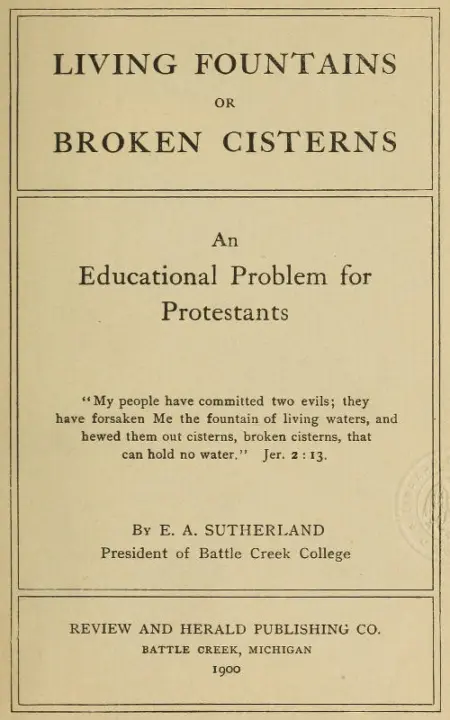
"Living Fountains or Broken Cisterns: An Educational Problem for Protestants" by E. A. Sutherland is an educational treatise written in the late 19th century. The work explores the historical relationship between Protestantism, education, and societal advancement, arguing that the decline of true education has contributed to the weakening of Protestant churches and American democracy. The book emphasizes the necessity of a proper education for the youth rooted in biblical principles, positing that such an education is essential for the revival of Protestantism and the maintenance of civic virtue. The opening of the book introduces the core argument that education is fundamentally intertwined with religion and societal health. Sutherland discusses the historical implications of educational systems, tracing the roots back to biblical times, including the Edenic school and the teachings of figures such as Abraham and Christ. He asserts that wisdom and understanding come from a divine source and are best cultivated through faith-based education. The introduction sets the stage for a detailed examination of various educational paradigms, highlighting the consequences of straying from Godly principles in educational practices.
Introduction adapted from the source catalogue; source summaries may be automatically generated.
Free to read · English · 82,682 words · No account needed
MAKE TIME FOR A GOOD BOOK
On by default. Untick to stop anonymous reading totals. Each page counts after 10 seconds in view. How this works.
Anonymous counting is on unless you have switched it off.
[63] “Church History,” cent. 2, part 2, chap. 1, par. 6.
[64] Rev. 2:4, 5.
[65] 1 Cor. 2:3-5, 13, Fenton’s translation.
[66] “Church History,” cent. 3, part 1, chap. 1, par. 5.
[67] “Church History,” Torrey’s trans., vol. 1, pages 71, 73.
[68] “Church History,” Maclain’s trans., cent. 1, part 2, chap. 3, par.
10.
[69] Idem.
[70] See Torrey’s trans., vol. 2, page 237.
[71] “Church History,” vol. 2, pages 224, 225.
[72] Idem, page 226.
[73] Idem, page 238.
[74] Idem, page 242.
[75] See Chambers’s Encyclopedia.
[76] Quoted by Neander, “Church History,” vol. 2, pp. 463, 464.
[77] Rev. 13:1.
[78] “Church History,” Maclain’s trans., cent. 3, chap. 3, par. 1.
[79] Idem, Murdock’s trans., cent. 3, part 2, chap. 3, par. 5.
[80] Mosheim, “Church History,” Maclain’s trans., cent. 3, chap. 3, par.
2.
[81] “Intellectual Development of Europe,” vol. 1, pages 432, 434.
[82] “History of the Reformation,” book 1, chap. 1.
[83] “Rise and Constitution of Universities,” page 55.
[84] Idem, page 56.
[85] W. T. Harris, U. S. Commissioner of Education.
[86] Idem.
[87] “Intellectual Development of Europe,” vol. 2, page 191.
[88] “Church History,” cent. 11, part 2, chap. 1, sec. 5.
[89] “History of Education,” page 100.
[90] “Church History,” cent. 11, part 2, chap. 1, sec. 5.
[91] “Intellectual Development of Europe,” vol. 2, page 159.
[92] “Intellectual Development of Europe,” vol. 2, page 121.
[93] Idem.
[94] Idem.
[95] Idem, page 125.
[96] Idem, pages 125, 126.
[97] “Church History,” cent. 12, part 2, chap. 1, par. 4.
[98] “History of Education,” page 114.
[99] Idem.
[100] Laurie, “Rise and Constitution of Universities,” page 168.
[101] Idem, pages 219, 220.
[102] Idem, page 169.
[103] Idem, page 222.
[104] Idem, page 227.
[105] Idem, page 220.
[106] Rev. B. Hartman, “Religion or No Religion in Education,” page 43.
[107] “History of Education,” pages 115, 116.
[108] See “Students in Riot,” at the Chicago University, Chicago
Record, Dec. 2, 1899.
[109] “Rise and Constitution of Universities,” page 288.
[110] “History of Education,” page 119.
[111] Idem, page 121.
[112] “History of Education,” pages 125-128.
[113] “History of Education,” page 138.
[114] Idem, pages 139, 140.
[115] “History of Education,” pages 142, 143.
[116] “History of the Reformation,” book 10, chap. 9.
[117] Ibid.
[118] Ibid.
[119] “History of Education,” page 143.
[120] D’Aubigné, book 10, chap. 9.
[121] Quoted in “History of Education,” page 145.
[122] “History of Education,” page 149.
[123] Idem, page 135.
[124] “History of the Reformation,” book 4, chap. 3.
[125] “History of the Reformation,” book 4, chap. 3.
[126] “Life of Melancthon,” page 81.
[127] “History of the Reformation,” book 3, chap. 9.
[128] “History of the Popes,” Kelley’s trans., book 5, pages 132-135.
[129] Idem, page 134.
[130] “History of Education,” page 155.
[131] Idem.
[132] “History of Education,” pages 154, 155.
[133] Idem.
[134] Idem, page 156.
[135] “History of Education,” page 160.
[136] Idem, page 162.
[137] Idem, page 163.
[138] “Philosophy of Education,” page 267.
[139] “History of Education,” pages 165, 166.
[140] “Philosophy of Education,” page 270.
[141] Idem, pages 271, 272.
[142] “History of Education,” pages 171, 172.
[143] Idem, pages 172, 173.
[144] “History of the Popes,” book 5, pages 134, 137-139.
[145] Idem, page 146.
[146] “Footprints of the Jesuits,” page 133.
[147] “History of the Popes,” book 5, page 152.
[148] Idem, page 252.
[149] Fiske, “United States History,” page 54.
[150] “Papacy and Civil Power,” page 685.
[151] Idem, page 98.
[152] “Footprints of the Jesuits,” page 419.
[153] Idem, page 408.
[154] Boone, “Education in the United States,” page 8.
[155] “Beginnings of New England,” pages 62, 63.
[156] E. E. White, “Proceedings of National Educational Association,”
1882.
[157] Idem, page 66.
[158] “Beginnings of New England,” page 146.
[159] “Education in the United States,” page 30.
[160] Idem, page 20.
[161] “Education in the United States,” pages 23, 24, 29.
[162] Idem, page 25.
[163] “Education in the United States,” pages 76, 77.
[164] “Education in the United States,” page 104.
[165] “Education in the United States,” pages 158, 159.
[166] Ladies’ Home Journal, January, 1900.
[167] The Christian Advocate, February, 1900.
Your reading position is saved on this browser. Take it to another device with a library code. Reading pages adapt to text, rather than matching a printed edition.
BEHIND THE BOOK
This eBook is for the use of anyone anywhere in the United States and most other parts of the world at no cost and with almost no restrictions whatsoever. You may copy it, give it away or re-use it under the terms of the Project Gutenberg License included with this eBook or online at www.gutenberg.org. If you are not located in the United States, you will have to check the laws of the country where you are located before using this eBook. Read the source licence.
The original source file, including credits and licence, is retained by this library. Request an original-format copy at no charge. Please include the book title and Project Gutenberg identifier #61640.
KEEP YOUR CURIOSITY GOING
David Patterson (Spirit) Hatch

David Patterson (Spirit) Hatch

David Patterson (Spirit) Hatch
Cécile Tormay

Moritz Busch
John L. Ransom