THE CLASSIC COLLECTION✦Shorter novels, vol. 3CLASSIC FREE BOOKS
Shorter novels, vol. 3
Samuel Johnson & William Beckford & Horace Walpole
THE CLASSIC COLLECTION · 1779
"Lives of the English Poets: Prior, Congreve, Blackmore, Pope" by Samuel Johnson is a biographical and critical work published between 1779-81. This volume presents Johnson's assessments of four poets, part of his larger collection examining 52 English poets. Johnson combines biographical narrative with character sketches and critical evaluations of their major works. Originally commissioned by London publishers to compete with Scottish editions, these prefaces grew beyond their intended scope, revealing Johnson's sharp judgments and occasional prejudices that sparked immediate debate among his contemporaries.
Introduction adapted from the source catalogue; source summaries may be automatically generated.
Free to read · English · 59,572 words · No account needed
MAKE TIME FOR A GOOD BOOK
On by default. Untick to stop anonymous reading totals. Each page counts after 10 seconds in view. How this works.
Anonymous counting is on unless you have switched it off.
In his descriptions both of life and nature, the poet and the philosopher happily co-operate; truth is recommended by elegance, and elegance sustained by truth. In the structure and order of the poem, not only the greater parts are properly consecutive, but the didactic and illustrative paragraphs are so happily mingled, that labour is relieved by pleasure, and the attention is led on through a long succession of varied excellence to the original position, the fundamental principle of wisdom and of virtue.
As the heroic poems of Blackmore are now little read, it is thought proper to insert, as a specimen from “Prince Arthur,” the song of Mopas mentioned by Molyneux:—
“But that which Arthur with most pleasure heard Were noble strains, by Mopas sung the bard, Who to his harp in lofty verse began, And through the secret maze of Nature ran. He the Great Spirit sung, that all things filled, That the tumultuous waves of Chaos stilled; Whose nod disposed the jarring seeds to peace, And made the wars of hostile Atoms cease. All Beings, we in fruitful Nature find, Proceeded from the Great Eternal mind: Streams of his unexhausted spring of power, And, cherished with his influence, endure. He spread the pure cerulean fields on high, And arched the chambers of the vaulted sky, Which he, to suit their glory with their height, Adorned with globes, that reel, as drunk with light. His hand directed all the tuneful spheres, He turned their orbs, and polished all the stars. He filled the Sun’s vast lamp with golden light: And bid the silver Moon adorn the night. He spread the airy Ocean without shores, Where birds are wafted with their feathered oars. Then sung the bard how the light vapours rise From the warm earth, and cloud the smiling skies; He sung how some, chilled in their airy flight, Fall scattered down in pearly dew by night; How some, raised higher, sit in secret steams On the reflected points of bounding beams, Till, chilled with cold, they shade th’ ethereal plain, Then on the thirsty earth descend in rain; How some, whose parts a slight contexture show, Sink hovering through the air in fleecy snow; How part is spun in silken threads, and clings Entangled in the grass is gluey strings; How others stamp to stones, with rushing sound Fall from their crystal quarries to the ground; How some are laid in trains, that kindled fly, In harmless fires by night, about the sky; How some in winds blow with impetuous force, And carry ruin where they bend their course, While some conspire to form a gentle breeze, To fan the air, and play among the trees; How some, enraged, grow turbulent and loud, Pent in the bowels of a frowning cloud, That cracks, as if the axis of the world Was broke, and Heaven’s bright towers were downwards hurled. He sung how earth’s wide ball, at Jove’s command, Did in the midst on airy columns stand; And how the soul of plants, in prison held, And bound with sluggish fetters, lies concealed, Till with the spring’s warm beams, almost released From the dull weight, with which it lay opprest, Its vigour spreads, and makes the teeming earth Heave up, and labour with the sprouting birth: The active spirit freedom seeks in vain, It only works and twists a stronger chain; Urging its prison’s sides to break a way, It makes that wider, where ’tis forced to stay: Till, having formed its living house, it rears Its head, and in a tender plant appears. Hence springs the oak, the beauty of the grove, Whose stately trunk fierce storms can scarcely move. Hence grows the cedar, hence the swelling vine Does round the elm its purple clusters twine. Hence painted flowers the smiling gardens bless, Both with their fragrant scent and gaudy dress. Hence the white lily in full beauty grows, Hence the blue violet and blushing rose. He sung how sunbeams brood upon the earth, And in the glebe hatch such a numerous birth; Which way the genial warmth in Summer storms Turns putrid vapours to a bed of worms; How rain, transformed by this prolific power, Falls from the clouds an animated shower. He sung the embryo’s growth within the womb, And how the parts their various shapes assume. With what rare art the wondrous structure’s wrought, From one crude mass to such perfection brought; That no part useless, none misplaced we see, None are forgot, and more would monstrous be.”
Your reading position is saved on this browser. Take it to another device with a library code. Reading pages adapt to text, rather than matching a printed edition.
Samuel Johnson & William Beckford & Horace Walpole
Samuel Johnson
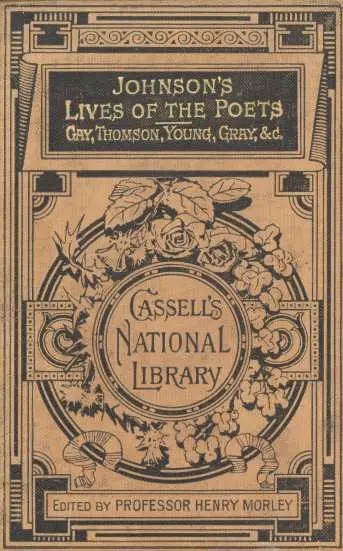
Samuel Johnson
Samuel Johnson
BEHIND THE BOOK
This eBook is for the use of anyone anywhere in the United States and most other parts of the world at no cost and with almost no restrictions whatsoever. You may copy it, give it away or re-use it under the terms of the Project Gutenberg License included with this eBook or online at www.gutenberg.org. If you are not located in the United States, you will have to check the laws of the country where you are located before using this eBook. Read the source licence.
The original source file, including credits and licence, is retained by this library. Request an original-format copy at no charge. Please include the book title and Project Gutenberg identifier #5101.
KEEP YOUR CURIOSITY GOING

David Patterson (Spirit) Hatch

David Patterson (Spirit) Hatch

David Patterson (Spirit) Hatch
Cécile Tormay

Moritz Busch
John L. Ransom