THE CLASSIC COLLECTION✦Shorter novels, vol. 3CLASSIC FREE BOOKS
Shorter novels, vol. 3
Samuel Johnson & William Beckford & Horace Walpole
THE CLASSIC COLLECTION · 1779
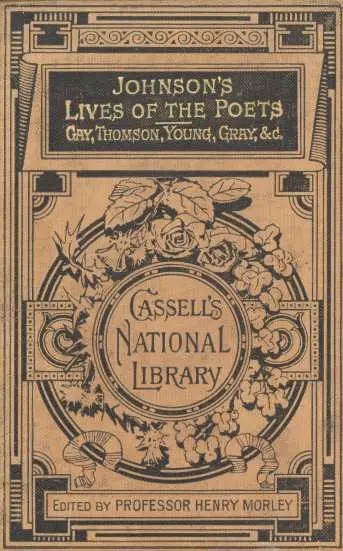
"Lives of the English Poets" by Samuel Johnson is a biographical collection written in the early 18th century. This work presents an array of poetic figures from the English literary canon, focusing on their lives, contributions, and the circumstances that shaped their artistry. Notable subjects include figures like Edward Young, William King, and John Gay, as Johnson examines both their literary merit and personal experiences. The opening of this work introduces the reader to the premise and structure of the collection, specifically noting that it includes twenty lives of English poets, with particular attention given to Edward Young. Johnson provides a chronological account of poets born in the late 17th and early 18th centuries, such as Samuel Garth, Charles Montague, and William Collins, discussing their literary achievements in relation to their backgrounds and the social dynamics of their time. He sets the stage for a deeper exploration of these writers, hinting at the varied themes and life stories that will follow in the subsequent chapters.
Introduction adapted from the source catalogue; source summaries may be automatically generated.
Free to read · English · 54,829 words · No account needed
MAKE TIME FOR A GOOD BOOK
On by default. Untick to stop anonymous reading totals. Each page counts after 10 seconds in view. How this works.
Anonymous counting is on unless you have switched it off.
Void of strong desire and fear,
Life’s void ocean trust no more;
Strive thy little bark to steer
With the tide, but near the shore.
Thus prepared, thy shortened sail
Shall, whene’er the winds increase,
Seizing each propitious gale,
Waft thee to the Port of Peace.
Keep thy conscience from offence,
And tempestuous passions free,
So, when thou art called from hence,
Easy shall thy passage be;
Easy shall thy passage be,
Cheerful thy allotted stay,
Short the account ’twixt God and thee;
Hope shall meet thee on the way:
Truth shall lead thee to the gate,
Mercy’s self shall let thee in,
Where its never-changing state,
Full perfection, shall begin.”
The poem was accompanied by a letter.
“La Trappe, the 27th of October, 1761
“DEAR SIR,—You seemed to like the ode I sent you for your amusement; I now send it you as a present. If you please to accept of it, and are willing that our friendship should be known when we are gone, you will be pleased to leave this among those of your own papers that may possibly see the light by a posthumous publication. God send us health while we stay, and an easy journey!—My dear Dr. Young,
“Yours, most cordially, “MELCOMBE.”
In 1762, a short time before his death, Young published “Resignation.” Notwithstanding the manner in which it was really forced from him by the world, criticism has treated it with no common severity. If it shall be thought not to deserve the highest praise, on the other side of fourscore, by whom, except by Newton and by Waller, has praise been merited?
To Mrs. Montagu, the famous champion of Shakespeare, I am indebted for the history of “Resignation.” Observing that Mrs. Boscawen, in the midst of her grief for the loss of the admiral, derived consolation from the perusal of the “Night Thoughts,” Mrs. Montagu proposed a visit to the author. From conversing with Young, Mrs. Boscawen derived still further consolation; and to that visit she and the world were indebted for this poem. It compliments Mrs. Montagu in the following lines:—
“Yet write I must. A lady sues:
How shameful her request!
My brain in labour with dull rhyme,
Hers teeming with the best!”
And again—
“A friend you have, and I the same,
Whose prudent, soft address
Will bring to life those healing thoughts
Which died in your distress.
That friend, the spirit of my theme
Extracting for your ease,
Will leave to me the dreg, in thoughts
Too common; such as these.”
Your reading position is saved on this browser. Take it to another device with a library code. Reading pages adapt to text, rather than matching a printed edition.
Samuel Johnson & William Beckford & Horace Walpole
Samuel Johnson
Samuel Johnson
Samuel Johnson
BEHIND THE BOOK
This eBook is for the use of anyone anywhere in the United States and most other parts of the world at no cost and with almost no restrictions whatsoever. You may copy it, give it away or re-use it under the terms of the Project Gutenberg License included with this eBook or online at www.gutenberg.org. If you are not located in the United States, you will have to check the laws of the country where you are located before using this eBook. Read the source licence.
The original source file, including credits and licence, is retained by this library. Request an original-format copy at no charge. Please include the book title and Project Gutenberg identifier #4678.
KEEP YOUR CURIOSITY GOING
Cécile Tormay

Moritz Busch
John L. Ransom
Frances Wright
Cécile Tormay

Mabel Potter Daggett