THE CLASSIC COLLECTION✦Shorter novels, vol. 3CLASSIC FREE BOOKS
Shorter novels, vol. 3
Samuel Johnson & William Beckford & Horace Walpole
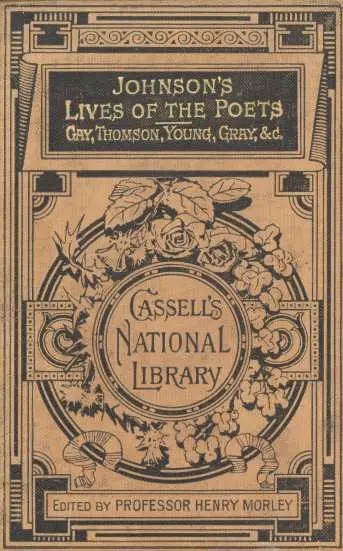
THE CLASSIC COLLECTION · 1779
"Lives of the English Poets" by Samuel Johnson is a biographical collection written in the early 18th century. This work presents an array of poetic figures from the English literary canon, focusing on their lives, contributions, and the circumstances that shaped their artistry. Notable subjects include figures like Edward Young, William King, and John Gay, as Johnson examines both their literary merit and personal experiences. The opening of this work introduces the reader to the premise and structure of the collection, specifically noting that it includes twenty lives of English poets, with particular attention given to Edward Young. Johnson provides a chronological account of poets born in the late 17th and early 18th centuries, such as Samuel Garth, Charles Montague, and William Collins, discussing their literary achievements in relation to their backgrounds and the social dynamics of their time. He sets the stage for a deeper exploration of these writers, hinting at the varied themes and life stories that will follow in the subsequent chapters.
Introduction adapted from the source catalogue; source summaries may be automatically generated.
Free to read · English · 54,829 words · No account needed
MAKE TIME FOR A GOOD BOOK
On by default. Untick to stop anonymous reading totals. Each page counts after 10 seconds in view. How this works.
Anonymous counting is on unless you have switched it off.
The next production of his muse was “The Sea-piece,” in two odes.
Young enjoys the credit of what is called an “Extempore Epigram on Voltaire,” who, when he was in England, ridiculed, in the company of the jealous English poet, Milton’s allegory of “Sin and Death:”
“You are so witty, profligate and thin,
At once we think thee Milton, Death, and Sin.”
From the following passage in the poetical dedication of his “Sea-piece” to Voltaire it seems that this extemporaneous reproof, if it must be extemporaneous (for what few will now affirm Voltaire to have deserved any reproof), was something longer than a distich, and something more gentle than the distich just quoted.
“No stranger, sir, though born in foreign climes. On Dorset Downs, when Milton’s page, With Sin and Death provoked thy rage, Thy rage provoked who soothed with gentle rhymes?”
By “Dorset Downs” he probably meant Mr. Dodington’s seat. In Pitt’s Poems is “An Epistle to Dr. Edward Young, at Eastbury, in Dorsetshire, on the Review at Sarum, 1722.”
“While with your Dodington retired you sit, Charmed with his flowing Burgundy and wit,” etc.
Thomson, in his Autumn, addressing Mr. Dodington calls his seat the seat
of the Muses,
“Where, in the secret bower and winding walk, For virtuous Young and thee they twine the bay.”
The praises Thomson bestows but a few lines before on Philips, the second
“Who nobly durst, in rhyme-unfettered verse, With British freedom sing the British song,”
added to Thomson’s example and success, might perhaps induce Young, as we shall see presently, to write his great work without rhyme.
In 1734 he published “The Foreign Address, or the best Argument for Peace, occasioned by the British Fleet and the Posture of Affairs. Written in the Character of a Sailor.” It is not to be found in the author’s four volumes. He now appears to have given up all hopes of overtaking Pindar, and perhaps at last resolved to turn his ambition to some original species of poetry. This poem concludes with a formal farewell to Ode, which few of Young’s readers will regret:
“My shell, which Clio gave, which Kings applaud,
Which Europe’s bleeding genius called abroad,
Adieu!”
In a species of poetry altogether his own he next tried his skill, and
succeeded.
Your reading position is saved on this browser. Take it to another device with a library code. Reading pages adapt to text, rather than matching a printed edition.
Samuel Johnson & William Beckford & Horace Walpole
Samuel Johnson
Samuel Johnson
Samuel Johnson
BEHIND THE BOOK
This eBook is for the use of anyone anywhere in the United States and most other parts of the world at no cost and with almost no restrictions whatsoever. You may copy it, give it away or re-use it under the terms of the Project Gutenberg License included with this eBook or online at www.gutenberg.org. If you are not located in the United States, you will have to check the laws of the country where you are located before using this eBook. Read the source licence.
The original source file, including credits and licence, is retained by this library. Request an original-format copy at no charge. Please include the book title and Project Gutenberg identifier #4678.
KEEP YOUR CURIOSITY GOING
Cécile Tormay

Moritz Busch
John L. Ransom
Frances Wright
Cécile Tormay

Mabel Potter Daggett