THE CLASSIC COLLECTION✦Shorter novels, vol. 3CLASSIC FREE BOOKS
Shorter novels, vol. 3
Samuel Johnson & William Beckford & Horace Walpole
THE CLASSIC COLLECTION · 1779
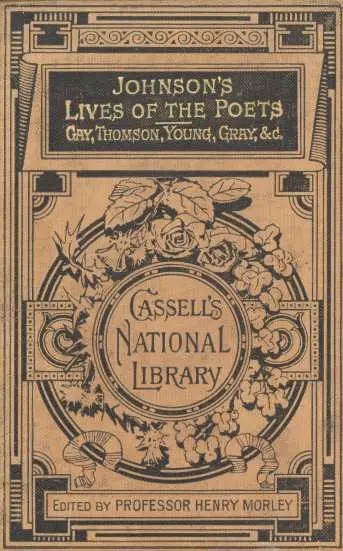
"Lives of the English Poets" by Samuel Johnson is a biographical collection written in the early 18th century. This work presents an array of poetic figures from the English literary canon, focusing on their lives, contributions, and the circumstances that shaped their artistry. Notable subjects include figures like Edward Young, William King, and John Gay, as Johnson examines both their literary merit and personal experiences. The opening of this work introduces the reader to the premise and structure of the collection, specifically noting that it includes twenty lives of English poets, with particular attention given to Edward Young. Johnson provides a chronological account of poets born in the late 17th and early 18th centuries, such as Samuel Garth, Charles Montague, and William Collins, discussing their literary achievements in relation to their backgrounds and the social dynamics of their time. He sets the stage for a deeper exploration of these writers, hinting at the varied themes and life stories that will follow in the subsequent chapters.
Introduction adapted from the source catalogue; source summaries may be automatically generated.
Free to read · English · 54,829 words · No account needed
MAKE TIME FOR A GOOD BOOK
On by default. Untick to stop anonymous reading totals. Each page counts after 10 seconds in view. How this works.
Anonymous counting is on unless you have switched it off.
His other poems are now to be considered; but a short consideration will despatch them. It is not easy to guess why he addicted himself so diligently to lyric poetry, having neither the ease and airiness of the lighter, nor the vehemence and elevation of the grander ode. When he lays his ill-fated hand upon his harp his former powers seem to desert him; he has no longer his luxuriance of expression or variety of images. His thoughts are cold, and his words inelegant. Yet such was his love of lyrics that, having written with great vigour and poignancy his “Epistle to Curio,” he transformed it afterwards into an ode disgraceful only to its author.
Of his odes nothing favourable can be said; the sentiments commonly want force, nature, or novelty; the diction is sometimes harsh and uncouth, the stanzas ill-constructed and unpleasant, and the rhymes dissonant or unskilfully disposed, too distant from each other, or arranged with too little regard to established use, and therefore perplexing to the ear, which in a short composition has not time to grow familiar with an innovation. To examine such compositions singly cannot be required; they have doubtless brighter and darker parts; but, when they are once found to be generally dull, all further labour may be spared, for to what use can the work be criticised that will not be read?
THOMAS GRAY, the son of Mr. Philip Gray, a scrivener of London, was born in Cornhill, November 26, 1716. His grammatical education he received at Eton, under the care of Mr. Antrobus, his mother’s brother, then assistant to Dr. George, and when he left school, in 1734, entered a pensioner at Peterhouse, in Cambridge. The transition from the school to the college is, to most young scholars, the time from which they date their years of manhood, liberty, and happiness; but Gray seems to have been very little delighted with academical gratifications; he liked at Cambridge neither the mode of life nor the fashion of study, and lived sullenly on to the time when his attendance on lectures was no longer required. As he intended to profess the common law, he took no degree. When he had been at Cambridge about five years, Mr. Horace Walpole, whose friendship he had gained at Eton, invited him to travel with him as his companion. They wandered through France into Italy; and Gray’s “Letters” contain a very pleasing account of many parts of their journey. But unequal friendships are easily dissolved; at Florence they quarrelled and parted; and Mr. Walpole is now content to have it told that it was by his fault. If we look, however, without prejudice on the world, we shall find that men whose consciousness of their own merit sets them above the compliances of servility are apt enough in their association with superiors to watch their own dignity with troublesome and punctilious jealousy, and in the fervour of independence to exact that attention which they refuse to pay. Part they did, whatever was the quarrel; and the rest of their travels was doubtless more unpleasant to them both. Gray continued his journey in a manner suitable to his own little fortune, with only an occasional servant. He returned to England in September, 1741, and in about two months afterwards buried his father, who had, by an injudicious waste of money upon a new house, so much lessened his fortune that Gray thought himself too poor to study the law. He therefore retired to Cambridge, where he soon after became Bachelor of Civil Law, and where, without liking the place or its inhabitants, or professing to like them, he passed, except a short residence at London, the rest of his life. About this time he was deprived of Mr. West, the son of a chancellor of Ireland, a friend on whom he appears to have set a high value, and who deserved his esteem by the powers which he shows in his “Letters” and in the “Ode to May,” which Mr. Mason has preserved, as well as by the sincerity with which, when Gray sent him part of Agrippina, a tragedy that he had just begun, he gave an opinion which probably intercepted the progress of the work, and which the judgment of every reader will confirm. It was certainly no loss to the English stage that Agrippina was never finished. In this year (1742) Gray seems to have applied himself seriously to poetry; for in this year were produced the “Ode to Spring,” his “Prospect of Eton,” and his “Ode to Adversity.” He began likewise a Latin poem, “De Principiis Cogitandi.”
Your reading position is saved on this browser. Take it to another device with a library code. Reading pages adapt to text, rather than matching a printed edition.
Samuel Johnson & William Beckford & Horace Walpole
Samuel Johnson
Samuel Johnson
Samuel Johnson
BEHIND THE BOOK
This eBook is for the use of anyone anywhere in the United States and most other parts of the world at no cost and with almost no restrictions whatsoever. You may copy it, give it away or re-use it under the terms of the Project Gutenberg License included with this eBook or online at www.gutenberg.org. If you are not located in the United States, you will have to check the laws of the country where you are located before using this eBook. Read the source licence.
The original source file, including credits and licence, is retained by this library. Request an original-format copy at no charge. Please include the book title and Project Gutenberg identifier #4678.
KEEP YOUR CURIOSITY GOING
Cécile Tormay

Moritz Busch
John L. Ransom
Frances Wright
Cécile Tormay

Mabel Potter Daggett