Lives of Fair and Gallant Ladies. Vol 1
Pierre de Bourdeille Brantôme
THE CLASSIC COLLECTION · 1922
"Lives of Fair and Gallant Ladies. Vol 2." by Pierre de Bourdeille Brantôme is a historical account likely written during the late 16th century. This work presents a compilation of anecdotes and discourses describing the interactions between noblewomen and men of valor, exploring themes of love, honor, and chivalry. The text reflects the moral and social dynamics of the French court, particularly focusing on prominent figures from the Valois era. The opening of the book introduces the theme of love among noble individuals, highlighting how women of status are often enchanted by the bravery and courage of men, despite their own more delicate inclinations. Brantôme discusses notable historical and mythical examples, including Venus's infatuation with Mars and the tale of the Amazonian Queen Penthesilea's admiration for Hector of Troy. He illustrates the reciprocal nature of valor and love, suggesting that acts of bravery in war are intertwined with romantic pursuits, thereby setting the tone for a broader exploration of love's complexities throughout the text.
Introduction adapted from the source catalogue; source summaries may be automatically generated.
Free to read · English · 118,777 words · No account needed
MAKE TIME FOR A GOOD BOOK
On by default. Untick to stop anonymous reading totals. Each page counts after 10 seconds in view. How this works.
Anonymous counting is on unless you have switched it off.
The king was completely broken by the results of St. Bartholomew’s Eve. His mind wandered back and forth. He became gloomy and vehement, had terrible hallucinations, and heard the spirits of the dead in the air. By superhuman exertions he tried to drown his conscience and procure sleep. He was constantly hunting, remaining in the saddle continuously from twelve to fourteen hours and often three days in succession. When he did not hunt he fenced or played ball or stood for three to four hours at the blacksmith’s anvil swinging an enormous hammer. Finally, consumption forced him to stay in bed. But even now he passed his time by writing about his favorite occupation, he was composing the Livre du Roy Charles, a dissertation on natural history and the deer hunt. When he reached the twenty-ninth chapter death overtook him. This fragment deserves praise, it was well thought out and not badly written.
It is always unpleasant to say of a king that he had more talent to be an author than a king. It is unfortunate but true that the Valois were a literary race. But France itself in 1577 was in a sorry state. Everywhere there were ruins of destroyed villages and castles. There were enormous stretches of uncultivated land and cattle-raising was greatly diminished. There were many loafing vagabonds accustomed to war and robbery who were a danger to the traveller and the farmer. Every province, every city, almost every house was divided against itself.
Francis of Alençon, the fourth of these brothers, who felt himself coming of age, the last of the Valois, had already begun his agitation. Charles IX. despised him and suspected his secret intrigues. His other brother, Henri, had to watch his every step in order to feel secure.
Henri III. (1574–1589), formerly Henri of Anjou, was barely twenty-five years old when his strength was exhausted. But his greed of power which had already made him king of the Polish throne was still undiminished. He was the most elegant, the most graceful and the most tasteful of the Valois. It was therefore only to be expected that he would introduce new forms of stricter etiquette. D’Aubigne relates that he was a good judge of the arts, and that he was “one of the most eloquent men of his age.” He was always on the search for poetry to gratify his erotic impulses. A life of revelry and pleasure now began in the palace. Immorality is the mildest reproach of his contemporary chroniclers. Although well educated and a friend of the Sciences, of Poetry and the Arts, as well as gifted by nature with a good mind, he was nevertheless very frivolous, indifferent, physically and mentally indolent. He almost despised hunting as much as the conscientious discharge of government affairs. He greatly preferred to be in the society of women, himself dressed in a feminine fashion, with two or three rings in each ear. He usually knew what was right and proper, but his desires, conveniences and other secondary matters prevented him from doing it. He discharged all the more serious and efficient men and surrounded himself with insignificant coxcombs, the so-called Mignons, with whom he dallied and adorned himself, and to whom he surrendered the government of the state. These conceited young men, who were without any redeeming merit, simply led a gay life at the court. In his History of France (I, 265), Ranke relates: “He surrounded himself with young people of pleasing appearance who tried to outdo him in cleanliness of dress and neatness of appearance. To be a favorite, a Mignon, was not a question of momentary approval but a kind of permanent position.” Assassinations were daily occurrences. D’Aubigne severely criticized the terrifying conditions in the court and public life in general. A chronicler says: “At that time anything was permitted except to say and do what was right and proper.” This frivolous, scandalous court consumed enormous sums of money. Such a miserable wretch as Henri III. required for his personal pleasures an annual sum of 1,000,000 gold thalers, which is equivalent to about $10,000,000 in present values, and yet the entire state had to get along with 6,000,000 thalers. For this was all that could be squeezed out of the country. Ranke says (page 269): “In a diary of this period, the violent means of obtaining money and the squandering of the same by the favorites are related side by side, and it shows the disagreeable impression that these things made.” Then there was also the contrast between his religious and his worldly life. At one time he would steep his feelings in orgies, then again he would parade them in processions. He was entirely capable of suddenly changing the gayest raiment for sackcloth and ashes. He would take off his jewel-covered belt and put on another covered with skulls. And in order that Satan might not be lacking, the criminal court (“chambre ardente”) which was established at Blois had plenty of work to do during his reign. It was also evident that he would never have any children with his sickly wife.
Your reading position is saved on this browser. Take it to another device with a library code. Reading pages adapt to text, rather than matching a printed edition.
Pierre de Bourdeille Brantôme
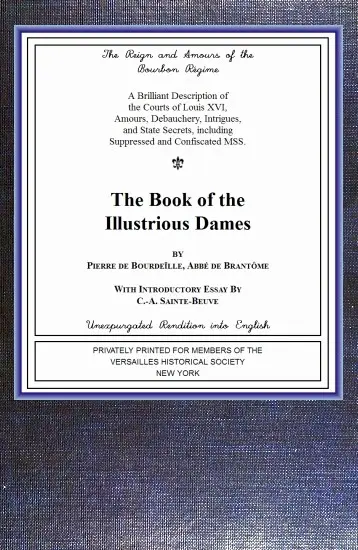
Pierre de Bourdeille Brantôme
BEHIND THE BOOK
This eBook is for the use of anyone anywhere in the United States and most other parts of the world at no cost and with almost no restrictions whatsoever. You may copy it, give it away or re-use it under the terms of the Project Gutenberg License included with this eBook or online at www.gutenberg.org. If you are not located in the United States, you will have to check the laws of the country where you are located before using this eBook. Read the source licence.
The original source file, including credits and licence, is retained by this library. Request an original-format copy at no charge. Please include the book title and Project Gutenberg identifier #67026.
KEEP YOUR CURIOSITY GOING
Cécile Tormay

Moritz Busch
John L. Ransom
Frances Wright
Cécile Tormay

Mabel Potter Daggett