Lives of Fair and Gallant Ladies. Vol 1
Pierre de Bourdeille Brantôme
THE CLASSIC COLLECTION · 1922
"Lives of Fair and Gallant Ladies. Vol 2." by Pierre de Bourdeille Brantôme is a historical account likely written during the late 16th century. This work presents a compilation of anecdotes and discourses describing the interactions between noblewomen and men of valor, exploring themes of love, honor, and chivalry. The text reflects the moral and social dynamics of the French court, particularly focusing on prominent figures from the Valois era. The opening of the book introduces the theme of love among noble individuals, highlighting how women of status are often enchanted by the bravery and courage of men, despite their own more delicate inclinations. Brantôme discusses notable historical and mythical examples, including Venus's infatuation with Mars and the tale of the Amazonian Queen Penthesilea's admiration for Hector of Troy. He illustrates the reciprocal nature of valor and love, suggesting that acts of bravery in war are intertwined with romantic pursuits, thereby setting the tone for a broader exploration of love's complexities throughout the text.
Introduction adapted from the source catalogue; source summaries may be automatically generated.
Free to read · English · 118,777 words · No account needed
MAKE TIME FOR A GOOD BOOK
On by default. Untick to stop anonymous reading totals. Each page counts after 10 seconds in view. How this works.
Anonymous counting is on unless you have switched it off.
I knew once a very fair lady, which after her husband’s death was so woebegone and utterly cast down that she would tear her hair, and disfigure her cheeks and bosom, pulling the longest face ever she could. And when folk did chide her for doing such wrong to her lovely countenance, “My God!” she would cry, “what would you have? What use is my pretty face to me now? Who should I safeguard it for, seeing mine husband is no more?” Yet some eight months later, who but she is making up her face with Spanish white and rouge and besprinkling her locks with powder,—a marvellous change truly?
Hereof I will cite an excellent example, for to prove my contention, that of a fair and honourable lady of Ephesus, which having lost her husband could find no consolation whatever in spite of all efforts of kinsmen and friends. Accordingly following her husband’s funeral, with endless grief and sorrow, with sobs, cries, tears and lamentations, after he was duly put away in the charnel-house where his body was to rest, she did throw herself therein in spite of all that could be done to hinder, swearing and protesting stoutly she would never leave that place, but would there tarry to the end and finish her days beside her husband’s corpse and never, never abandon the same. This resolution she did hold to, and did actually so live by the space of two or three days. Meantime, as fortune would have it, a man of those parts was executed for some crime and hanged in the city, and afterward carried forth the walls to the gibbets there situate to the end of the bodies of malefactors so hanged and put to death should there remain for an example to others, carefully watched by a band of officers and soldiers to prevent their being carried off. So it fell out that a soldier that was guarding the body, and was standing sentry, did hear near by a very lamentable voice crying and approaching perceived ’twas in the charnel-house. Having gone down therein, he beheld the said lady, as fair and beautiful as day, all bathed in tears and lamenting sore; and accosting her, set him to enquiring the reason of her pitiful state, the which she told him gently enough. Thereupon doing his endeavours to console her grief, but naught succeeding for the first time, he did return again and once again. Finally he was enabled to gain his point, and did little by little comfort her and got her to dry her eyes; till at length hearkening to reason, she did yield so far as that he had her twice over, holding her on her back on the very coffin of her husband, which did serve as their couch. This done, they did swear marriage, one with the other; after which happy consummation, the soldier did return to his duty, to guard the gibbet,—for ’twas a matter of life and death to him. But fortunate as he had been in this fine enterprise of his and its carrying out, his misfortune now was such that while he was so inordinately taking his pleasure, lo! the kinsfolk of the poor dangling criminal did steal up, for to cut the body down, an if they should find it unguarded. So finding no guard there, they did cut it down with all speed, and carried the corpse away with them swiftly, to bury it where they might, to the end they might rid them of so great dishonour and a sight so foul and hateful to the dead man’s kindred. The soldier coming up and finding the body a-missing, hied him in despair to his mistress, to tell her his calamity and how he was ruined and undone; for the law of that country was that any soldier which should sleep on guard and suffer the body to be carried off, should he put in its place and hanged instead, which risk he did thus run. The lady, who had but now been consoled of him, and had felt sore need of comfort for herself, did quick find the like for him, and said as follows: “Be not afeared; only come help me to lift mine husband from his tomb, and we will hang him and set him up in place of the other; so they will take him for the other.” No sooner said than done. Moreover ’tis said the first occupant of the gibbet had had an ear cut off; so she did the same to the second, the better to preserve the likeness. Next day the officers of justice did visit the place, but found naught amiss. Thus did she save her gallant by a most abominable deed and wicked act toward her husband,—the very same woman, I would have you note, which had so grievously deplored and lamented his loss, so that no man would ever have expected so shameful an issue.
Your reading position is saved on this browser. Take it to another device with a library code. Reading pages adapt to text, rather than matching a printed edition.
Pierre de Bourdeille Brantôme
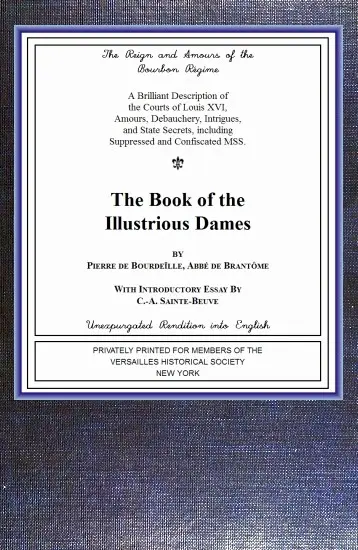
Pierre de Bourdeille Brantôme
BEHIND THE BOOK
This eBook is for the use of anyone anywhere in the United States and most other parts of the world at no cost and with almost no restrictions whatsoever. You may copy it, give it away or re-use it under the terms of the Project Gutenberg License included with this eBook or online at www.gutenberg.org. If you are not located in the United States, you will have to check the laws of the country where you are located before using this eBook. Read the source licence.
The original source file, including credits and licence, is retained by this library. Request an original-format copy at no charge. Please include the book title and Project Gutenberg identifier #67026.
KEEP YOUR CURIOSITY GOING
Cécile Tormay

Moritz Busch
John L. Ransom
Frances Wright
Cécile Tormay

Mabel Potter Daggett