Lives of Fair and Gallant Ladies. Vol 1
Pierre de Bourdeille Brantôme
THE CLASSIC COLLECTION · 1922
"Lives of Fair and Gallant Ladies. Vol 2." by Pierre de Bourdeille Brantôme is a historical account likely written during the late 16th century. This work presents a compilation of anecdotes and discourses describing the interactions between noblewomen and men of valor, exploring themes of love, honor, and chivalry. The text reflects the moral and social dynamics of the French court, particularly focusing on prominent figures from the Valois era. The opening of the book introduces the theme of love among noble individuals, highlighting how women of status are often enchanted by the bravery and courage of men, despite their own more delicate inclinations. Brantôme discusses notable historical and mythical examples, including Venus's infatuation with Mars and the tale of the Amazonian Queen Penthesilea's admiration for Hector of Troy. He illustrates the reciprocal nature of valor and love, suggesting that acts of bravery in war are intertwined with romantic pursuits, thereby setting the tone for a broader exploration of love's complexities throughout the text.
Introduction adapted from the source catalogue; source summaries may be automatically generated.
Free to read · English · 118,777 words · No account needed
MAKE TIME FOR A GOOD BOOK
On by default. Untick to stop anonymous reading totals. Each page counts after 10 seconds in view. How this works.
Anonymous counting is on unless you have switched it off.
Such then is the summary account I have been able to give of our good Queen Elisabeth, of her kindness, virtue, constancy and faithfulness, and her true and loyal love toward the King, her husband. And ’twas but her nature to be so good and virtuous (I have heard M. de Lansac,[100*] who was in Spain when she died, tell how the Empress said to him on that occasion, El mejor de nosotros es muerto,—“The best of us all is dead”), and we may well believe how in such actions this Queen was but for imitating her own mother, her great aunts and aunts. For the Empress, her mother, albeit she was left a widow when still quite young and very handsome, would never marry again, but did ever after continue in her widowhood, right wisely and steadfastly, having quitted Austria and Germany, the scene of her rule, after the death of the Emperor, her husband. She went to join her brother in Spain, having been summoned of him and besought to go thither to help him in the heavy burden of his affairs. This she did, for indeed she was a very prudent and well-counselled Princess. I have heard the late King Henri III., who was more skilled in reading character than any other man in all his Kingdom, declare she was in his opinion one of the most honourable, wise and accomplished Princesses in the world.
On this, her journey to Spain, after passing through the divers States of Germany, she did presently arrive at Genoa in Italy, where she embarked. But seeing ’twas in winter, in the month of December, that she took ship, a storm did overtake her at Marseilles, at which port she was forced to cast anchor in the roads. Yet would she never come within the harbour, she or her galleys, for fear of giving any ground for umbrage or suspicion; nor did herself enter the town but only once, to see the sights. Off this port she did tarry seven or eight days, a-waiting for fair weather. Her most favourite course was every morning to leave her galley (for she did usually sleep a-board), and so during the day to go hear the service of mass at the Church of St. Victor with very devout attention. Then presently, her dinner having been brought and made ready in the Abbey, she would there dine; after which she would indulge in discourse with her ladies, or her folk generally, or else with divers gentlemen of Marseilles, which did show her all the honour and respect due to so noble a Princess, the King of France indeed having bid them specially to receive her as it were his own kingly person in recompense for the good welcome and excellent cheer she had given him at Vienna. This she did readily enough perceive; and for that reason would converse very intimately with them and show herself exceeding condescending, treating them more after the German and French fashion than the Spanish. In fact they were no less delighted with her than she with them, and did write a most courteous letter to the King, thanking him and informing him they were as worthy and honourable folk as ever she had seen in any place. Moreover she did make separate mention by name of some score or so of them, among whom was M. Castellan, known as the Seigneur Altyvity, Captain of the King’s Galleys, a man much renowned for having wedded the fair Chasteauneuf, a Court lady, and for having killed the Grand Prior, himself falling along with him, as I do hope to relate in another place. It was none other than his wife which did relate to me what I here set down, and did tell me of all the perfections of this noble Princess, and how pleasant she did find her enforced stay at Marseilles, and how she admired and enjoyed the place in her walks abroad. But evening once come, she did never fail to return to sleep on board her galley, to the end, the moment fine weather and a favourable wind should come, she might straight make sail, or mayhap because she was anxious to give no cause of umbrage. I was at Court at the time these facts were reported to the King concerning her passing visit, who was most anxious to know if she had been well received, and how she was, and did wish her well in all respects. The said Princess is yet alive, and doth continue in her good and virtuous behaviour, having done her brother excellent service, by all I am told. She did later retire for her final abode and dwelling-place to a Convent of religious women, called the descalçadas (unshod), because they do wear neither shoes nor stockings. This house was founded by her sister, the Princess of Spain.
Your reading position is saved on this browser. Take it to another device with a library code. Reading pages adapt to text, rather than matching a printed edition.
Pierre de Bourdeille Brantôme
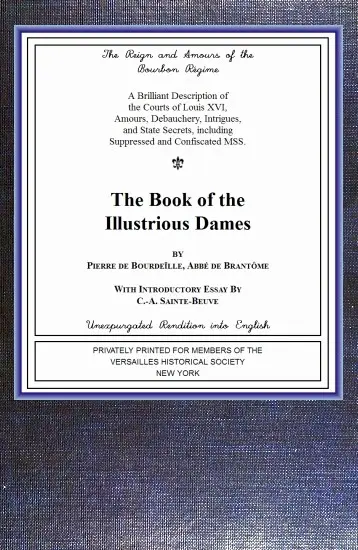
Pierre de Bourdeille Brantôme
BEHIND THE BOOK
This eBook is for the use of anyone anywhere in the United States and most other parts of the world at no cost and with almost no restrictions whatsoever. You may copy it, give it away or re-use it under the terms of the Project Gutenberg License included with this eBook or online at www.gutenberg.org. If you are not located in the United States, you will have to check the laws of the country where you are located before using this eBook. Read the source licence.
The original source file, including credits and licence, is retained by this library. Request an original-format copy at no charge. Please include the book title and Project Gutenberg identifier #67026.
KEEP YOUR CURIOSITY GOING
Cécile Tormay

Moritz Busch
John L. Ransom
Frances Wright
Cécile Tormay

Mabel Potter Daggett