Lives of Fair and Gallant Ladies. Vol 1
Pierre de Bourdeille Brantôme
THE CLASSIC COLLECTION · 1922
"Lives of Fair and Gallant Ladies. Vol 2." by Pierre de Bourdeille Brantôme is a historical account likely written during the late 16th century. This work presents a compilation of anecdotes and discourses describing the interactions between noblewomen and men of valor, exploring themes of love, honor, and chivalry. The text reflects the moral and social dynamics of the French court, particularly focusing on prominent figures from the Valois era. The opening of the book introduces the theme of love among noble individuals, highlighting how women of status are often enchanted by the bravery and courage of men, despite their own more delicate inclinations. Brantôme discusses notable historical and mythical examples, including Venus's infatuation with Mars and the tale of the Amazonian Queen Penthesilea's admiration for Hector of Troy. He illustrates the reciprocal nature of valor and love, suggesting that acts of bravery in war are intertwined with romantic pursuits, thereby setting the tone for a broader exploration of love's complexities throughout the text.
Introduction adapted from the source catalogue; source summaries may be automatically generated.
Free to read · English · 118,777 words · No account needed
MAKE TIME FOR A GOOD BOOK
On by default. Untick to stop anonymous reading totals. Each page counts after 10 seconds in view. How this works.
Anonymous counting is on unless you have switched it off.
And thus his book originated. He must have taken up his pen quite spontaneously one day. Now from the great variety of his own experiences at court and in war, he poured forth a remarkable wealth of peculiar and interesting features which his memory had preserved. It is a book of the love-life during the reign of the Valois. These stories were not invented, but they were anecdotes and reports taken from real life. He was able to evade the danger of boredom. There is style even in his most impudent indiscretions. He only stopped at mere obscenities. On the other hand, he never hesitated to be cynical. As this age was fond of strong expressions, a puritanical language was out of the question. Not until the reign of Louis XIV. did the language become more polite. Neither was Brantôme a Puritan, how could he have been? But he had character. He took pleasure in everything which was a manifestation of human energy. He loved passion and the power to do good or evil. (To be sure he also had some splendid things to say against immoderacy and vehemence of passions. So he was a fit companion of the Medici and the Valois.)
There is not much composition in his books. His attention wandered from one story to the other. Boccaccio, the foremost story-teller of this period, is more logical. An academical critic says of Brantôme: “He reports without choice what is good and bad, what is noble and abominable, the good not without warmth, but the bad with indestructible cheerfulness.” There is neither order nor method in his writing. He passes on abruptly, without motif, without transition. A courtier, unfamiliar with the rules of the school, he himself confesses (in the Rodomontades Espagnoles): “Son pen de profession du scavoir et de l’art de bien dire, et remet aux meux disans la belle disposition de paroles eloquentes.” Because of the variety his stories have unusual charm. In these numerous anecdotes the graceful indecencies of the ladies-in-waiting at the court of the Valois are described as if they had happened openly. His reports of the illicit relations are rendered in a charming style. Even though his sketches and pictures are modelled entirely on the life at the courts, nevertheless he adds two personal elements: an amusing smile and a remarkable literary talent. The following may even have been the case. In the beginning Brantôme may have taken an entirely neutral attitude towards the material at hand, but took no greater personal interest in them than he would, say, in memoirs. But when we can tell a story well, then we also take pleasure in our ability. We permeate the story with our own enjoyment, and in a flash it turns out to be pleasure in the thing itself. The light of our soul glows upon them and then the things themselves look like gold. Brantôme rarely breaks through his reserve. He usually keeps his own opinions regarding these grand ladies and gentlemen in the background, he leaves it to the competent “grands discoureurs” to judge these things. To be sure, if one wished to get information regarding the court of Henri II. and Catherine of Medici, one ought not exactly to read Brantôme, who creates the impression as if the court were a model of a moral institution. “Sa compaignie et sa court estait un vray paradis du monde et escole de toute honnestate, de virtu, l’ornement de la France,” he once says somewhere in the Dames illustres (page 64). On the other hand, L’Etorle in May, 1577, gives us a report of a banquet given by the Queen-mother in Chenonceaux: “Les femmes les plus belles et honnestes de la cour, estant a moitie nues et ayant, les cheveux epars comme espousees, fuient employees a faire le service.” Other contemporaries likewise report a great deal of the immorality prevailing at the court. Thus we have curious reports regarding the pregnancy of Limeuil, who had her birth-throes in the queen’s wardrobe in Lyon (1564), the father being the Prince of Conde. Likewise, Johanna d’Albret warns her son, later Henri IV., against the corruption of the court. When she later visited him in Paris she was horrified at the immorality at the court of her daughter-in-law, later Queen Margot, who lived in the “most depraved and dissolute society.” (Brantôme pretended that he was a relative of hers, and pronounced a panegyric upon her in his Rodomontades which was answered in her memoirs dedicated to him.) He did not feel it his mission to be a Savonarola. To his great regret this “culture” came home to him in his own family. He had more and more cause to be dissatisfied with his youngest sister, Madeleine. The wicked life of this lady-in-waiting filled him with fury. He paid her her share and drove her from the house.
Your reading position is saved on this browser. Take it to another device with a library code. Reading pages adapt to text, rather than matching a printed edition.
Pierre de Bourdeille Brantôme
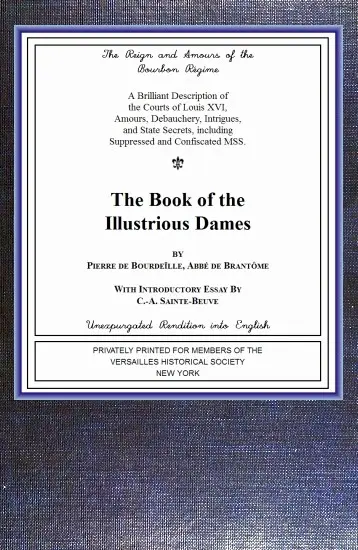
Pierre de Bourdeille Brantôme
BEHIND THE BOOK
This eBook is for the use of anyone anywhere in the United States and most other parts of the world at no cost and with almost no restrictions whatsoever. You may copy it, give it away or re-use it under the terms of the Project Gutenberg License included with this eBook or online at www.gutenberg.org. If you are not located in the United States, you will have to check the laws of the country where you are located before using this eBook. Read the source licence.
The original source file, including credits and licence, is retained by this library. Request an original-format copy at no charge. Please include the book title and Project Gutenberg identifier #67026.
KEEP YOUR CURIOSITY GOING
Cécile Tormay

Moritz Busch
John L. Ransom
Frances Wright
Cécile Tormay

Mabel Potter Daggett