Lives of Fair and Gallant Ladies. Vol 1
Pierre de Bourdeille Brantôme
THE CLASSIC COLLECTION · 1922
"Lives of Fair and Gallant Ladies. Vol 2." by Pierre de Bourdeille Brantôme is a historical account likely written during the late 16th century. This work presents a compilation of anecdotes and discourses describing the interactions between noblewomen and men of valor, exploring themes of love, honor, and chivalry. The text reflects the moral and social dynamics of the French court, particularly focusing on prominent figures from the Valois era. The opening of the book introduces the theme of love among noble individuals, highlighting how women of status are often enchanted by the bravery and courage of men, despite their own more delicate inclinations. Brantôme discusses notable historical and mythical examples, including Venus's infatuation with Mars and the tale of the Amazonian Queen Penthesilea's admiration for Hector of Troy. He illustrates the reciprocal nature of valor and love, suggesting that acts of bravery in war are intertwined with romantic pursuits, thereby setting the tone for a broader exploration of love's complexities throughout the text.
Introduction adapted from the source catalogue; source summaries may be automatically generated.
Free to read · English · 118,777 words · No account needed
MAKE TIME FOR A GOOD BOOK
On by default. Untick to stop anonymous reading totals. Each page counts after 10 seconds in view. How this works.
Anonymous counting is on unless you have switched it off.
“Chaffoureur du papier”—this might be the motto of his further life. Alas, writing was also such a resignation for Brantôme, otherwise he would not have heaped such abuse upon it. But we must not imagine that his literary talent only developed after his unfortunate fall. Naturally he made quite different and more extensive use of it under these conditions than he otherwise would have done. Stirring up his old memories became more and more a means of mastering the sterile life of that period. Literature is a product of impoverished life. It is the opium intoxication of memory, the conjuring up of bygone events. The death-shadowed eyes of Alençon had seen the first fragments of the book of Fair and Gallant Ladies. The Rondomontades Espagnoles must have been finished in 1590, for he offered them to the Queen of Navarre in the Castle of Usson in Auvergne. But beginning in 1590 there was a conscious exchange of the sword for the pen. He knew himself well. On his bed of pain the recollections of his varied life, his sufferings and the complaints of his thwarted ambitions became a longed-for distraction. He died July 15, 1614, and was buried in the Chapel of Richemond.
His manuscripts had a strange fate. They were the principal care of his last will and testament. This in itself is a monument to his pride. “J’ai bien de l’ambition,” he writes, “je la veux encore monstrer apres ma mort.” He had decided elements of greatness. The books in his library were to remain together, “set up in the castle and not to be scattered hither and thither or loaned to anyone.” He wished to have the library preserved “in eternal commemoration of himself.” He was particularly interested in having his works published. He pretended to be a knight, and a nobleman, and yet he prized most highly these six volumes beautifully bound in blue, green and black velvet. His books, furthermore, were not to be published with a pseudonym, but his own name was to be openly printed on the title-page. He does not wish to be deprived of his labors and his fame. He gave the strictest instructions to his heirs, but he was constantly forced to make additions to the will, because his executors died. He outlived too many of them and had made his will too early. The instructions regarding the printing of his books are very amusing: “Pour les faire imprimer mieux a ma fantaisie, ... y’ordonne et veux, que l’on prenne sur ma lotate heredite l’argent qu ’en pouvra valoir la dite impression, et qui ne se pouvra certes monter a beaucoup, cur j’ay veu force imprimeurs ... que s’ils out mis une foys la veue, en donneront plusoost pour les imprimer qu’ils n’en voudraient recepvoir; car ils en impriment plusierus gratis que no valent pas les mieux. Je m’en puys bien vanter, mesmes que je les ay monstrez au moins en partie, a aueuns qui les ont voulu imprimer sans rien.... Mais je n’ay voulu qu ils fussent imprimez durant mon vivant. Surtout, je veux que la dicte impression en soit en belle et gross lettre, et grand colume, pour mieux paroistre....” The typographical directions are quite modern. The execution of the will finally came into the hands of his niece, the Countess of Duretal, but on account of the offence that these books might give, she hesitated to carry out the last will of her uncle. Then his later heirs refused to have the books published, and locked the manuscripts in the library. In the course of time, however, copies came into circulation, more and more copies were made, and one of them found its way into the office of a printer. A fragment was smuggled into the memoirs of Castelnau and was printed with them in 1659. A better edition was now not far off. In 1665 and 1666 the first edition was published in Leyden by Jean Sambix. It comprised nine volumes in Elzevir. This very incomplete and unreliable edition was printed from a copy. Speculating printers now made a number of reprints. A large number of manuscripts were now in circulation which were named according to the copyists. In the 17th and 18th centuries these books were invariably printed from copies. The edition of 1822, Oeuvres completes du seigneur de Brantôme (Paris: Foucault), was the first to go back to the original manuscripts in possession of the family Bourdeille. Monmergue edited it. The manuscript of the book of Fair and Gallant Ladies was in the possession of the Baroness James Rothschild as late as 1903. After her death in the beginning of 1904, it came into possession of the National Library in Paris, which now has all of Brantôme’s manuscripts, and also plans to publish a critical revised edition of his collected works.
Your reading position is saved on this browser. Take it to another device with a library code. Reading pages adapt to text, rather than matching a printed edition.
Pierre de Bourdeille Brantôme
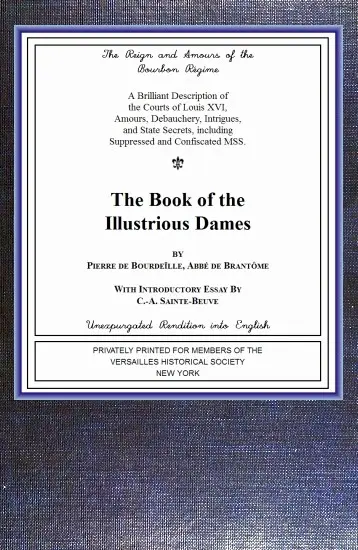
Pierre de Bourdeille Brantôme
BEHIND THE BOOK
This eBook is for the use of anyone anywhere in the United States and most other parts of the world at no cost and with almost no restrictions whatsoever. You may copy it, give it away or re-use it under the terms of the Project Gutenberg License included with this eBook or online at www.gutenberg.org. If you are not located in the United States, you will have to check the laws of the country where you are located before using this eBook. Read the source licence.
The original source file, including credits and licence, is retained by this library. Request an original-format copy at no charge. Please include the book title and Project Gutenberg identifier #67026.
KEEP YOUR CURIOSITY GOING
Cécile Tormay

Moritz Busch
John L. Ransom
Frances Wright
Cécile Tormay

Mabel Potter Daggett