Lives of Fair and Gallant Ladies. Vol 2.
Pierre de Bourdeille Brantôme
THE CLASSIC COLLECTION · 1922
"Lives of Fair and Gallant Ladies. Vol 1" by Pierre de Bourdeille Brantôme is a historical account written in the late 16th century. This work presents a collection of anecdotes and narratives concerning women of high social standing and their experiences with love and relationships. The writing reflects a mixture of admiration for and satire of the gallant ladies of the court, delineating their romantic exploits and the social constructs surrounding them. The opening of this volume sets the stage with a foreword praising A. R. Allinson's translation, stating that it retains the charm and essence of Brantôme's original work. It introduces readers to the author's intentions as he dedicates the tales to a noble patron, expressing both jest and reverence. The initial discourse explores themes of infidelity, displaying women’s cunning and bravery in the face of possessive husbands, while also hinting at the dangers and violent outcomes that often accompany such escapades. Brantôme mentions various characters, illustrating a keen understanding of human nature through anecdotes about lovers and their perilous affairs, thus inviting readers into a world of gallantry, seduction, and the complexities of marital relationships.
Introduction adapted from the source catalogue; source summaries may be automatically generated.
Free to read · English · 126,938 words · No account needed
MAKE TIME FOR A GOOD BOOK
On by default. Untick to stop anonymous reading totals. Each page counts after 10 seconds in view. How this works.
Anonymous counting is on unless you have switched it off.
◆Hadrian (P. Aelius Hadrianus), 14th in the series of Roman Emperors, A. D. 117–138, succeeded his guardian and kinsman Trajan. His wife, Sabina, here mentioned, was a grand-daughter of Trajan’s sister Marciana.
◆Marcus Aurelius Antoninus (“The Philosopher”) succeeded Antonius Pius as Emperor in A. D. 168. Died 180. His wife Faustina (as profligate a woman as Messalina herself) was daughter of Pius. Author of the famous Meditations. His son Commodus, who succeeded him as Emperor, was a complete contrast in character to his father, being vicious, weak, cruel and dissolute.
◆Another embellished passage. Faustine had died before Antoninus Commodus was emperor. Moreover, she was only washed (sublevare, says the text) with the blood of the gladiator. (J. Capitolin, Marc-Antoine le Philosophe, Chap. xix.)
◆A discreet and veiled allusion to the amours of Marguerite de Valois and of the Duchess de Nevers with La Môle and Coconas. Implicated in the affair of Field Marshals de Cossé and de Montmorency, La Môle, a Provençal nobleman, and Coconas, a Piedmontese, were beheaded on the square of Grève towards the end of April, 1574, and not killed in battle as Brantôme tries to insinuate. The two princesses, mad with despair, transported the bodies in their carriages to the place of burial, at Montmartre, and kept the heads, which they had had embalmed. (Mémoires de Nevers, I., p. 75, and Le Divorce satirique.)
◆It is Philippe Strozzi, Field Marshal of France, who was born at Venice. Made lieutenant of the naval army in 1579 in order to further the pretensions of Antonio of Portugal, he was defeated, July 28, 1583, and put to death in cold blood by Santa Cruz, his rival. (Vie et mort ... de Philippe Strozzi. Paris, Guil. Lenoir, 1608.)
◆Thomas de Foix, lord of L’Escu or Lescun, was the brother of Mme. de Chateaubriant, mistress of François I^{er}. He was captured at Pavia and carried, mortally wounded, to the home of the lady of whom Brantôme speaks. It was he who, by the surrender of Cremona in 1522, caused France to lose Italy. (Guicciardini, t. III., p. 473, Fribourg edition, 1775.)
◆Paolo Jovio, Dialogo delle imprese militari ed amorose, 1559, p.
13.
◆Blaise de Montluc, author of the Commentaires, a diabolical Gascon, made Field Marshal of France in 1574. The siege of La Rochelle, which is here mentioned, took place in 1573. For details on this personage, see the De Ruble edition of the Commentaires, 1854–74, 5 vols.
◆Paulus Jovius (Paolo Giovio), Historian, was a native of Como; born
1483, died 1552.
Your reading position is saved on this browser. Take it to another device with a library code. Reading pages adapt to text, rather than matching a printed edition.
Pierre de Bourdeille Brantôme
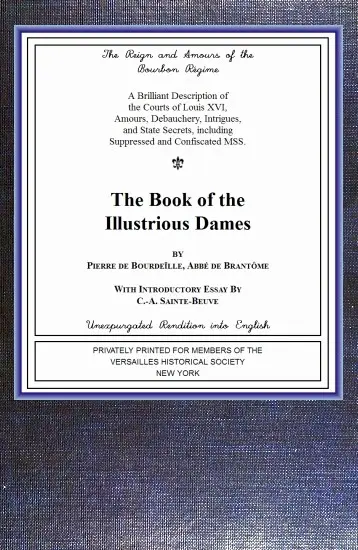
Pierre de Bourdeille Brantôme
BEHIND THE BOOK
This eBook is for the use of anyone anywhere in the United States and most other parts of the world at no cost and with almost no restrictions whatsoever. You may copy it, give it away or re-use it under the terms of the Project Gutenberg License included with this eBook or online at www.gutenberg.org. If you are not located in the United States, you will have to check the laws of the country where you are located before using this eBook. Read the source licence.
The original source file, including credits and licence, is retained by this library. Request an original-format copy at no charge. Please include the book title and Project Gutenberg identifier #67025.
KEEP YOUR CURIOSITY GOING
Cécile Tormay

Moritz Busch
John L. Ransom
Frances Wright
Cécile Tormay

Mabel Potter Daggett