Lives of Fair and Gallant Ladies. Vol 2.
Pierre de Bourdeille Brantôme
THE CLASSIC COLLECTION · 1922
"Lives of Fair and Gallant Ladies. Vol 1" by Pierre de Bourdeille Brantôme is a historical account written in the late 16th century. This work presents a collection of anecdotes and narratives concerning women of high social standing and their experiences with love and relationships. The writing reflects a mixture of admiration for and satire of the gallant ladies of the court, delineating their romantic exploits and the social constructs surrounding them. The opening of this volume sets the stage with a foreword praising A. R. Allinson's translation, stating that it retains the charm and essence of Brantôme's original work. It introduces readers to the author's intentions as he dedicates the tales to a noble patron, expressing both jest and reverence. The initial discourse explores themes of infidelity, displaying women’s cunning and bravery in the face of possessive husbands, while also hinting at the dangers and violent outcomes that often accompany such escapades. Brantôme mentions various characters, illustrating a keen understanding of human nature through anecdotes about lovers and their perilous affairs, thus inviting readers into a world of gallantry, seduction, and the complexities of marital relationships.
Introduction adapted from the source catalogue; source summaries may be automatically generated.
Free to read · English · 126,938 words · No account needed
MAKE TIME FOR A GOOD BOOK
On by default. Untick to stop anonymous reading totals. Each page counts after 10 seconds in view. How this works.
Anonymous counting is on unless you have switched it off.
◆See the Annales d’Aquitaine, f^o 140 v^o.—Jeanne de Montal, married to Charles d’Aubusson, lord of La Borne. This Charles had had a liaison with the prioress of Blessac, who bore him four children. He was tried for theft and robbery in the convents of his vicinity, and hanged, February 23, 1533. (Anselme, t. V., p. 835.) A genealogy by Pierre Robert states precisely what Brantôme records here.
◆See Brantôme in the Lalanne edition, t. VIII., p. 148. There must be some mistake here. Jacques d’Aragon, the titular king of Majorca, died in an expedition in 1375, according to the Art de verifier les dates.
◆Charles VII. (surnamed the Victorious), crowned at Poitiers 1422, consecrated at Rheims 1429; died 1461, the King for whom Jeanne d’Arc fought against the Burgundians and English, and who really owed his crown to her.
◆Francis I., 1515–1547.
◆Jeanne I., Queen of Naples, 1353–1381, daughter of Charles Duke of Calabria and grand-daughter of the wise King Robert of Naples.
◆The proverb says, the ferret. It should be the ermine, which animal is said to allow itself to be caught rather than soil itself.
◆The opinion that the female ferret would die if it did not find a male to satisfy her during the mating season was still held by naturalists at the beginning of the nineteenth century. Lalanne is mistaken about the ermine, which, on the contrary, dies of the slightest contamination:
Et moi, je suis si délicate
Qu’une tache me fait mourir.
(Florian, Fables, liv. III., fab. xiii.)
◆Nouvelle III.
◆Unhappy husbands were classified as follows:
Celluy qui, marié, par sa femme est coqu Et (qui) pas ne le sçait, d’une corne est cornu. Deux en a cestui-là qui peut dissimuler; Qui le voit et le souffre, celluy trois en porte; Et quatre cestui-là qui meine pour culler Chez lui des poursuivans. Cil qui en toute sorte Dit qu’il n’est de ceux-là, et en sa femme croid, Cinq cornes pour certain sur le front on lui void.
(Bib. Nat., ms. français 22565, f^o 41.)
◆It was the marriage of Marguerite of France, the Duchess de Savoie, to Emmanuel Philibert, the Duke de Savoie, which caused the army to grumble.
◆Boccaccio, Seventh tale of the second day.
◆Brantôme alludes here most likely to Marguerite of France, sister of Henri II., who was 45 when she married the Duke of Savoy.
Your reading position is saved on this browser. Take it to another device with a library code. Reading pages adapt to text, rather than matching a printed edition.
Pierre de Bourdeille Brantôme
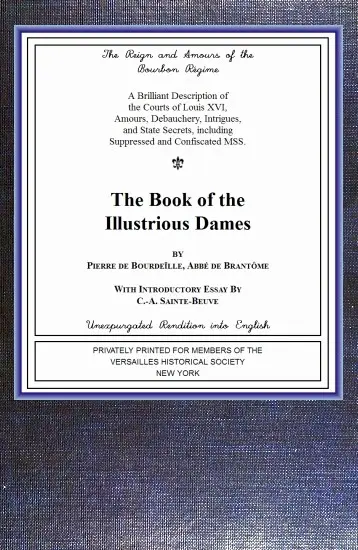
Pierre de Bourdeille Brantôme
BEHIND THE BOOK
This eBook is for the use of anyone anywhere in the United States and most other parts of the world at no cost and with almost no restrictions whatsoever. You may copy it, give it away or re-use it under the terms of the Project Gutenberg License included with this eBook or online at www.gutenberg.org. If you are not located in the United States, you will have to check the laws of the country where you are located before using this eBook. Read the source licence.
The original source file, including credits and licence, is retained by this library. Request an original-format copy at no charge. Please include the book title and Project Gutenberg identifier #67025.
KEEP YOUR CURIOSITY GOING
Cécile Tormay

Moritz Busch
John L. Ransom
Frances Wright
Cécile Tormay

Mabel Potter Daggett