THE CLASSIC COLLECTION✦The Star of IndiaCLASSIC FREE BOOKS
The Star of India
Edward Sylvester Ellis
THE CLASSIC COLLECTION · 1877
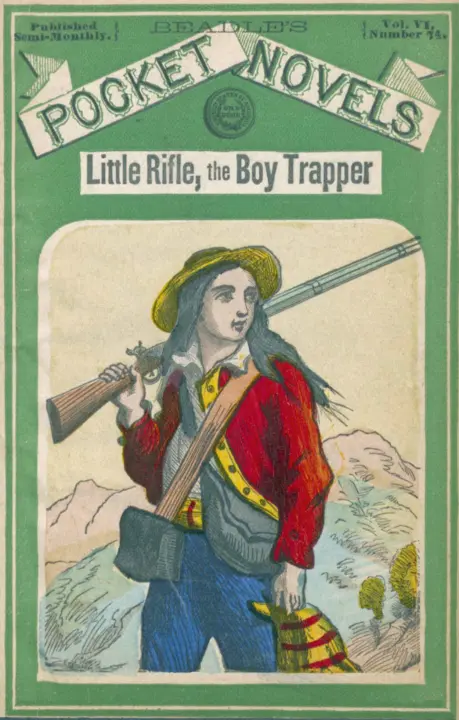
"Little Rifle; or, The Young Fur Hunters" by Edward Sylvester Ellis is a novel written in the late 19th century. The story follows a young boy named Little Rifle, who is an aspiring trapper and hunter living in the wilderness of the Pacific Northwest, particularly around the Upper Columbia River. As he navigates the challenges of this dangerous environment, he faces threats from both wildlife and the indigenous Blackfoot warriors, all while seeking to uncover the mysteries of his own past. The opening portion presents Little Rifle as a resourceful and skilled young boy, adept at moving stealthily through the woods as he sets traps for beavers. His solitude is palpable as he reflects on his life and his unknown origins, having been raised by the trapper Old Ruff Robsart. This segment builds tension effectively, highlighting an impending confrontation with a Blackfoot Indian while introducing themes of survival, solitude, and the search for identity. As the narrative progresses, Little Rifle's bravery and wit become apparent, especially when he cleverly outsmarts an enemy hunter, setting the stage for further adventures in the wild.
Introduction adapted from the source catalogue; source summaries may be automatically generated.
Free to read · English · 35,675 words · No account needed
MAKE TIME FOR A GOOD BOOK
On by default. Untick to stop anonymous reading totals. Each page counts after 10 seconds in view. How this works.
Anonymous counting is on unless you have switched it off.
“It’s our only chance!” he exclaimed, dashing toward the water. “Come on, Harry! it is death or life with us!”
Young Northend had no idea what he meant, but he did not hesitate to
follow him at full speed, so that he reached the spot scarcely behind
him.
Little Rifle dashed down among the rocks, and reaching the edge of the water, at the very edge or side of the falls, he paused, and looked despairingly around. He could see nothing like a cavern, nor any thing that seemed to afford an entrance to such a retreat.
“I guess we shall have to give it up,” he shouted to Harry, who, unable to catch a syllable in the thunderous din, but understanding the trouble, pointed ahead and yelled:
“There’s a chance to make your way through to something else!”
Neither did Little Rifle hear a word uttered by his comrade, but the motion of his lips, and the gesture of his hand indicated sufficiently well what he meant.
Following the direction indicated, he saw through a thin sheet of water, scarcely thicker than the soap bubble, and that reflected the prismatic hues, the dark outlines of a rock, that scarcely was as high as his waist and which was within easy leaping distance.
Not a second was to be lost, and Little Rifle had no sooner detected it than he made a spring, cleaving through the gauzy vail, and striking the flat surface of the rock, which was so slippery that his feet slid forward, and he fell flat upon his back.
Before he could gather himself up, Harry followed, and he too sprawled at full length, neither receiving any injury, and both assuming the perpendicular almost at the same moment.
The fear of Little Rifle was that by plunging through the feathery sheet, and temporarily breaking it, they had dissolved it altogether, and failing to reunite, it would leave not only the rock upon which they stood, but themselves, in full view of the Blackfeet, as soon as they should descend the rocks and place themselves below the falls.
But the screen instantly resumed its normal place, and spread over them like a fan of the thinnest glass, shutting them in, but permitting them to look through upon the outer world. Its transparency, or rather its texture, however, was not like that of a perfect window-pane, but it was faulty, abounding with tremulous nebulæ here and there that gave a fanciful, grotesque imagery to the objects upon which the eye rested, and that as a consequence, made the picture of themselves equally untrue to nature.
Your reading position is saved on this browser. Take it to another device with a library code. Reading pages adapt to text, rather than matching a printed edition.
Edward Sylvester Ellis
Edward Sylvester Ellis
Edward Sylvester Ellis
Edward Sylvester Ellis
BEHIND THE BOOK
This eBook is for the use of anyone anywhere in the United States and most other parts of the world at no cost and with almost no restrictions whatsoever. You may copy it, give it away or re-use it under the terms of the Project Gutenberg License included with this eBook or online at www.gutenberg.org. If you are not located in the United States, you will have to check the laws of the country where you are located before using this eBook. Read the source licence.
The original source file, including credits and licence, is retained by this library. Request an original-format copy at no charge. Please include the book title and Project Gutenberg identifier #65923.
KEEP YOUR CURIOSITY GOING
Coulson Kernahan

Maurice Baring
Frances Wright
Cécile Tormay

Frederic Jesup Stimson

W. H. P. (William Henry Pope) Jarvis