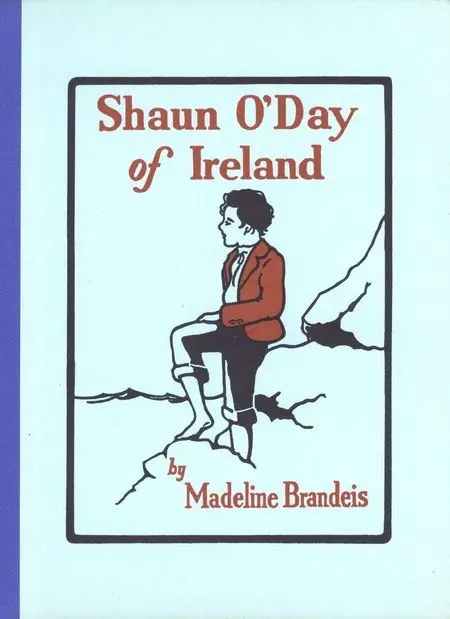
Shaun O’Day of Ireland
Madeline Brandeis
THE CLASSIC COLLECTION · 1930
"Little Philippe of Belgium" by Madeline Brandeis is a children's novel written in the early 20th century. The story follows a young boy named Philippe, affectionately known as "Petit Choux de Bruxelles," as he navigates his desires for companionship, adventure, and independence in post-World War I Belgium. The book delves into themes of childhood dreams, family bonds, and the impact of war on personal lives. At the start of the book, we meet Philippe, a five-year-old boy living on a farm near Brussels who longs for a baby sister and has dreams of becoming a cook like his father. The opening chapters introduce us to the idyllic yet challenging world he inhabits, highlighting his imaginative beliefs and aspirations. Philippe's adventures begin when he learns of his mother's pregnancy, and his excitement guides the narrative as he engages with his surroundings, interacts with animals, and dreams of grand adventures. His tale evolves as he experiences the challenges of growing up and faces the realities of life beyond the safety of the farm.
Introduction adapted from the source catalogue; source summaries may be automatically generated.
Free to read · English · 17,788 words · No account needed
MAKE TIME FOR A GOOD BOOK
On by default. Untick to stop anonymous reading totals. Each page counts after 10 seconds in view. How this works.
Anonymous counting is on unless you have switched it off.
The boy answered, "Oh, I should like to go to Antwerp (=ănt´-wẽrp=) and Ghent (=gĕnt=) and see the sights of Belgium, because I know so many stories about everything."
He then told them about his wandering friends, Tom and Zelie.
The Englishman remarked, "That is a hard life. It is much better to travel in a motor car." Then he smiled pleasantly and continued, "That is the way we travel. We are leaving for Antwerp tomorrow in our car."
Philippe's eyes shone. Here were more traveling folks. It seemed to the boy that everyone in the world was traveling except himself.
And while Philippe was thus thinking, the gentlemen were talking
together in English.
Suddenly the Englishman turned to Philippe and asked, "How would you like to come along with us to Antwerp? You would make an excellent guide, since you know so much about the country."
Philippe's heart almost stopped beating.
"Oh, sir," he breathed, "that is very good of you." Then he hesitated. "But my father would not let me go."
"Where is your father?" asked the gentleman.
"At the restaurant where we lunched, sir. He is in the kitchen," replied
Philippe.
"Very well; let us go and see him," suggested the Englishman.
Philippe led the gentlemen back to the restaurant. They followed him
into the big kitchen.
There Philippe began to introduce them to Papa Pomme.
But the Englishman and Papa Pomme stared at one another and then they both cried out together, "Well, well, well!"
Philippe was surprised to see that Papa Pomme and this English gentleman already knew each other. They were very happy to meet again.
Papa Pomme turned to Philippe and said, "My boy, here you see a war-time friend of your father's. We were soldiers together in the World War. This gentleman was a great hero!"
The Englishman interrupted, "Oh, no, no, my friend, not so great a hero
as you."
Then he looked at Papa Pomme's wooden leg and they both grew serious.
"But come! We have something to ask you," the gentleman suddenly observed. "My friend and I are going to Antwerp tomorrow. Will you allow your son to go along? We promise to take good care of him, and I'm sure he'll take splendid care of us. For you know, he has guided us through Brussels all day."
Papa Pomme fairly beamed with pride.
Then he said, "It is very kind of you, and I am delighted to have my Philippe go along with you. He has wanted so much to travel. Eh, little Philippe?"
And he pulled the boy's hair playfully.
"Oh, yes, Papa," joyfully agreed Philippe.
Your reading position is saved on this browser. Take it to another device with a library code. Reading pages adapt to text, rather than matching a printed edition.
Madeline Brandeis
Madeline Brandeis
Madeline Brandeis
Madeline Brandeis
BEHIND THE BOOK
This eBook is for the use of anyone anywhere in the United States and most other parts of the world at no cost and with almost no restrictions whatsoever. You may copy it, give it away or re-use it under the terms of the Project Gutenberg License included with this eBook or online at www.gutenberg.org. If you are not located in the United States, you will have to check the laws of the country where you are located before using this eBook. Read the source licence.
The original source file, including credits and licence, is retained by this library. Request an original-format copy at no charge. Please include the book title and Project Gutenberg identifier #40856.
KEEP YOUR CURIOSITY GOING
Coulson Kernahan

Maurice Baring
Frances Wright
Cécile Tormay

Frederic Jesup Stimson

W. H. P. (William Henry Pope) Jarvis