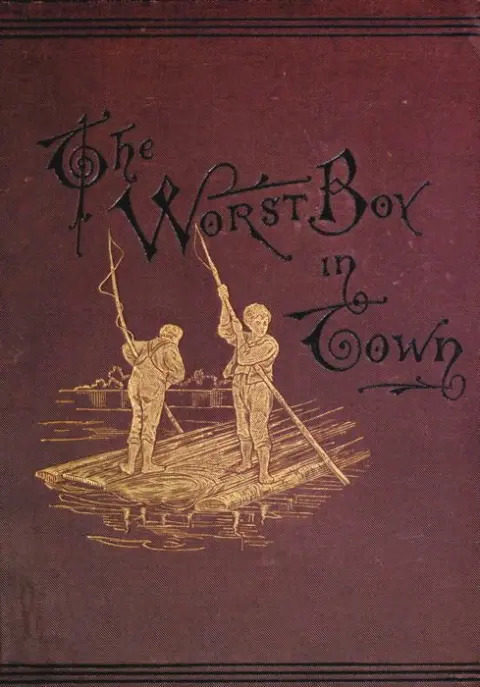
The Worst Boy in Town
John Habberton
THE CLASSIC COLLECTION · 1878
"Little Guzzy" by John Habberton is a collection of short stories written in the late 19th century. The stories range across various themes, capturing humorous, grave, and poignant moments in life. The book likely appeals to readers who enjoy light-hearted narratives with engaging characters, as suggested by its connection to Habberton's previous work, "Helen’s Babies." The opening of "Little Guzzy" introduces the setting of a mining camp called Bottle Flat, where the arrival of a new schoolteacher stirs discontent among local miners who are vehemently opposed to formal education. The miners plot to confront the teacher, but their plans shift when they discover that the incoming educator is a charming young woman named Miss Brown. Her pleasant demeanor leads to unexpectedly warm interactions, challenging the men’s initial resistance and igniting a change in their attitudes towards education and women in their community. The narrative captures the dynamics of small-town life, infusing humor and character depth throughout its opening chapter.
Introduction adapted from the source catalogue; source summaries may be automatically generated.
Free to read · English · 114,349 words · No account needed
MAKE TIME FOR A GOOD BOOK
On by default. Untick to stop anonymous reading totals. Each page counts after 10 seconds in view. How this works.
Anonymous counting is on unless you have switched it off.
Meanwhile Miss Brown approached, and Toledo stepped forward.
“Anything wrong up at the schoolhouse?” said he.
“Oh, no,” replied Miss Brown, “but I have always had a great curiosity to see how gold was obtained. It seems as if it must be very easy to handle those little pans. Don’t you—don’t you suppose some miner would lend me his pan and let me try just once?”
“Certingly, marm; ev’ry galoot ov ’em would be glad of the chance. Here, you fellers—who’s got the cleanest pan?”
Half a dozen men washed out their pans, and hurried off with them. Toledo selected one, put in dirt and water, and handed it to Miss Brown.
“Thar you are, marm, but I’m afeard you’ll wet your dress.”
“Oh, that won’t harm,” cried Miss Brown, with a laugh which caused one enthusiastic miner to “cut the pigeon-wing.”
She got the miner’s touch to a nicety, and in a moment had a spray of dirty water flying from the edge of the pan, while all the boys stood in a respectful semicircle, and stared delightedly. The pan empty, Toledo refilled it several times; and, finally, picking out some pebbles and hard pieces of earth, pointed to the dirty, shiny deposit in the bottom of the pan, and briefly remarked:
“Thar ’tis, marm.”
“Oh!” screamed Miss Brown, with delight; “is that really gold-dust?”
“That’s it,” said Toledo. “I’ll jest put it up fur yer, so yer ken kerry
it.”
“Oh, no,” said Miss Brown, “I couldn’t think of it—it isn’t mine.”
“You washed it out, marm, an’ that makes a full title in these parts.”
All of the traditional honesty of New England came into Miss Brown’s face in an instant; and, although she, Yankee-like, estimated the value of the dust, and sighingly thought how much easier it was to win gold in that way than by forcing ideas into stupid little heads, she firmly declined the gold, and bade the crowd a smiling good-day.
“Did yer see them little fingers uv hern a-holdin’ out that pan?—did yer see her, fellers?” inquired an excited miner.
“Yes, an’ the way she made that dirt git, ez though she was useder to washin’ than wallopin’,” said another.
“Wallopin’!” echoed a staid miner. “I’d gie my claim, an’ throw in my pile to boot, to be a young ’un an’ git walloped by them playthings of han’s.”
“Jest see how she throwed dirt an’ water on them boots,” said another, extending an enormous ugly boot. “Them boots ain’t fur sale now—them ain’t.”
Your reading position is saved on this browser. Take it to another device with a library code. Reading pages adapt to text, rather than matching a printed edition.
John Habberton
John Habberton
John Habberton
John Habberton
BEHIND THE BOOK
This eBook is for the use of anyone anywhere in the United States and most other parts of the world at no cost and with almost no restrictions whatsoever. You may copy it, give it away or re-use it under the terms of the Project Gutenberg License included with this eBook or online at www.gutenberg.org. If you are not located in the United States, you will have to check the laws of the country where you are located before using this eBook. Read the source licence.
The original source file, including credits and licence, is retained by this library. Request an original-format copy at no charge. Please include the book title and Project Gutenberg identifier #67985.
KEEP YOUR CURIOSITY GOING
Coulson Kernahan

Maurice Baring
Frances Wright
Cécile Tormay

Frederic Jesup Stimson

W. H. P. (William Henry Pope) Jarvis