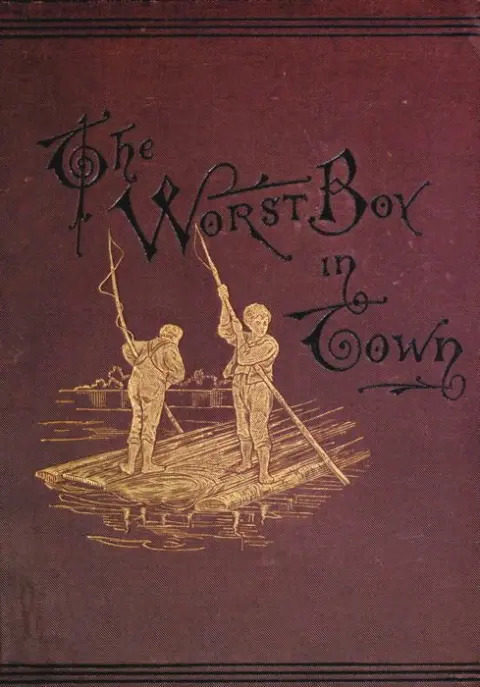
The Worst Boy in Town
John Habberton
THE CLASSIC COLLECTION · 1878
"Little Guzzy" by John Habberton is a collection of short stories written in the late 19th century. The stories range across various themes, capturing humorous, grave, and poignant moments in life. The book likely appeals to readers who enjoy light-hearted narratives with engaging characters, as suggested by its connection to Habberton's previous work, "Helen’s Babies." The opening of "Little Guzzy" introduces the setting of a mining camp called Bottle Flat, where the arrival of a new schoolteacher stirs discontent among local miners who are vehemently opposed to formal education. The miners plot to confront the teacher, but their plans shift when they discover that the incoming educator is a charming young woman named Miss Brown. Her pleasant demeanor leads to unexpectedly warm interactions, challenging the men’s initial resistance and igniting a change in their attitudes towards education and women in their community. The narrative captures the dynamics of small-town life, infusing humor and character depth throughout its opening chapter.
Introduction adapted from the source catalogue; source summaries may be automatically generated.
Free to read · English · 114,349 words · No account needed
MAKE TIME FOR A GOOD BOOK
On by default. Untick to stop anonymous reading totals. Each page counts after 10 seconds in view. How this works.
Anonymous counting is on unless you have switched it off.
“I’m much obliged, boys, but I won’t give Whitey the trouble. Doctor’s mistaken—there’s someting broken inside, and I haven’t got many minutes more to live.”
“Do yer best, cap’en,” said the barkeeper, encouragingly. “Promise me you’ll stay alive, and I’ll go straight down to ’Frisco, and get you all the champagne you can drink.”
“You’re very kind,” replied the captain, faintly; “but I’m sent for, and I’ve got to go. I’ve left the East to make my mark, but I didn’t expect to make it in real estate. Whitey, I was a fool for wanting to be chief of Black Hat, and you’ve forgiven me like a gentleman and a Christian. It’s getting dark—I’m thirsty—I’m going—gone!”
The doctor felt the captain’s wrist, and said:
“Fact, gentlemen, he’s panned his last dirt.”
“Do the honors, boys,” said the barkeeper, placing glasses along the
bar.
Each man filled his glass, and all looked at Whitey.
“Boys,” said Whitey, solemnly, “ef the cap’en hed struck a nugget, good luck might hev spiled him; ef he’d been chief of Black Hat, or any other place, he might hev got shot. But he’s made his mark, so nobody begrudges him, an’ nobody can rub it out. So here’s to ‘the cap’en’s mark, a dead sure thing.’ Bottoms up.”
The glasses were emptied in silence, and turned bottoms uppermost on the
bar.
The boys were slowly dispersing, when one, who was strongly suspected of having been a Church-member, remarked:
“He was took of a sudden, so he shouldn’t be stuck up.”
Whitey turned to him, and replied, with some asperity:
“Young man, you’ll be lucky ef you’re ever stuck up as high as the
captain.”
And all the boys understood what Whitey meant.
TWO o’clock A.M. is supposed to be a popular sleeping hour the world over, and as Flatfoot Bar was a portion of the terrestrial sphere, it was but natural to expect its denizens to be in bed at that hour.
Yet, on a certain morning twenty years ago, when there was neither sickness nor a fashionable entertainment to excuse irregular hours in camp, a bright light streamed from the only window of Chagres Charley’s residence at Flatfoot Bar, and inside of the walls of Chagres Charley’s domicile were half a dozen miners engaged in earnest conversation.
Your reading position is saved on this browser. Take it to another device with a library code. Reading pages adapt to text, rather than matching a printed edition.
John Habberton
John Habberton
John Habberton
John Habberton
BEHIND THE BOOK
This eBook is for the use of anyone anywhere in the United States and most other parts of the world at no cost and with almost no restrictions whatsoever. You may copy it, give it away or re-use it under the terms of the Project Gutenberg License included with this eBook or online at www.gutenberg.org. If you are not located in the United States, you will have to check the laws of the country where you are located before using this eBook. Read the source licence.
The original source file, including credits and licence, is retained by this library. Request an original-format copy at no charge. Please include the book title and Project Gutenberg identifier #67985.
KEEP YOUR CURIOSITY GOING
Coulson Kernahan

Maurice Baring
Frances Wright
Cécile Tormay

Frederic Jesup Stimson

W. H. P. (William Henry Pope) Jarvis