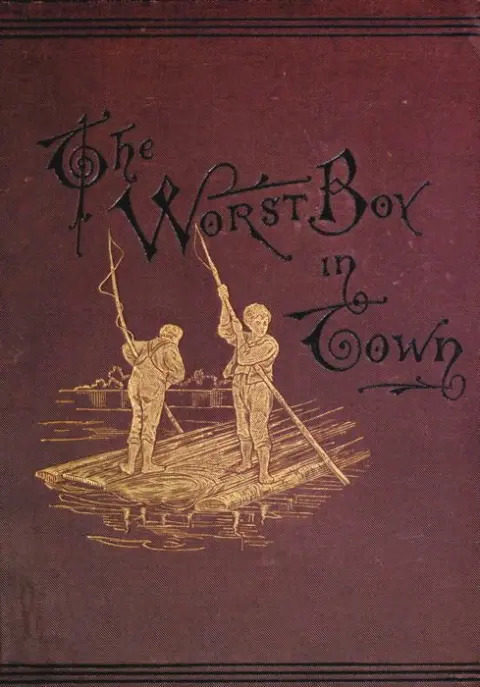
The Worst Boy in Town
John Habberton
THE CLASSIC COLLECTION · 1878
"Little Guzzy" by John Habberton is a collection of short stories written in the late 19th century. The stories range across various themes, capturing humorous, grave, and poignant moments in life. The book likely appeals to readers who enjoy light-hearted narratives with engaging characters, as suggested by its connection to Habberton's previous work, "Helen’s Babies." The opening of "Little Guzzy" introduces the setting of a mining camp called Bottle Flat, where the arrival of a new schoolteacher stirs discontent among local miners who are vehemently opposed to formal education. The miners plot to confront the teacher, but their plans shift when they discover that the incoming educator is a charming young woman named Miss Brown. Her pleasant demeanor leads to unexpectedly warm interactions, challenging the men’s initial resistance and igniting a change in their attitudes towards education and women in their community. The narrative captures the dynamics of small-town life, infusing humor and character depth throughout its opening chapter.
Introduction adapted from the source catalogue; source summaries may be automatically generated.
Free to read · English · 114,349 words · No account needed
MAKE TIME FOR A GOOD BOOK
On by default. Untick to stop anonymous reading totals. Each page counts after 10 seconds in view. How this works.
Anonymous counting is on unless you have switched it off.
“Beg pardon, sir—very sorry, but—we’d be compounding felony in that case, you know,” replied one of the officers, gazing with genuine pity on the weeping girl.
“Don’t worry,” whispered the colonel in Mr. Botayne’s ear; “we’ll clean out them two fellers, and let Tarpaulin loose again. Ev’ry feller come here for somethin’, darn it!” with which sympathizing expression the colonel again retired.
“I’ll give you as much as the bank offers,” said Mr. Botayne.
“Very sorry, sir; but can’t,” replied the detective. “We’d be just as bad then in the eyes of the law as before. Reward, five thousand, bank lose twenty-five thousand—thirty thousand, in odd figures, is least we could take. Even that wouldn’t be reg’lar; but it would be a safe risk, seeing all the bank cares for’s to get its money back.”
Mr. Botayne groaned.
“We’ll make it as pleasant as we can for you, sir,” continued the detective, “if you and the lady’ll go back on the ship with us. We’ll give him the liberty of the ship as soon as we’re well away from land. We’d consider it our duty to watch him, of course; but we’d try to do it so’s not to give offense—we’ve got hearts, though we are in this business. Hope you can buy him clear when you get home, sir?”
“I’ve sacrificed everything to get here—I can never clear him,” sighed
Mr. Botayne.
“I can!” exclaimed a clear, manly voice.
Millicent raised her eyes, and for the first time saw Jim Hockson.
She gave him a look in which astonishment, gratitude and fear strove for the mastery, and he gave her a straight-forward, honest, respectful look in return.
The two detectives dropped their lower jaws alarmingly, and raised their eyebrows to their hat-rims.
“The bank at San Francisco has an agent here,” said Jim. “Colonel, won’t you fetch him?”
The colonel took a lively double-quick, and soon returned with a
business-looking man.
“Mr. Green,” said Jim, “please tell me how much I have in your bank?”
The clerk looked over a small book he extracted from his pocket, and
replied, briefly:
“Over two thousand ounces.”
“Please give these gentlemen a check, made whatever way they like it, for the equivalent of thirty thousand dollars. I’ll sign it,” said Jim.
The clerk and one of the detectives retired to an adjacent hut, and soon called Jim. Jim joined them, and immediately he and the officer returned to the prisoner.
“It’s all right, Maxley,” said the officer; “let him go.”
Your reading position is saved on this browser. Take it to another device with a library code. Reading pages adapt to text, rather than matching a printed edition.
John Habberton
John Habberton
John Habberton
John Habberton
BEHIND THE BOOK
This eBook is for the use of anyone anywhere in the United States and most other parts of the world at no cost and with almost no restrictions whatsoever. You may copy it, give it away or re-use it under the terms of the Project Gutenberg License included with this eBook or online at www.gutenberg.org. If you are not located in the United States, you will have to check the laws of the country where you are located before using this eBook. Read the source licence.
The original source file, including credits and licence, is retained by this library. Request an original-format copy at no charge. Please include the book title and Project Gutenberg identifier #67985.
KEEP YOUR CURIOSITY GOING
Coulson Kernahan

Maurice Baring
Frances Wright
Cécile Tormay

Frederic Jesup Stimson

W. H. P. (William Henry Pope) Jarvis