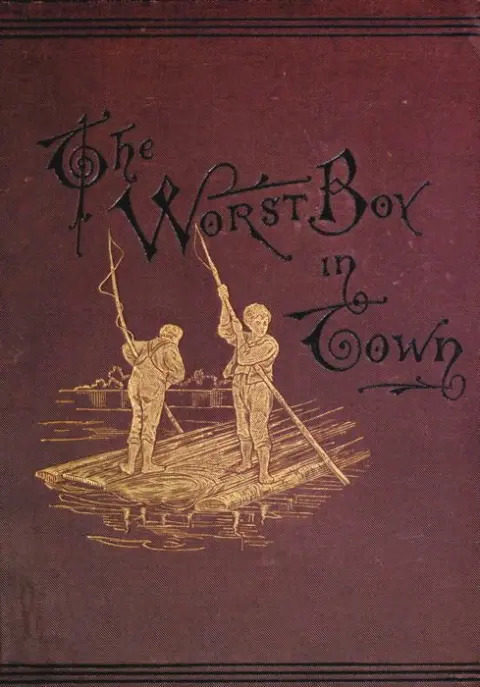
The Worst Boy in Town
John Habberton
THE CLASSIC COLLECTION · 1878
"Little Guzzy" by John Habberton is a collection of short stories written in the late 19th century. The stories range across various themes, capturing humorous, grave, and poignant moments in life. The book likely appeals to readers who enjoy light-hearted narratives with engaging characters, as suggested by its connection to Habberton's previous work, "Helen’s Babies." The opening of "Little Guzzy" introduces the setting of a mining camp called Bottle Flat, where the arrival of a new schoolteacher stirs discontent among local miners who are vehemently opposed to formal education. The miners plot to confront the teacher, but their plans shift when they discover that the incoming educator is a charming young woman named Miss Brown. Her pleasant demeanor leads to unexpectedly warm interactions, challenging the men’s initial resistance and igniting a change in their attitudes towards education and women in their community. The narrative captures the dynamics of small-town life, infusing humor and character depth throughout its opening chapter.
Introduction adapted from the source catalogue; source summaries may be automatically generated.
Free to read · English · 114,349 words · No account needed
MAKE TIME FOR A GOOD BOOK
On by default. Untick to stop anonymous reading totals. Each page counts after 10 seconds in view. How this works.
Anonymous counting is on unless you have switched it off.
Boston Ben immediately detailed a special officer to summon Old Scrabblegrab, declared a recess of five minutes, and invited the boys to drink with him.
Those who took sugar in theirs had the cup dashed from their lips just as they were draining the delicious dregs, for the officer and culprit appeared, and the chairman rapped the assembly to order.
Boston Ben had been an interested attendant at certain law-courts in the States, so in the calm consciousness of his acquaintance with legal procedure he rapidly arraigned Scrabblegrab.
“Scrabblegrab, you’re complained uv for goin’ back on bitters, coaxin’ Curly to give up keards, thus spoilin’ his fun, an’ knockin’ appreciatin’ observers out of their amusement; uv insultin’ the judge, uv not cussin’ when you stumble into the river, uv not havin’ any good p’ints, an’ not showin’ yer bad ones; uv bein’ a set-back on the tone uv the place—lookin’ like a green-apple-fed, vinegar-watered corkscrew, or words to that effect; an’, finally, in savin’ yer money. What hev you got to say agin’ sentence bein’ passed on yer?”
The old man flushed as the chairman proceeded, and when the indictment reached its end, he replied, in a tone which indicated anything but respect for the court:
“I’ve got just this to say, that I paid my way here, I’ve asked no odds of any man sence I’ve ben here, an’ that anybody that takes pains to meddle with my affairs is an impudent scoundrel!”
Saying which, the old man turned to go, while the court was paralyzed
into silence.
But Tom Dosser, a new arrival, and a famous shot, now stepped in front
of the old man.
“I ax yer parding,” said Tom, in the blandest of tones, “but, uv course, yer didn’t mean me when yer mentioned impudent scoundrels?”
“Yes, I did—I meant you, and ev’rybody like yer,” replied the old man.
Tom’s hand moved toward his pistol. The chairman expeditiously got out of range. Stumpy Flukes promptly retired to the extreme end of the bar, and groaned audibly.
The old man was in the wrong; but, then, wasn’t it too mean, when blood was so hard to get out, that these difficulties always took place just after he’d got the floor clean?
“I don’t generally shoot till the other feller draws,” explained Tom Dosser, while each man in the room wept with emotion as they realized they had lived to see Tom’s skill displayed before their very eyes—“I don’t generally shoot till the other feller draws; but you’d better be spry. I usually make a little allowance for age, but——”
Your reading position is saved on this browser. Take it to another device with a library code. Reading pages adapt to text, rather than matching a printed edition.
John Habberton
John Habberton
John Habberton
John Habberton
BEHIND THE BOOK
This eBook is for the use of anyone anywhere in the United States and most other parts of the world at no cost and with almost no restrictions whatsoever. You may copy it, give it away or re-use it under the terms of the Project Gutenberg License included with this eBook or online at www.gutenberg.org. If you are not located in the United States, you will have to check the laws of the country where you are located before using this eBook. Read the source licence.
The original source file, including credits and licence, is retained by this library. Request an original-format copy at no charge. Please include the book title and Project Gutenberg identifier #67985.
KEEP YOUR CURIOSITY GOING
Coulson Kernahan

Maurice Baring
Frances Wright
Cécile Tormay

Frederic Jesup Stimson

W. H. P. (William Henry Pope) Jarvis