
The Worst Boy in Town
John Habberton
THE CLASSIC COLLECTION · 1878
"Little Guzzy" by John Habberton is a collection of short stories written in the late 19th century. The stories range across various themes, capturing humorous, grave, and poignant moments in life. The book likely appeals to readers who enjoy light-hearted narratives with engaging characters, as suggested by its connection to Habberton's previous work, "Helen’s Babies." The opening of "Little Guzzy" introduces the setting of a mining camp called Bottle Flat, where the arrival of a new schoolteacher stirs discontent among local miners who are vehemently opposed to formal education. The miners plot to confront the teacher, but their plans shift when they discover that the incoming educator is a charming young woman named Miss Brown. Her pleasant demeanor leads to unexpectedly warm interactions, challenging the men’s initial resistance and igniting a change in their attitudes towards education and women in their community. The narrative captures the dynamics of small-town life, infusing humor and character depth throughout its opening chapter.
Introduction adapted from the source catalogue; source summaries may be automatically generated.
Free to read · English · 114,349 words · No account needed
MAKE TIME FOR A GOOD BOOK
On by default. Untick to stop anonymous reading totals. Each page counts after 10 seconds in view. How this works.
Anonymous counting is on unless you have switched it off.
“Somebody’s comin’!” whispered one of the party. “Sheriff’s got wind of the arrangements, maybe!”
“Comes from the wrong direction,” cried Caney, of Texas, quickly. “It’s somebody on foot—an’ tired—an’ light-footed—ther’s two or three—dunno what kind o’ bein’s they ken be. Thunder an’ lightnin’!”
Caney’s concluding remark was inspired by the sudden appearance of a woman, who rushed into the shadow of the tree, stopped, looked wildly about for a moment, and then threw herself against the prisoner’s feet, and uttered a low, pitiful cry.
There was a low murmur from the crowd, and the major cried:
“Take him down; give him fifteen minutes with his wife, and see she
doesn’t untie him.”
The man in the tree loosened the rope, Bowney was lifted off and placed on the ground again, and the woman threw herself on the ground beside him, caressed his ugly face, and wailed pitifully. The judge and jury fidgeted about restlessly. Still the horses stood on the alert, and soon three came through the oats—three children, all crying.
As they saw the men they became dumb, and stood mute and frightened,
staring at their parents.
They were not pretty—they were not even interesting. Mother and children were alike—unwashed, uncombed, shoeless, and clothed in dirty, faded calico. The children were all girls—the oldest not more than ten years old, and the youngest scarce five. None of them pleaded for the prisoner, but still the woman wailed and moaned, and the children stood staring in dumb piteousness.
The major stood quietly gazing at the face of his watch. There was not in Southern California a more honest man than Major Burkess; yet the minute-hand of his watch had not indicated more than one-half of fifteen minutes, when he exclaimed:
“Time’s up!”
The men approached the prisoner—the woman threw her arms around him, and
cried:
“My husband! Oh, God!”
“Madam,” said the major, “your husband’s life is in his own hands. He can save himself by giving the names of his confederates and leaving the State.”
“I’ll tell you who they are?” cried the woman.
“God curse yer if yer do!” hissed Bowney from between his teeth.
“Better let him be, madam,” argued Caney, of Texas. “He’d better die like a man than go back on his friends. Might tell us which of ’em was man enough to fetch you and the young uns here? We’ll try to be easy on him when we ketch him.”
“None of ’em,” sobbed the woman. “We walked, an’ I took turns totin’ the young uns. My husband! Oh, God! my husband!”
Your reading position is saved on this browser. Take it to another device with a library code. Reading pages adapt to text, rather than matching a printed edition.
John Habberton
John Habberton

John Habberton
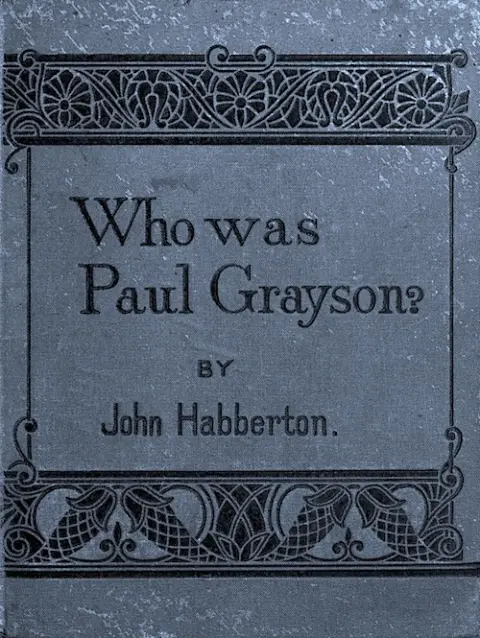
John Habberton
BEHIND THE BOOK
This eBook is for the use of anyone anywhere in the United States and most other parts of the world at no cost and with almost no restrictions whatsoever. You may copy it, give it away or re-use it under the terms of the Project Gutenberg License included with this eBook or online at www.gutenberg.org. If you are not located in the United States, you will have to check the laws of the country where you are located before using this eBook. Read the source licence.
The original source file, including credits and licence, is retained by this library. Request an original-format copy at no charge. Please include the book title and Project Gutenberg identifier #67985.
KEEP YOUR CURIOSITY GOING
Coulson Kernahan

Maurice Baring
Frances Wright
Cécile Tormay

Frederic Jesup Stimson

W. H. P. (William Henry Pope) Jarvis