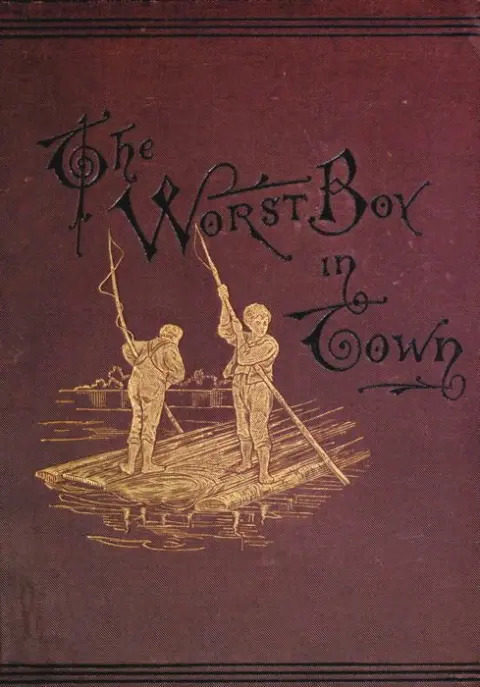
The Worst Boy in Town
John Habberton
THE CLASSIC COLLECTION · 1878
"Little Guzzy" by John Habberton is a collection of short stories written in the late 19th century. The stories range across various themes, capturing humorous, grave, and poignant moments in life. The book likely appeals to readers who enjoy light-hearted narratives with engaging characters, as suggested by its connection to Habberton's previous work, "Helen’s Babies." The opening of "Little Guzzy" introduces the setting of a mining camp called Bottle Flat, where the arrival of a new schoolteacher stirs discontent among local miners who are vehemently opposed to formal education. The miners plot to confront the teacher, but their plans shift when they discover that the incoming educator is a charming young woman named Miss Brown. Her pleasant demeanor leads to unexpectedly warm interactions, challenging the men’s initial resistance and igniting a change in their attitudes towards education and women in their community. The narrative captures the dynamics of small-town life, infusing humor and character depth throughout its opening chapter.
Introduction adapted from the source catalogue; source summaries may be automatically generated.
Free to read · English · 114,349 words · No account needed
MAKE TIME FOR A GOOD BOOK
On by default. Untick to stop anonymous reading totals. Each page counts after 10 seconds in view. How this works.
Anonymous counting is on unless you have switched it off.
“Why!” replied Weasel, greatly pleased by the colonel’s compliment, “after what you said about hair and beard hidin’ a man, one of them fellers cut a card an’ held it over the picture, so as to hide hair an’ chin. The forehead an’ face an’ nose an’ ears wuz Tarpaulin’s, an’ nobody else’s.”
“Lightning’s blazes!” roared the colonel. “Ha, ha, ha! why, Tarpaulin hisself came into my shanty, an’ looked at the pictur’, an’ talked to them ’bout it! Trot out yer glass-ware, barkeeper—got to drink to a feller that’s ez cool ez all that!”
The boys drank with the colonel, but they were too severely astonished to enjoy the liquor particularly. In fact, old Bermuda, who had never taken anything but plain rye, drank three fingers of claret that day, and did not know of it until told.
The colonel’s mind was unusually excited. It seemed to him there were a number of probabilities upon which to hang bets. He walked outside, that his meditation might be undisturbed, but in an instant he was back, crying:
“Lady comin’!”
Shirt-sleeves and trowsers-legs were hurriedly rolled down, shirt-collars were buttoned, hats were dusted, and then each man went leisurely out, with the air of having merely happened to leave the saloon—an air which imposed upon no disinterested observer.
Coming up the trail beside the creek were a middle-aged gentleman and a young lady, both on horseback.
The gentleman’s dress and general style plainly indicated that he was not a miner, nor a storekeeper, nor a barkeeper; while it was equally evident that the lady was neither a washerwoman, a cook, nor a member of either of the very few professions which were open to ladies on the Pacific Coast in those days.
This much every miner quickly decided for himself; but after so deciding, each miner reached the uttermost extremity of his wits, and devoted himself to staring.
The couple reined up before the saloon, and the gentleman drew something small and black and square from his pocket.
“Gentlemen,” said he, “we are looking for an old friend of ours, and have traced him to this camp. We scarcely know whether it would be any use to give his name, but here is his picture. Can any one remember having seen the person here?”
Every one looked toward Colonel Two, he being the man with the most
practical tongue in camp.
The colonel took the picture, and Weasel slipped up behind him and looked over his shoulder. The colonel looked at the picture, abruptly handed it back, looked at the young lady, and then gazed vacantly into space, and seemed very uncomfortable.
Your reading position is saved on this browser. Take it to another device with a library code. Reading pages adapt to text, rather than matching a printed edition.
John Habberton
John Habberton
John Habberton
John Habberton
BEHIND THE BOOK
This eBook is for the use of anyone anywhere in the United States and most other parts of the world at no cost and with almost no restrictions whatsoever. You may copy it, give it away or re-use it under the terms of the Project Gutenberg License included with this eBook or online at www.gutenberg.org. If you are not located in the United States, you will have to check the laws of the country where you are located before using this eBook. Read the source licence.
The original source file, including credits and licence, is retained by this library. Request an original-format copy at no charge. Please include the book title and Project Gutenberg identifier #67985.
KEEP YOUR CURIOSITY GOING
Coulson Kernahan

Maurice Baring
Frances Wright
Cécile Tormay

Frederic Jesup Stimson

W. H. P. (William Henry Pope) Jarvis