
The Worst Boy in Town
John Habberton
THE CLASSIC COLLECTION · 1878
"Little Guzzy" by John Habberton is a collection of short stories written in the late 19th century. The stories range across various themes, capturing humorous, grave, and poignant moments in life. The book likely appeals to readers who enjoy light-hearted narratives with engaging characters, as suggested by its connection to Habberton's previous work, "Helen’s Babies." The opening of "Little Guzzy" introduces the setting of a mining camp called Bottle Flat, where the arrival of a new schoolteacher stirs discontent among local miners who are vehemently opposed to formal education. The miners plot to confront the teacher, but their plans shift when they discover that the incoming educator is a charming young woman named Miss Brown. Her pleasant demeanor leads to unexpectedly warm interactions, challenging the men’s initial resistance and igniting a change in their attitudes towards education and women in their community. The narrative captures the dynamics of small-town life, infusing humor and character depth throughout its opening chapter.
Introduction adapted from the source catalogue; source summaries may be automatically generated.
Free to read · English · 114,349 words · No account needed
MAKE TIME FOR A GOOD BOOK
On by default. Untick to stop anonymous reading totals. Each page counts after 10 seconds in view. How this works.
Anonymous counting is on unless you have switched it off.
“Don’t know him, mister,” said Colonel Two, who happened to be the owner of the hut. “Besides ef, as is most likely, he’s growed long hair an’ a beard since he left the States, his own mother wouldn’t know him from George Washington. Brother o’ yourn?”
“No,” said one of the thin men; “he’s—well, the fact is, we’ll give a thousand dollars to any one who’ll find him for us in twenty-four hours.”
“Deppity sheriffs?” asked the colonel, retiring somewhat hastily under
his blankets.
“About the same thing,” said one of the thin men, with a sickly smile.
“Git!” roared the colonel, suddenly springing from his bed, and cocking his revolver. “I b’lieve in the Golden Rule, I do!”
The detectives, with the fine instinct peculiar to their profession, rightly construed the colonel’s action as a hint, and withdrew, and Jim retired to his own hut, and fell asleep while waiting for his partner.
Morning came, but no Tarpaulin; dinner-time arrived, but Jim ate alone, and was rather blue. He loved a sociable chat, and of late Tarpaulin had been almost his sole companion.
Evening came, but Tarpaulin came not.
Jim couldn’t abide the saloon for a whole evening, so he lit a candle in his own hut, and attempted to read.
Tarpaulin was a lover of newspapers—it seemed to Jim he received more papers than all the remaining miners put together.
Jim thought he would read some of these same papers, and unrolled Tarpaulin’s blankets to find them, when out fell a picture-case, opening as it fell. Jim was about to close it again, when he suddenly started, and exclaimed:
“Millicent Botayne!”
He held it under the light, and examined it closely.
There could be no doubt as to identity—there were the same exquisite features which, a few months before, had opened to Jim Hockson a new world of beauty, and had then, with a sweet yet sad smile, knocked down all his fair castles, and destroyed all his exquisite pictures.
Strange that it should appear to him now, and so unexpectedly, but stranger did it seem to Jim that on the opposite side of the case should be a portrait which was a duplicate of the one shown by the detectives!
“That rascal Brown!” exclaimed Jim. “So he succeeded in getting her, did he? But I shouldn’t call him names; he had as much right to make love to her as I. God grant he may make her happy! And he is probably a very fine fellow—must be, by his looks.”
Your reading position is saved on this browser. Take it to another device with a library code. Reading pages adapt to text, rather than matching a printed edition.
John Habberton
John Habberton

John Habberton
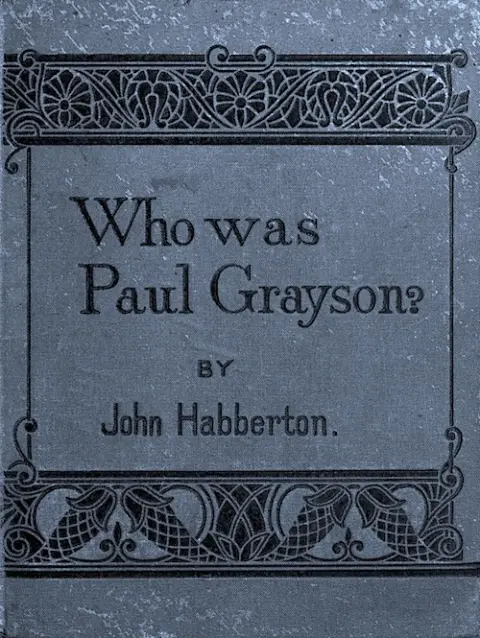
John Habberton
BEHIND THE BOOK
This eBook is for the use of anyone anywhere in the United States and most other parts of the world at no cost and with almost no restrictions whatsoever. You may copy it, give it away or re-use it under the terms of the Project Gutenberg License included with this eBook or online at www.gutenberg.org. If you are not located in the United States, you will have to check the laws of the country where you are located before using this eBook. Read the source licence.
The original source file, including credits and licence, is retained by this library. Request an original-format copy at no charge. Please include the book title and Project Gutenberg identifier #67985.
KEEP YOUR CURIOSITY GOING
Coulson Kernahan

Maurice Baring
Frances Wright
Cécile Tormay

Frederic Jesup Stimson

W. H. P. (William Henry Pope) Jarvis