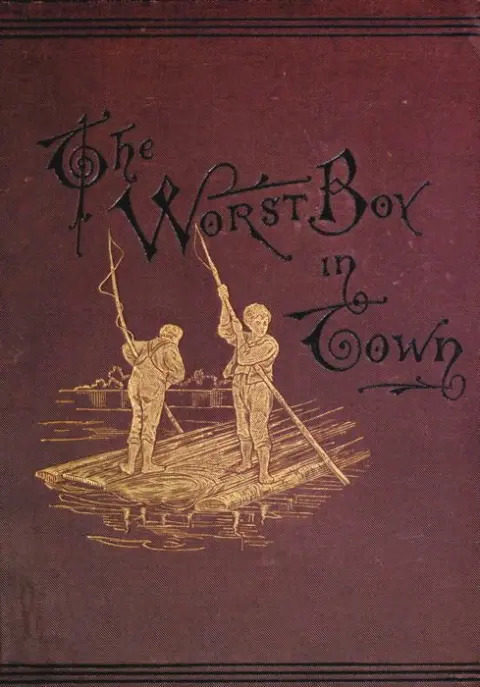
The Worst Boy in Town
John Habberton
THE CLASSIC COLLECTION · 1878
"Little Guzzy" by John Habberton is a collection of short stories written in the late 19th century. The stories range across various themes, capturing humorous, grave, and poignant moments in life. The book likely appeals to readers who enjoy light-hearted narratives with engaging characters, as suggested by its connection to Habberton's previous work, "Helen’s Babies." The opening of "Little Guzzy" introduces the setting of a mining camp called Bottle Flat, where the arrival of a new schoolteacher stirs discontent among local miners who are vehemently opposed to formal education. The miners plot to confront the teacher, but their plans shift when they discover that the incoming educator is a charming young woman named Miss Brown. Her pleasant demeanor leads to unexpectedly warm interactions, challenging the men’s initial resistance and igniting a change in their attitudes towards education and women in their community. The narrative captures the dynamics of small-town life, infusing humor and character depth throughout its opening chapter.
Introduction adapted from the source catalogue; source summaries may be automatically generated.
Free to read · English · 114,349 words · No account needed
MAKE TIME FOR A GOOD BOOK
On by default. Untick to stop anonymous reading totals. Each page counts after 10 seconds in view. How this works.
Anonymous counting is on unless you have switched it off.
“Once in grace, always in grace. I’ve been there, I know. Let us
pray.”
The victim waived his hand impatiently, and faintly exclaimed:
“You won’t do; somebody that’s better acquainted with God than you
are must do it.”
“But, Baggs,” reasoned the barkeeper, “perhaps he’s been a preacher—you’d better not throw away a chance.”
“Don’t care if he has,” whispered Baggs; “he don’t look like any of the prayin’ people mother used to know.”
The would-be petitioner took his rebuff considerably to heart, and began, in a low and rapid voice, an argument with himself upon the duration of the state of grace. The Enders listened but indifferently, however; the dying man was more interesting to them than living questions, for he had no capacity for annoyance. The barkeeper scratched his head and pinched his brow, but, gaining no idea thereby, he asked:
“Do you know the right man, Baggs?”
“Not here, I don’t,” gasped the sufferer; “not the right man.”
The emphasis on the last word was not unheeded by the bystanders; they looked at each other with as much astonishment as Enders were capable of displaying, and thrust their hands deep into the pockets of their pantaloons, in token of their inability to handle the case. Baggs spoke again.
“I wish mother was here!” he said. “She’d know just what to say and
how to say it.”
“She’s too far away; leastways, I suppose she is,” said the barkeeper.
“I know it,” whispered the wounded man; “an’ yet a woman——”
Baggs looked inquiringly, appealingly about him, but seemed unable to finish his sentence. His glance finally rested upon Brownie, a man as characteristic as himself, but at times displaying rather more heart than was common among Enders. Brownie obeyed the summons, and stooped beside Baggs. The bystanders noticed that there followed some whispering, at times shame-faced, and then in the agony of earnestness on the part of Baggs, and replied to by Brownie with averted face and eyes gazing into nowhere.
Finally Brownie arose with an un-Ender-like decision, and left the saloon. No one else said much, but there seemed to circulate an impression that Baggs was consuming more time than was customary at the End.
Very different was the scene in Mrs. Wader’s parlor; instead of a dying man surrounded by uncouth beings, there stood a beautiful woman, radiant with health and animation; while about her stood a throng of well-dressed gentlemen, some of them handsome, all of them smart, and each one craving a smile, a word, or a look. Suddenly the pompous voice of General Wader arose:
Your reading position is saved on this browser. Take it to another device with a library code. Reading pages adapt to text, rather than matching a printed edition.
John Habberton
John Habberton
John Habberton
John Habberton
BEHIND THE BOOK
This eBook is for the use of anyone anywhere in the United States and most other parts of the world at no cost and with almost no restrictions whatsoever. You may copy it, give it away or re-use it under the terms of the Project Gutenberg License included with this eBook or online at www.gutenberg.org. If you are not located in the United States, you will have to check the laws of the country where you are located before using this eBook. Read the source licence.
The original source file, including credits and licence, is retained by this library. Request an original-format copy at no charge. Please include the book title and Project Gutenberg identifier #67985.
KEEP YOUR CURIOSITY GOING
Coulson Kernahan

Maurice Baring
Frances Wright
Cécile Tormay

Frederic Jesup Stimson

W. H. P. (William Henry Pope) Jarvis