The Maker of Rainbows, and Other Fairy-tales and Fables
Richard Le Gallienne
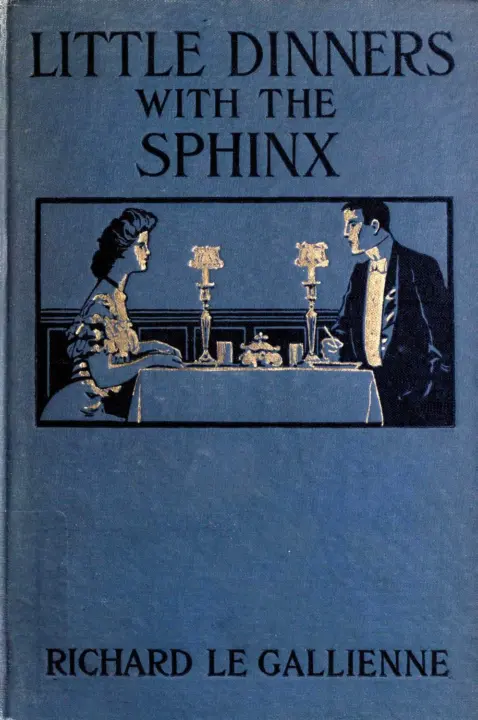
THE CLASSIC COLLECTION · 1907
"Little Dinners With the Sphinx, and Other Prose Fancies" by Richard Le Gallienne is a collection of prose reflections written in the early 20th century. The text features a series of philosophical and whimsical conversations between the narrator and a character known as the Sphinx, exploring themes of love, beauty, and the nature of existence against the backdrop of elegant dinner settings. The opening portion introduces a reunion between the narrator and the Sphinx after a considerable time apart. They engage in light-hearted yet profound discussions about their changes over the years, intertwining humor and sentimentality as they reminisce and reflect on sorrows and pleasures. The conversation flows into the realms of philosophy, touching on the mystical connections between gastronomy and human emotions. The narrative style evokes a sense of intimacy and wit, inviting readers into a world where intellectual banter and understated emotion coexist at the dinner table, setting the tone for a deeper exploration of human experience through the metaphor of dining.
Introduction adapted from the source catalogue; source summaries may be automatically generated.
Free to read · English · 39,721 words · No account needed
MAKE TIME FOR A GOOD BOOK
On by default. Untick to stop anonymous reading totals. Each page counts after 10 seconds in view. How this works.
Anonymous counting is on unless you have switched it off.
Sid sat dumb under the raillery, with set, gloomy face. Turning over a page or two, Rosamund began again.
“Here is one of my favourites,” she said, ignoring Sid’s silence. “It is
to Meriel:
Was there a moon in the sky,
Was there a wind in the tree,
I only remember that you and I
Sat somewhere with you and me.
I only remember the joy--the joy--
And the ache of going away:
O little girl, here’s a little boy
Will love you till Judgment Day.”
As she finished reading this, Rosamund let the book close in her lap, and her mood seemed suddenly to have changed to a thoughtful seriousness. She repeated, as if to herself, the last two lines.
“O little girl, here’s a little boy
Will love you till Judgment Day--”
she said over slowly, as though weighing every word; and there was something in her voice that might have suggested that in playfully pressing this thorn into Sid’s side, she had unexpectedly pricked herself. Sid sat on in the same attitude of patient gloom. Presently, observing her silence, he turned to her.
“Are you finished?” he said.
“Yes!” she answered. “Yes!” with a certain aloofness in her voice, which Sid, with the painful sensitiveness of a lover, did not miss.
“Is there anything the matter?” he asked.
“No,” she answered, speaking slowly, and with the same serious quietness of tone, as though she were thinking hard. “No! but I’ve got an idea. That last poem has set me thinking....”
“Curse the poem,” exclaimed Sid desperately, seizing hold of the volume.
“You can take it,” said Rosamund, to his surprise, “I don’t think I want to see it again either.”
“But surely, you are not allowing it to trouble you. It is all past and gone, and one cannot have reached thirty without some experiences. Even you, dear....”
“O yes, I know, but there’s a peculiarly deep ring about those last two
lines, Sid--
O little girl, here’s a little boy
Will love you till Judgment day--
whatever you may say, you meant them pretty badly, Sid,” she added, turning upon him eyes whose recent mirth was replaced by a questioning gravity.
“Of course I meant them at the time, or thought I meant them. Besides, poetry always exaggerates,” answered Sid, writhing with explanation.
“No, Sid, don’t belittle your old feelings. That doesn’t help. Rather the reverse,” and then once more she repeated the lines musingly as if to herself. Then she turned to Sid with a sudden decision of manner, as if her mind was made up.
Your reading position is saved on this browser. Take it to another device with a library code. Reading pages adapt to text, rather than matching a printed edition.
Richard Le Gallienne
Richard Le Gallienne
Richard Le Gallienne
Richard Le Gallienne
BEHIND THE BOOK
This eBook is for the use of anyone anywhere in the United States and most other parts of the world at no cost and with almost no restrictions whatsoever. You may copy it, give it away or re-use it under the terms of the Project Gutenberg License included with this eBook or online at www.gutenberg.org. If you are not located in the United States, you will have to check the laws of the country where you are located before using this eBook. Read the source licence.
The original source file, including credits and licence, is retained by this library. Request an original-format copy at no charge. Please include the book title and Project Gutenberg identifier #64854.
KEEP YOUR CURIOSITY GOING

David Patterson (Spirit) Hatch

David Patterson (Spirit) Hatch

David Patterson (Spirit) Hatch
Coulson Kernahan

Ralph Waldo Emerson

Maurice Baring