THE CLASSIC COLLECTION✦Accepting the universeCLASSIC FREE BOOKS
Accepting the universe
John Burroughs
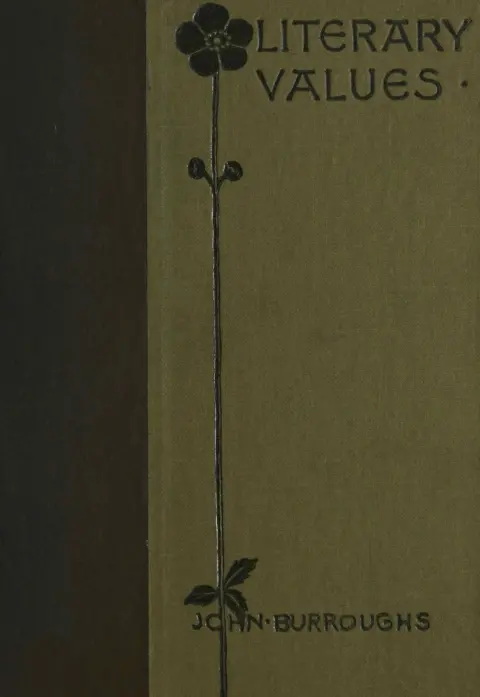
THE CLASSIC COLLECTION · 1902
"Literary Values, and Other Papers" by John Burroughs is a collection of literary essays written in the early 20th century. The essays delve into the essence of literary value, the significance of style, and the intrinsic connection between a writer's personality and their work. The compilation reflects Burroughs' exploration of what makes literature endure through time and the qualities inherent in great writing. At the start of the book, the author contemplates the fate of literary figures as time passes, questioning how their relevance will fade or endure long after their deaths. He reflects on the importance of sincerity, simplicity, and vital qualities in writing that contribute to timeless literary value. Burroughs emphasizes that the essence of an author's voice and personal character is critical to the impact of their work. Through this approach, he sets the stage for an in-depth discussion of the ways in which literary style and personal authenticity shape literature's lasting legacy.
Introduction adapted from the source catalogue; source summaries may be automatically generated.
Free to read · English · 68,695 words · No account needed
MAKE TIME FOR A GOOD BOOK
On by default. Untick to stop anonymous reading totals. Each page counts after 10 seconds in view. How this works.
Anonymous counting is on unless you have switched it off.
Jonson, Ben, a bit of his prose, 26.
Keats, John, 11;
his Ode to a Nightingale, 75.
Kidd, Benjamin, his Social Evolution, 9.
Landor, Walter Savage, 93;
lacking in moral stress and fervor, 124; 132, 184.
Lemaître, Jules, 87.
Life, the earlier years of one’s, 231-243.
Lincoln, Abraham, his Gettysburg speech, 5;
an elemental man, 6;
his greatness of the democratic type, 113, 114;
his commonness, 115, 116.
Literature, the enduring in, 1-3, 216-231;
values in, 4-9;
definitions of, 9-13;
style in, 14, 52-79;
truth in, 14, 15;
morality and art in, 16;
art in, 17-20;
the teaching of, 20-25;
good and bad taste in, 26, 116-118;
democracy in, 109-115;
the doctrinaire in, 118-126;
art vs. didacticism in, 135-142, 144-150;
an end in and of itself, 140;
immorality in, 148-150;
effect of democracy upon, 152-156;
humanitarianism in, 156;
the mechanical and industrial age in, 157-160;
lucidity in, 180-182;
appreciation in the reading of, 182-185;
necessity of something more than style in, 186-190;
Nature in, 202-204;
suggestiveness in, 205-215.
Longfellow, Henry Wadsworth, 137, 185, 230;
his sonnet on Sumner, 230.
Lowell, James Russell, 105, 108, 122, 124;
on scholarship, 186;
quotation from, 186.
Lucidity, 180-182.
Macaulay, Thomas Babington, Lord, on Miss Burney, 62; 65, 79, 96,
131, 166;
quotation from, 62.
Maeterlinck, Maurice, his Life of the Bee, 211.
Martineau, Harriet, 103.
Meredith, George, 69;
his obscurity of expression, 180-182;
quotations from, 180, 181.
Metaphors, 28-31.
Mill, John Stuart, a suggestive sentence of, 210.
Milton, John, 13, 74;
his Lycidas, 103;
his Paradise Lost, 105;
begotten of the classical tradition, 111; 115;
makes no personal appeal, 183, 184.
Montaigne, Michel Eyquem de, 16, 58, 59, 217, 218;
quotation from, 59.
Moody, William Vaughn, 156;
his poem on the steam engine, 158, 159;
quotation from, 158, 159.
Morley, John, his definition of literature, 10.
Nature, Thoreau’s interest in, 201, 202;
in literature, 203, 204.
Newman, John Henry, 119.
Nisard, Jean Marie Napoléon Désiré, 104.
Obscurity of expression, 180-182.
Occupation, essential to happiness, 249-256.
Oriole, 174.
Owl, white, 175.
Parkman, Francis, his Oregon Trail, 226.
Parnell, Thomas, 220.
Past, the, our feeling for, 232-243, 246.
Pater, Walter, 69, 70;
a mere stylist, 189.
Peacock, 176.
Poe, Edgar Allan, 7, 11;
his art, 17-19;
his Raven, 17, 19, 138;
his Bells, 19, 138;
the universality of his art, 138;
his Annabel Lee, 138;
his appeal only to the sense of artistic forms and verbal melody,
184, 185;
quotation from, 11.
Poetry, relation of eloquence to, 161-167;
the elusive in, 204;
more suggestive than prose, 213.
See also Literature.
Pope, Alexander, 80, 203;
on friends, 240;
quotation from, 240.
Protestantism, 125, 126.
Quintilian, 43.
Rabelais, François, 132.
Raleigh, Prof. Walter, on the business of letters, 62;
his style, 63, 64; 65;
quotations from, 62-65.
Rat, water, 177.
Reading, understanding and appreciation in, 182-185;
the re-reading of books, 216-231.
Renan, Ernest, 32, 50;
his object as a writer, 65; 119;
his Future of Science, 161;
on eloquence and poetry, 161; 190;
quotations from, 50, 161, 190.
Robertson, John M., his Essays toward a Critical Method, 109.
Rousseau, Jean Jacques, 55, 56.
Ruskin, John, 5, 79, 90, 119, 123, 144, 145, 147, 163;
quotations from, 144, 147.
Sainte-Beuve, Charles Augustin, 6;
on Montaigne’s metaphors, 16;
on Rousseau’s Confessions, 55; 73, 92-96;
as a critic, 97, 112, 115, 118, 132, 145, 146; 102, 104, 128, 132;
on moral censure in criticism, 145, 146;
quotations from, 16, 55, 145, 146.
Saturday Review, The, 4.
Schérer, Edmond Henri Adolphe, 80, 94, 96, 105, 132.
Schiller, his Robbers, 138.
Schopenhauer, Arthur, his use of analogy, 42, 43;
his definition of style, 60; 73, 234, 243;
quotations from, 60, 73, 234.
Your reading position is saved on this browser. Take it to another device with a library code. Reading pages adapt to text, rather than matching a printed edition.
John Burroughs
John Burroughs
John Burroughs
John Burroughs
BEHIND THE BOOK
This eBook is for the use of anyone anywhere in the United States and most other parts of the world at no cost and with almost no restrictions whatsoever. You may copy it, give it away or re-use it under the terms of the Project Gutenberg License included with this eBook or online at www.gutenberg.org. If you are not located in the United States, you will have to check the laws of the country where you are located before using this eBook. Read the source licence.
The original source file, including credits and licence, is retained by this library. Request an original-format copy at no charge. Please include the book title and Project Gutenberg identifier #74104.
KEEP YOUR CURIOSITY GOING

David Patterson (Spirit) Hatch

David Patterson (Spirit) Hatch

David Patterson (Spirit) Hatch
Cécile Tormay

Moritz Busch
John L. Ransom