
Life of Edwin Forrest, the American Tragedian. Volume 1 (of 2)
William Rounseville Alger & Horatio, Jr. Alger

THE CLASSIC COLLECTION · 1877
"Life of Edwin Forrest, the American Tragedian. Volume 2 (of 2)" by William Rounseville Alger is a historical account written in the late 19th century. The book explores the life and career of Edwin Forrest, one of America's most prominent actors in the 19th century, noting his impact on the dramatic arts as well as the public's and critics' reception of his performances. It delves into his struggles with criticism and the evolution of public perception, highlighting both the acclaim he received and the scorn from detractors. The beginning of this volume presents a rich discussion on the nature of newspaper criticism during Edwin Forrest's career, illustrating how different factions of critics regarded him. It outlines the complexities of dramatic art and the difficulties actors face in responding to public scrutiny. Additionally, it emphasizes Forrest's careful reading of critiques and his aspirations to improve his craft, as well as the influence of personal animosities and societal expectations on the perception of his work. The opening sets the stage for a nuanced exploration of Forrest's challenges and achievements in the theatrical world.
Introduction adapted from the source catalogue; source summaries may be automatically generated.
Free to read · English · 168,377 words · No account needed
MAKE TIME FOR A GOOD BOOK
On by default. Untick to stop anonymous reading totals. Each page counts after 10 seconds in view. How this works.
Anonymous counting is on unless you have switched it off.
‘So, with one chained friend, perhaps a jealous foe, The dreariest and the longest journey go.’
“That there is any necessity to insure, by any means, a woman’s happiness, is a proposition you do not seem to have entertained while writing your letter of May 24th; but perhaps we are supposed to be happy under all circumstances.”
There is for man and woman on this earth one supreme happiness, one contenting fulfilment of destiny, whether there are more or not. It is a pure, calm, holy, and impassioned love, joining them in one life, filling both soul and body with a peaceful and rapturous harmony, glorifying the scenery of nature by its reflection, making the current of daily experience a stream of prophetic bliss, revealing to them authentic glimpses of God in each other, and opening eternity to their faith with mystic suggestions of worlds bygone and worlds to come, lives already led and forgotten and lives yet to be welcomed. This is the one absolute blessing, without whose appeasing and sufficing seal the human creature pines for he knows not what, and dies unsatisfied, no matter how much else is granted him. Any one to whom this divine fortune falls, and whose conscience, instead of wearing it proudly as a crown of glory in the sight of God, shrinks with it guiltily before the sight of men, is a contemptible coward, unworthy of the boon, and sure to forfeit it. As the most original thinker, the boldest diver into the mysteries of our nature, America has produced, expresses it,—
“The sense of the world is short,
Long and various the report,
To love and be beloved.
Men and gods have not outlearned it,
And how oft soe’er they’ve turned it,
’Tis not to be improved.”
Thousands, enslaved by the conventional, distracted by the external, absorbed in the trivial, may be ignorant of the incomparable importance of the truth here expressed, care nothing about it, and give themselves up to selfish ambitions and contemptible materialities. This must be so, since the blind cannot see; and even the seeing eye sees in an object only what it brings the means of seeing; and the marvellous heights and depths of experience are fatally locked from the inexperienced. Nevertheless, the truth above affirmed survives its overlooking by the unworthy, and every man and woman gifted with profound insight and sensibility knows it and feels it beyond everything else. The great multitudes of society also have at least dim glimpses of it, strange presentiments of it, blind intuitions awakening a strong and incessant curiosity in that direction. This is the secret cause of the universal interest felt in the subject of love and in every instance of its transcendent experience or exemplification. One of the most central functions of art—whether written romance, painting, sculpture, music, or the drama—is directly or indirectly to celebrate this truth by giving it concentrated and relieved expression, and thus inciting the contemplators to aspire after their own highest bliss. To those whose emotions are rich and quick enough to interpret them, what are the finest songs of the composers but sighings for the fulfilment of affection, or raptures in its fruition, or wailings over its loss? With what unrivalled power Rubens, in his fearful pictures of love and war, has uncovered to the competent spectator the horrible tragedy all through history of the intimate association of lust and murder, libidinous passion and death! And pre-eminently the stage, in all its forms,—tragic, comic, and operatic,—has ever found, and always will find, its most fascinating employment and crowning mission in the open display—published to those who have the keys to read it, veiled from all who have not—of the varied bewitchments, evasions, agonies, and ecstasies of the passion of love between the sexes. That is the most effective actor or actress whose gamut of emotional being and experience, real and ideal, is greatest, and whose training gives completest command of the apparatus of expression, making the organism a living series of revelations, setting before the audience in visible play, in the most precise and intense manner, the working of love, in all its kinds and degrees, through the language of its occult signals. The competent actor shows to the competent gazer the exact rank and quality of the love actuating him by the adjustment of his behavior to it,—every look and tone, every changing rate and quality in the rhythm of his motions, every part of his body which leads or dominates in his bearing, whether head, shoulder, chest, elbow, hand, abdomen, hip, knee, or foot, having its determinate significance. Thus people are taught to discern grades of character through styles of manners, inspired to admire the noble and loathe the base at the same time that they are deepened in their own desires for the divine prizes of beauty and joy.
Your reading position is saved on this browser. Take it to another device with a library code. Reading pages adapt to text, rather than matching a printed edition.
William Rounseville Alger & Horatio, Jr. Alger

Horatio, Jr. Alger

Horatio, Jr. Alger
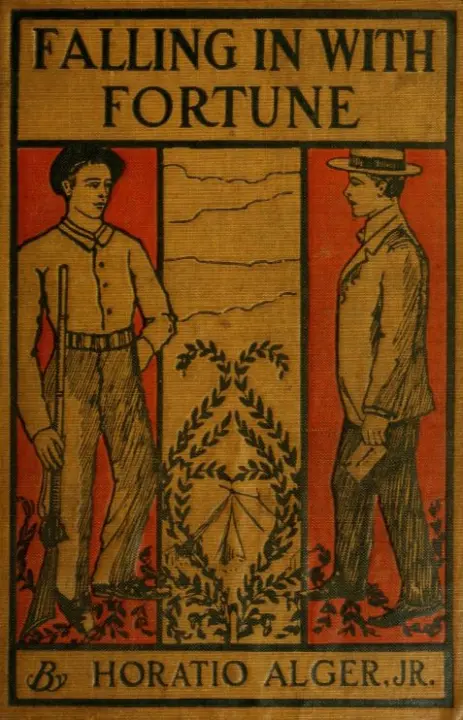
Horatio, Jr. Alger & Edward Stratemeyer
BEHIND THE BOOK
This eBook is for the use of anyone anywhere in the United States and most other parts of the world at no cost and with almost no restrictions whatsoever. You may copy it, give it away or re-use it under the terms of the Project Gutenberg License included with this eBook or online at www.gutenberg.org. If you are not located in the United States, you will have to check the laws of the country where you are located before using this eBook. Read the source licence.
The original source file, including credits and licence, is retained by this library. Request an original-format copy at no charge. Please include the book title and Project Gutenberg identifier #61470.
KEEP YOUR CURIOSITY GOING
Maurice Baring
W. B. (William Butler) Yeats
Edward Martyn

John Brougham & Charlotte Brontë
Marguerite Merington
Leonid Andreyev