
Life of Edwin Forrest, the American Tragedian. Volume 1 (of 2)
William Rounseville Alger & Horatio, Jr. Alger

THE CLASSIC COLLECTION · 1877
"Life of Edwin Forrest, the American Tragedian. Volume 2 (of 2)" by William Rounseville Alger is a historical account written in the late 19th century. The book explores the life and career of Edwin Forrest, one of America's most prominent actors in the 19th century, noting his impact on the dramatic arts as well as the public's and critics' reception of his performances. It delves into his struggles with criticism and the evolution of public perception, highlighting both the acclaim he received and the scorn from detractors. The beginning of this volume presents a rich discussion on the nature of newspaper criticism during Edwin Forrest's career, illustrating how different factions of critics regarded him. It outlines the complexities of dramatic art and the difficulties actors face in responding to public scrutiny. Additionally, it emphasizes Forrest's careful reading of critiques and his aspirations to improve his craft, as well as the influence of personal animosities and societal expectations on the perception of his work. The opening sets the stage for a nuanced exploration of Forrest's challenges and achievements in the theatrical world.
Introduction adapted from the source catalogue; source summaries may be automatically generated.
Free to read · English · 168,377 words · No account needed
MAKE TIME FOR A GOOD BOOK
On by default. Untick to stop anonymous reading totals. Each page counts after 10 seconds in view. How this works.
Anonymous counting is on unless you have switched it off.
“Probably the public does not quite yet appreciate either the value of its opportunity or the importance of improving it. Two facts, therefore, ought to be strongly stated: one, that Mr. Forrest’s personation of Lear is an extraordinary work of art; the other, that, in the natural order of things, it must soon pass forever away from the stage. Those who see it now will enjoy a luxury and a benefit. Those who miss seeing it now will sow the seed of a possible future regret. We have not in times past been accustomed to extol, without considerable qualification, the acting of Mr. Forrest. This was natural, and it was right. An unpleasant physical element—the substitution of muscle for brain and of force for feeling—has usually tainted his performances. That element has been substantially discarded from his Lear. We have seen him play the part when he was no more than a strong, resolute, robustious man in a state of inconsequent delirium. The form of the work, of course, was always definite. Strength of purpose in Mr. Forrest’s acting always went hand in hand with strength of person. He was never vague. He knew his intent, and he was absolutely master of the means that were needful to fulfil it. Precision, directness, culminating movement, and physical magnetism were his weapons; and he used them with a firm hand. Self-distrust never depressed him. Vacillation never defeated his purpose. It was the triumph of enormous and overwhelming individuality. Lear could not be seen, because Mr. Forrest stood before him and eclipsed him.
“All that is greatly modified. Time and suffering seem to have done their work. It is no secret that Mr. Forrest has passed through a great deal of trouble. It is no secret that he is an old man. We do not touch upon these facts in a spirit of heartlessness or flippancy. But what we wish to indicate is that natural causes have wrought a remarkable change in Mr. Forrest’s acting, judged, as we now have the opportunity of judging it, by his thrilling delineation of the tremendous agonies and the ineffably pathetic madness of Shakspeare’s Lear. In form his performance is neither more nor less distinct than it was of old. Almost every condition of symmetry is satisfied in this respect. The port is kingly; the movement is grand; the transitions are natural; the delivery is resonant; the intellect is potential; the manifestations of madness are accurate; the method is precise. But, beyond all this, there is now a spiritual quality such as we have not seen before in this extremely familiar work. Here and there, indeed, the actor uses his ancient snort, or mouths a line for the sake of certain words that intoxicate his imagination by their sound and movement. Here and there, also, he becomes suddenly and inexplicably prosaic in his rendering of meanings. But these defects are slight in contrast with the numberless beauties that surround and overshadow them. We have paid to this personation the involuntary and sincere tribute of tears. We cannot, and would not desire to, withhold from it the merited recognition of critical praise. Description it can scarcely be said to require. Were we to describe it in detail, however, we should dwell, with some prolixity of remark, upon the altitude of imaginative abstraction which Mr. Forrest attains in the mad scenes. Shakspeare’s Lear is a person with the most tremulously tender heart and the most delicately sensitive and poetical mind possible to mortal man, and his true grandeur appears in his overthrow, which is pathetic for that reason. The shattered fragments of the column reveal its past magnificence. No man can play Lear in these scenes so as to satisfy, even approximately, the ideal inspired by Shakspeare’s text unless he knows, whether by intuition or by experience, the vanity, the mutability, the hollowness of this world. The deepest deep of philosophy is sounded here, and the loftiest height of pathos is attained. It is high praise to say that Mr. Forrest, whether consciously or unconsciously, interprets these portions of the tragedy in such a manner as frequently to enthrall the imagination and melt the heart. The miserable desolation of a noble and tender nature scathed and blasted by physical decay and by unnatural cruelty looks out of his eyes and speaks in his voice. This may be only the successful simulation of practised art; but, whatever it be, its power and beauty and emotional influence are signal and irresistible.”
Your reading position is saved on this browser. Take it to another device with a library code. Reading pages adapt to text, rather than matching a printed edition.
William Rounseville Alger & Horatio, Jr. Alger

Horatio, Jr. Alger

Horatio, Jr. Alger
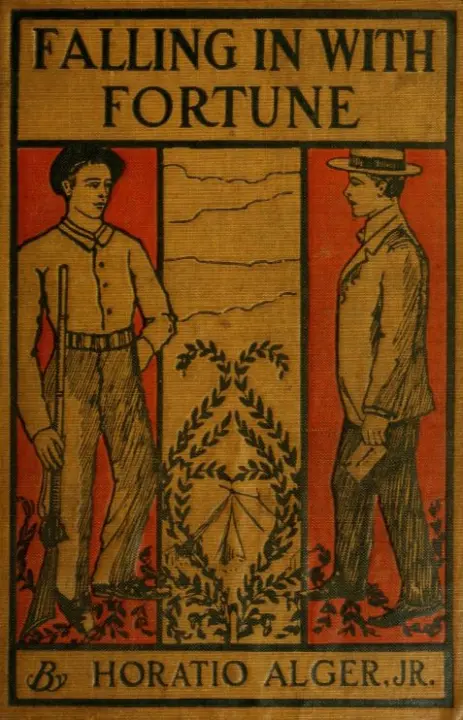
Horatio, Jr. Alger & Edward Stratemeyer
BEHIND THE BOOK
This eBook is for the use of anyone anywhere in the United States and most other parts of the world at no cost and with almost no restrictions whatsoever. You may copy it, give it away or re-use it under the terms of the Project Gutenberg License included with this eBook or online at www.gutenberg.org. If you are not located in the United States, you will have to check the laws of the country where you are located before using this eBook. Read the source licence.
The original source file, including credits and licence, is retained by this library. Request an original-format copy at no charge. Please include the book title and Project Gutenberg identifier #61470.
KEEP YOUR CURIOSITY GOING
Maurice Baring
W. B. (William Butler) Yeats
Edward Martyn

John Brougham & Charlotte Brontë
Marguerite Merington
Leonid Andreyev