
Life of Edwin Forrest, the American Tragedian. Volume 1 (of 2)
William Rounseville Alger & Horatio, Jr. Alger

THE CLASSIC COLLECTION · 1877
"Life of Edwin Forrest, the American Tragedian. Volume 2 (of 2)" by William Rounseville Alger is a historical account written in the late 19th century. The book explores the life and career of Edwin Forrest, one of America's most prominent actors in the 19th century, noting his impact on the dramatic arts as well as the public's and critics' reception of his performances. It delves into his struggles with criticism and the evolution of public perception, highlighting both the acclaim he received and the scorn from detractors. The beginning of this volume presents a rich discussion on the nature of newspaper criticism during Edwin Forrest's career, illustrating how different factions of critics regarded him. It outlines the complexities of dramatic art and the difficulties actors face in responding to public scrutiny. Additionally, it emphasizes Forrest's careful reading of critiques and his aspirations to improve his craft, as well as the influence of personal animosities and societal expectations on the perception of his work. The opening sets the stage for a nuanced exploration of Forrest's challenges and achievements in the theatrical world.
Introduction adapted from the source catalogue; source summaries may be automatically generated.
Free to read · English · 168,377 words · No account needed
MAKE TIME FOR A GOOD BOOK
On by default. Untick to stop anonymous reading totals. Each page counts after 10 seconds in view. How this works.
Anonymous counting is on unless you have switched it off.
When told that Birnam wood was moving, the sense of supernatural power turned against him. For a moment he stood, a solid dismay. Then he staggered as if his brain had received a blow from the words which smote to its reeling centre. So, when Macduff exposed to him the paltering of the fiends in a double sense, his boasted charm seemed visibly to melt from him, and he shrank back as though struck by a withering spell. His towering form contracted into itself, his knees shook, and his sword half dropped from his grasp. But the next instant, goaded by the taunts of his adversary, he rallied on his native heroism, braced himself for the struggle as if he resolved to rise superior to fate whether natural or demoniac, and fell at last like a ruined king, with all his blazing regalia on. The performance left on the mind of the appreciative beholder, stamped in terrible impress, the eternal moral of temptation and crime culminating in fatal success and followed by the inevitable swoop of retribution:
“Naught’s had, all’s spent,
Where our desire is got without content.”
Quite early in his histrionic career Forrest wrote to his friend Leggett, “My notions of the character of Richard the Third do not accord with those of the players I have seen personate it. They have not made him gay enough in the earlier scenes, but too sullen, frowning, and obvious a villain. He was an exulting and dashing, not a moody, villain. Success followed his schemes too rapidly and gave him too much elation to make appropriate the haggard and penthouse aspect he is usually made to wear. Contempt for mankind forms a stronger feature of his character than hatred; and he has a sort of reckless jollity, a joyous audacity, which has not been made conspicuous enough.” In general accord with this conception he afterwards elaborated his portraiture of the deformed tyrant, the savage humorist, the murderous and brilliant villain. He set aside the stereotyped idea of Richard as a strutting, ranting, gloomy plotter, forever cynical and sarcastic and parading his crimes. Not excluding these traits, Forrest subordinated them to his cunning hypocrisy, his gleaming intellectuality, his jocose irony, his exulting self-complacence and fiendish sportiveness. He represented him not only as ravenously ambitious, but also full of a subtle pride and vanity which delighted him with the constant display of his mental superiority to those about him. Above all he was shown to be possessed of a laughing devil, a witty and sardonic genius, which amused itself with playing on the faculties of the weaklings he wheedled, scoffing at what they thought holy, and bluntly utilizing the most sacred things for the most selfish ends. There can be no doubt that in removing the conventional stage Richard with this more dashing and versatile one Forrest restored the genuine conception of Shakspeare, who has painted him as rattling not brooding, exuberantly complacent even under his own dispraises, an endlessly inventive and triumphant hypocrite, master of a gorgeous eloquence whose splendid phrases adorn the ugliness of his schemes almost out of sight. His mental nature devours his moral nature, and, swallowing remorse, leaves him free to be gay. The character thus portrayed was hard, cruel, deceitful, mocking,—less melodramatically fiendish and electrical than the Richard of Kean, but more true to nature. The picture was a consistent one. The deformity of the man, reacting on his matchless intellect and courage and sensual passion, had made him a bitter cynic. But his genius was too rich to stagnate into an envenomed gloom of misanthropy. Its exuberance broke out in aspiring schemes and crimes gilded with philosophy, hypocrisy, laughter, and irony. Moving alone in a murky atmosphere of sin and sensuality, he knew himself to the bottom of his soul, and read everybody else through and through. He believed in no one, and scoffed at truth, because he was himself without conscience. But his insight and his solid understanding and glittering wit, making of everything a foil to display his self- satisfied powers, hid the degradation of his wickedness from his own eyes, and sometimes almost excused it in the eyes of others. Yet, so wondrous was the moral genius of Shakspeare, the devilish chuckling with which he hugged the notion of his own superiority in his exemption from the standards that rule other men, instead of infecting, shocked and warned and repelled the auditor:
Your reading position is saved on this browser. Take it to another device with a library code. Reading pages adapt to text, rather than matching a printed edition.
William Rounseville Alger & Horatio, Jr. Alger

Horatio, Jr. Alger

Horatio, Jr. Alger
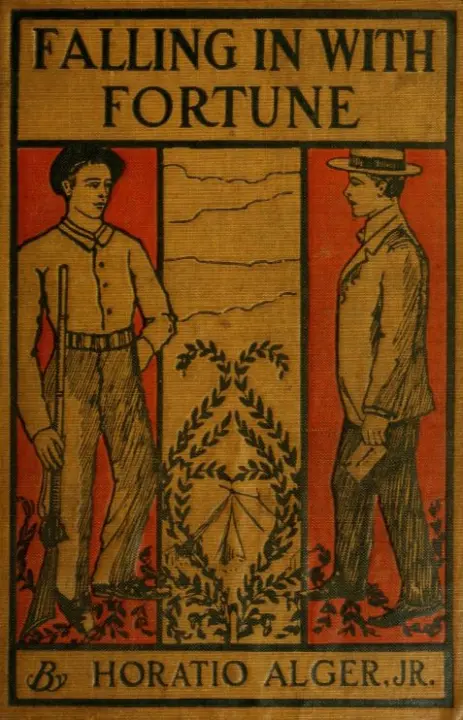
Horatio, Jr. Alger & Edward Stratemeyer
BEHIND THE BOOK
This eBook is for the use of anyone anywhere in the United States and most other parts of the world at no cost and with almost no restrictions whatsoever. You may copy it, give it away or re-use it under the terms of the Project Gutenberg License included with this eBook or online at www.gutenberg.org. If you are not located in the United States, you will have to check the laws of the country where you are located before using this eBook. Read the source licence.
The original source file, including credits and licence, is retained by this library. Request an original-format copy at no charge. Please include the book title and Project Gutenberg identifier #61470.
KEEP YOUR CURIOSITY GOING
Maurice Baring
W. B. (William Butler) Yeats
Edward Martyn

John Brougham & Charlotte Brontë
Marguerite Merington
Leonid Andreyev