
Life of Edwin Forrest, the American Tragedian. Volume 1 (of 2)
William Rounseville Alger & Horatio, Jr. Alger

THE CLASSIC COLLECTION · 1877
"Life of Edwin Forrest, the American Tragedian. Volume 2 (of 2)" by William Rounseville Alger is a historical account written in the late 19th century. The book explores the life and career of Edwin Forrest, one of America's most prominent actors in the 19th century, noting his impact on the dramatic arts as well as the public's and critics' reception of his performances. It delves into his struggles with criticism and the evolution of public perception, highlighting both the acclaim he received and the scorn from detractors. The beginning of this volume presents a rich discussion on the nature of newspaper criticism during Edwin Forrest's career, illustrating how different factions of critics regarded him. It outlines the complexities of dramatic art and the difficulties actors face in responding to public scrutiny. Additionally, it emphasizes Forrest's careful reading of critiques and his aspirations to improve his craft, as well as the influence of personal animosities and societal expectations on the perception of his work. The opening sets the stage for a nuanced exploration of Forrest's challenges and achievements in the theatrical world.
Introduction adapted from the source catalogue; source summaries may be automatically generated.
Free to read · English · 168,377 words · No account needed
MAKE TIME FOR A GOOD BOOK
On by default. Untick to stop anonymous reading totals. Each page counts after 10 seconds in view. How this works.
Anonymous counting is on unless you have switched it off.
The universal interest felt in the subject of friendship—the strange fascination the story of any ardent and noble instance of it has for all readers,—the intense longing for such an experience which exists explicit or latent in the centre of every heart in spite of all the corrupting and hardening influences of the world—is a pathetic signal of the mystery of our nature and a profound prophecy of our destiny. It means that no man is sufficient unto himself, but must find a complement in another. It means that man was not made to be alone, but must supplement himself with his fellows. The final significance of friendship—whereof love itself is but a specialized and intensified variety—is an almost unfathomable deep, but it would appear to be this. Every man in the structure and forces of his physical organism is an epitome of all Nature, a living mirror of the material universe; and in the faculties and desires of his soul he is a revelation of the Creator, a conscious image of God. As the ancients said, man is a little universe in the great universe,—microcosmos in macrocosmo. But every one of these divine microcosms has a central indestructible originality differencing it from all the rest. This is the eternal essence or monad of its personality, which reflects in its own peculiar forms and colors the substances and lights and shades of the whole. Thence arises that inexhaustible charm of idiosyncrasy, that everlasting play and shimmer of individual qualities, which constitutes the lure for all pursuit, the zest wherewith all life antidotes the monotonous bane of sameness and death. Now the secret of friendship becomes clear in the light of these statements. First, it is the destiny of every man eternally to epitomize in his own being the universe of matter and mind,—in other words, to be an intelligent focal point in the surrounding infinitude of nature and the interior infinitude of God. Secondly, he is to recognize such an epitome embodied and endlessly varied in the endless variety of other men, all of whom are perfectly distinguishable from one another by unnumbered peculiarities, every shape and tinge of their experience determined by their personal moulds and tints. Thirdly, the entire life of every person consists, in the last analysis, of a mutual communication between his selfhood and that surrounding Whole made up of everything which is not himself,—an interchange of action and reaction between his infinitely concentrated soul and his infinitely expanded environment. Fourthly, when two men, two of these intellectual and sentient microcosms, meet, so adjusted as mutually to reflect each other with all their contents and possibilities in sympathetic communion, their life is perfected, their destiny is fulfilled, since the infinite Unity of Being is revealed in each made piquant with the bewitching relish of foreign individuality, and nothing more is required, save immortality of career in boundless theatre of space, to round in the drama with sempiternal adventures and surprises, as, beneath the sleepless eye of the One, the Many hide and peep beneath their incarnate masks in life after life and world beyond world. Thus the highest idea of the experience of friendship is that it is God glimmering in and out of the souls of the friends in revelation of their destiny,—as Plato would say, the perpetually varied perception of the SAME under the provocative and delightful disguise of the OTHER. And every lower idea of it which has any truth is in connection with this and points up to it,—from the revellers who entwine their cups and attune their glee, the soldiers who stand side by side in battle, and the politicians who vote the same ballot, to the thinkers who see the same truths and the martyrs who die in allegiance to the same sentiment. Everywhere, on all its ranges, friendship means communion of lives, sharing of thought and feeling, co-operative fellowship of personalities, the reflection of one consciousness in another. Those who meet only at the bottom of the scale in sensual mirth should be able sometimes, at least by the aid of a literary telescope, to see those who commingle at its top in immortal faith and aspiration.
Your reading position is saved on this browser. Take it to another device with a library code. Reading pages adapt to text, rather than matching a printed edition.
William Rounseville Alger & Horatio, Jr. Alger

Horatio, Jr. Alger

Horatio, Jr. Alger
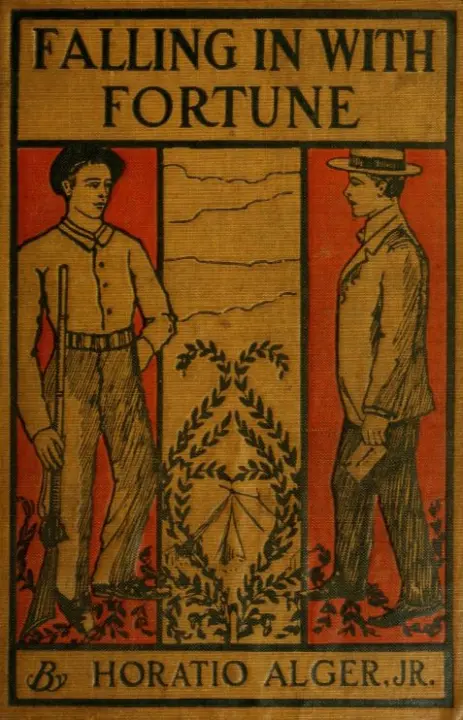
Horatio, Jr. Alger & Edward Stratemeyer
BEHIND THE BOOK
This eBook is for the use of anyone anywhere in the United States and most other parts of the world at no cost and with almost no restrictions whatsoever. You may copy it, give it away or re-use it under the terms of the Project Gutenberg License included with this eBook or online at www.gutenberg.org. If you are not located in the United States, you will have to check the laws of the country where you are located before using this eBook. Read the source licence.
The original source file, including credits and licence, is retained by this library. Request an original-format copy at no charge. Please include the book title and Project Gutenberg identifier #61470.
KEEP YOUR CURIOSITY GOING
Maurice Baring
W. B. (William Butler) Yeats
Edward Martyn

John Brougham & Charlotte Brontë
Marguerite Merington
Leonid Andreyev