
Life of Edwin Forrest, the American Tragedian. Volume 1 (of 2)
William Rounseville Alger & Horatio, Jr. Alger

THE CLASSIC COLLECTION · 1877
"Life of Edwin Forrest, the American Tragedian. Volume 2 (of 2)" by William Rounseville Alger is a historical account written in the late 19th century. The book explores the life and career of Edwin Forrest, one of America's most prominent actors in the 19th century, noting his impact on the dramatic arts as well as the public's and critics' reception of his performances. It delves into his struggles with criticism and the evolution of public perception, highlighting both the acclaim he received and the scorn from detractors. The beginning of this volume presents a rich discussion on the nature of newspaper criticism during Edwin Forrest's career, illustrating how different factions of critics regarded him. It outlines the complexities of dramatic art and the difficulties actors face in responding to public scrutiny. Additionally, it emphasizes Forrest's careful reading of critiques and his aspirations to improve his craft, as well as the influence of personal animosities and societal expectations on the perception of his work. The opening sets the stage for a nuanced exploration of Forrest's challenges and achievements in the theatrical world.
Introduction adapted from the source catalogue; source summaries may be automatically generated.
Free to read · English · 168,377 words · No account needed
MAKE TIME FOR A GOOD BOOK
On by default. Untick to stop anonymous reading totals. Each page counts after 10 seconds in view. How this works.
Anonymous counting is on unless you have switched it off.
The one fault in the constitution of Forrest was the gouty diathesis he inherited from his grandfather on the maternal side. This rheumatic inflammability—a contracted and congested state of some part of the capillary circulation and the associated sensory nerves accumulating force to be discharged in hot explosions of twinging agony—might have been cured by an æsthetic gymnastic adapted to free and harmonize all the circulations,—the breath, the blood, the nerve-force. But, unfortunately, his heavy and violent gymnastic was fitted to produce rigidity rather than suppleness, and thus to cause breaks in the nervous flow instead of an equable uniformity. This was the secret of his painful attacks and of his otherwise unexpectedly early death. There are three natures in man, the vital nature, the mental nature, the moral nature. These natures express and reveal themselves in three kinds or directions of movement. The vital nature betrays or asserts itself in eccentric movement, movement from a centre; the mental, in acentric movement, movement towards a centre; the moral, in concentric movement, movement around a centre. Outward lines of motion express vital activity, inward lines express mental activity, curved lines, which are a blending of the two other, express moral or affectional activity. This physiological philosophy is the basis of all sound and safe gymnastic. The essential evil and danger of the heavy and violent gymnastic of the circus and the ring is that it consists so largely of the outward and inward lines which express the individual will or vital energy and mental purpose. Each of these tends exclusively to strengthen the nature which it exercises. Straight hitting, pushing, lifting, jumping, in their two directions of exertion, tend to expand and to contract. That is vital, and this is mental. Both are expensive in their drain on the volition, but one tends to enlarge the physical organism, the other to shrink it and to produce strictures at every weak point. The former gives a heavy, obese development; the latter an irritable, irregular, at once bulgy and constricted development. The vice of the vital nature dominating unchecked is gluttony, and its end, idiocy. The vice of the mental nature is avarice, both corporal and spiritual, and its end, madness. The vice of the moral nature, when it becomes diseased, is fanaticism; and its subject becomes, if the vital element in it controls, an ecstatic devotee; if the mental element controls, a reckless proselyter. Now, a true system of gymnastic will perfect all the three natures of man by not allowing the vital or the mental to domineer or its special motions to preponderate, but blending them in those rotatory elliptical or spiral movements which combine the generous expansion of the vital organs and the selfish concentration of the mental faculties in just proportion and thereby constitute the language of the moral nature. Rigid outward movements enlarge the bulk and strengthen sensuality. Rigid inward movements cramp the organism and break the unity and liberty of its circulations, leading to every variety of disease. But flowing musical movements justly blent of the other two movements, in which rhythm is observed, and the extensor muscles are used in preponderance over the contractile so as to neutralize the modern instinctive tendency to use the contractile more than the extensor,—movements in which the motor nerves are, for the same reason, used more than the sensory,—will economize the expenditure of force, soothe the sensibilities, and secure a balanced and harmonious development of the whole man in equal strength and grace. Such a system of exercise will remove every tendency to a monstrous force in one part and a dwarfed proportion in another. It will secure health and beauty in a rounded fulness equally removed from shrivelled meagreness and repulsive corpulence. It will make its practiser far more than a match for the huge athletes of the coarse school, as the man whose every limb is a whip is thrice more puissant and terrible than the man whose every limb is a club. The deepest secret of the final result of this æsthetic gymnastic is that it gives one the perfect possession of himself in the perfected unity of his organism, the connective tissue being so developed by the practice of a slow and rhythmical extensor action that it serves as an unbroken bed of solidarity for the whole muscular coating of the man. Nothing else can be so conducive as this to equilibrium, and consequently to longevity. When the unity of the connective tissue is broken by strictures at the articulations or elsewhere, the waves of motion or force ever beating through the webs of nerves are interrupted, stopped, or reflected by devitalized wrinkles which they cannot pass. Thence result the innumerable mischiefs of inflammation in the outer membrane and catarrh in the inner.
Your reading position is saved on this browser. Take it to another device with a library code. Reading pages adapt to text, rather than matching a printed edition.
William Rounseville Alger & Horatio, Jr. Alger

Horatio, Jr. Alger

Horatio, Jr. Alger
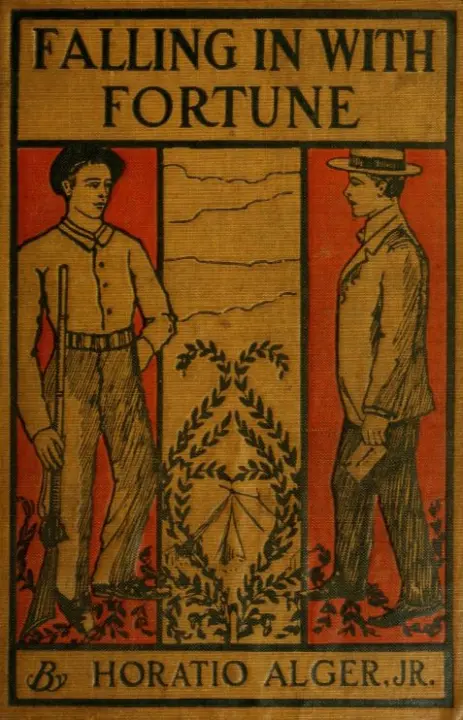
Horatio, Jr. Alger & Edward Stratemeyer
BEHIND THE BOOK
This eBook is for the use of anyone anywhere in the United States and most other parts of the world at no cost and with almost no restrictions whatsoever. You may copy it, give it away or re-use it under the terms of the Project Gutenberg License included with this eBook or online at www.gutenberg.org. If you are not located in the United States, you will have to check the laws of the country where you are located before using this eBook. Read the source licence.
The original source file, including credits and licence, is retained by this library. Request an original-format copy at no charge. Please include the book title and Project Gutenberg identifier #61470.
KEEP YOUR CURIOSITY GOING
Maurice Baring
W. B. (William Butler) Yeats
Edward Martyn

John Brougham & Charlotte Brontë
Marguerite Merington
Leonid Andreyev