
Life of Edwin Forrest, the American Tragedian. Volume 2 (of 2)
William Rounseville Alger & Horatio, Jr. Alger

THE CLASSIC COLLECTION · 1877
"Life of Edwin Forrest, the American Tragedian. Volume 1 (of 2)" by William Rounseville Alger is a biography written in the late 19th century. The book chronicles the life of Edwin Forrest, a prominent American actor, and provides insights into his contributions to the theater, his personality, and the influences that shaped his career. It seeks to not only narrate his experiences but also to explore the broader significance of his life within the narrative of American theater. The opening of the biography establishes the context for Edwin Forrest's life, highlighting his importance as a groundbreaking figure in American acting. Alger reflects on the motivations behind his work, emphasizing the value of detailing the life of someone who had a profound impact on the theatrical world. The initial chapters detail the background of Forrest's family, underscoring the virtues they instilled in him, and hint at the challenges he faced growing up in a struggling household. The author also discusses the societal prejudices against actors during Forrest's time, aiming to address misconceptions about the dramatic profession. Overall, the beginning sets a reflective and analytical tone, suggesting a deep exploration of Forrest's complex character and the tumultuous world of 19th-century American theater.
Introduction adapted from the source catalogue; source summaries may be automatically generated.
Free to read · English · 164,046 words · No account needed
MAKE TIME FOR A GOOD BOOK
On by default. Untick to stop anonymous reading totals. Each page counts after 10 seconds in view. How this works.
Anonymous counting is on unless you have switched it off.
As children grow older and become school-boys and school-girls, this faculty and impulse do not cease to act, but, developed still further, instead of imparting fancied life and action to inanimate toys, lead them to imitative performances of their own, causing them to group themselves together for the representation of games, and of the historic scenes, social events, or fictitious stories which have most impressed and pleased their imaginations.
The point of interest demanding attention at this stage of our inquiry is how to discriminate clearly between the drama of the savage and the drama of the child. The dramatization of the savage is mimetic, a putting on from without of the disguise, the postures, sounds, motions, of the animal he impersonates. He imitates the outer signs of the animal; and these often in return produce in him the corresponding states of consciousness. But the dramatization of the child is creative, a projection from within of his own thoughts and emotions into the counterfeit toys he personifies, and a consequent heightening of his own sense of life by an imagination of its being imparted and sympathetically taken up and shared. With the barbarian the primary movement of action is from without inward; with the child it is from within outward. There it is the interpretative assumption by the actor of the signs of states in another; here it is the direct transference by sympathetic imagination of the states of the actor to another. That is the raw drama of the senses, this the initial drama of the soul.
We must pause here, before passing to the next head, to make a brief exposition of another department and application of the dramatic power of man, a department intermediate between the examples already given and those which are to come. Its peculiarity is that it combines in one, with certain original features of its own, the barbaric and the childish drama. The creation of Fables is the strongest delight of the dramatizing literary faculty in its first movements. Its workings are to be traced in the ingenuous oral treasures preserved among tribes who have no written language, as well as in the most beloved vernacular writings current among the populace in civilized countries. Fables are short compositions designed to teach moral truths, or to impress moral truisms, by representing beasts, birds, reptiles, insects, trees, flowers, or other objects, as endowed with the faculties of men, retaining their own forms but acting and talking as men, exemplifying the virtues and vices of men in characteristic deeds, followed by their proper consequences. In the degrading barbarian drama the actors admit into themselves the lower creatures whom they represent, putting on the skins, movements, cries, of the crocodiles, hyenas, or boa-constrictors the ideas of whom they take into their brains. In the naïve child drama the little performers project the ideas of themselves into the dolls and toys they personify and move. But in the fable drama these two processes are joined, with a mere inversion of the subjects of the first; for in fables the actors, in place of being, as in the plays of savages, the assumed souls of animals and the disguised bodies of men, are the disguised souls of men in the assumed forms and costumes of animals. The one is an actual representation of animals by men for free sport; the other is an imaginary representation of men by animals for the inculcation of lessons, as, for example, in the well-known instance of the Wolf and the Lamb. The author of a fable puts his own human nature into the humbler creatures whom he dramatizes, with a deliberate conscious thought, a creative exercise of the reflective faculty at the second remove, quite unlike the instinctive and half-believing action of the child who straddles a stick pretending that it is a horse. He has a clear didactic purpose in addition to the sportive impulse of fancy. This picturing of human nature and its experiences in the living framework of the lower world yields the keenest pleasure to all who have not outgrown it; and no one ought ever to outgrow it. He outgrows it only by the gradual hardening of his heart and fancy, the immovable stolidity of his faculties in their fixed ruts and crusts. It is the favorite literature of the childhood of the world. It is filled with quaint wisdom, raciness, and droll burlesque, as is abundantly to be seen in the traditions of the Hottentots, the Esquimaux, the Africans, and other barbaric nations. And in the classic compositions of Pilpai the Persian, Lokman the Arab, Æsop the Greek, Phædrus the Roman, La Fontaine the Frenchman, and other masters, it constitutes, with its innocent gayety, its malicious mischief, its delicious wit and humor, its cutting satire and caricature, one of the most exquisite portions of cosmopolitan literature.
Your reading position is saved on this browser. Take it to another device with a library code. Reading pages adapt to text, rather than matching a printed edition.
William Rounseville Alger & Horatio, Jr. Alger

Horatio, Jr. Alger

Horatio, Jr. Alger
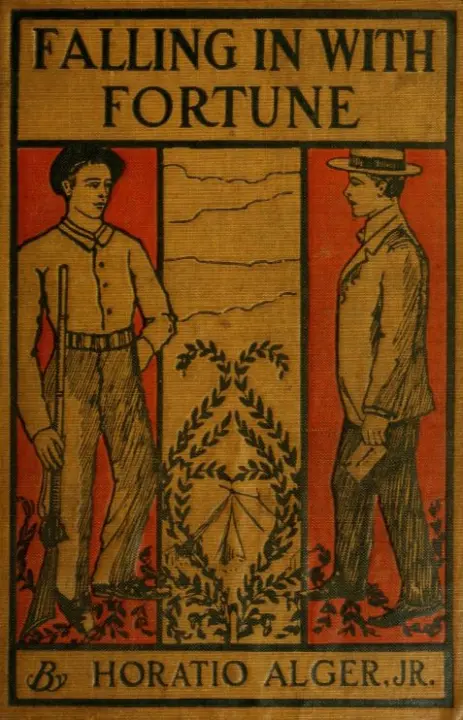
Horatio, Jr. Alger & Edward Stratemeyer
BEHIND THE BOOK
This eBook is for the use of anyone anywhere in the United States and most other parts of the world at no cost and with almost no restrictions whatsoever. You may copy it, give it away or re-use it under the terms of the Project Gutenberg License included with this eBook or online at www.gutenberg.org. If you are not located in the United States, you will have to check the laws of the country where you are located before using this eBook. Read the source licence.
The original source file, including credits and licence, is retained by this library. Request an original-format copy at no charge. Please include the book title and Project Gutenberg identifier #61348.
KEEP YOUR CURIOSITY GOING
Maurice Baring
W. B. (William Butler) Yeats
Edward Martyn

John Brougham & Charlotte Brontë
Marguerite Merington
Leonid Andreyev