
Life of Edwin Forrest, the American Tragedian. Volume 2 (of 2)
William Rounseville Alger & Horatio, Jr. Alger

THE CLASSIC COLLECTION · 1877
"Life of Edwin Forrest, the American Tragedian. Volume 1 (of 2)" by William Rounseville Alger is a biography written in the late 19th century. The book chronicles the life of Edwin Forrest, a prominent American actor, and provides insights into his contributions to the theater, his personality, and the influences that shaped his career. It seeks to not only narrate his experiences but also to explore the broader significance of his life within the narrative of American theater. The opening of the biography establishes the context for Edwin Forrest's life, highlighting his importance as a groundbreaking figure in American acting. Alger reflects on the motivations behind his work, emphasizing the value of detailing the life of someone who had a profound impact on the theatrical world. The initial chapters detail the background of Forrest's family, underscoring the virtues they instilled in him, and hint at the challenges he faced growing up in a struggling household. The author also discusses the societal prejudices against actors during Forrest's time, aiming to address misconceptions about the dramatic profession. Overall, the beginning sets a reflective and analytical tone, suggesting a deep exploration of Forrest's complex character and the tumultuous world of 19th-century American theater.
Introduction adapted from the source catalogue; source summaries may be automatically generated.
Free to read · English · 164,046 words · No account needed
MAKE TIME FOR A GOOD BOOK
On by default. Untick to stop anonymous reading totals. Each page counts after 10 seconds in view. How this works.
Anonymous counting is on unless you have switched it off.
A letter written by Mrs. Forrest to her youngest sister-in-law, Eleanora, while absent with Edwin on one of his distant theatrical engagements, may find a fitting place here, for the interest of its domestic allusions and of its description of the scenery on their journey:
"BUFFALO, August 29th, 1843.
"MY DEAR ELEANORA,--According to the promise made in Philadelphia, I will endeavor to give you some account of our travels in the Far West. From New York we went first to Detroit, where Edwin was engaged to perform for six nights; but the business was so good that he was induced to remain eleven.
"On leaving Detroit, we took the railroad to Jackson, the capital of Michigan, and then proceeded by stage to a village called Battle Creek, in all a journey of about one hundred and thirty miles. There we remained overnight. After this we abandoned the public conveyances so long as we travelled in Michigan,--the routes taken by the stages being generally through the most uninteresting portions of the country, and the additional expense of a private conveyance being small, and the additional comfort great. Leaving Battle Creek, our road lay through one of the most beautiful portions of the State. For nearly twenty miles we rode through magnificent forests of huge old oaks, unencumbered by any undergrowth, and surrounded on all sides by wild flowers of every form and hue, roses, lilies, and the vivid scarlet lobelia everywhere growing up in the richest luxuriance. Occasionally we proceeded for a mile or two along the banks of the Kalamazoo River, a most picturesque stream, but so shallow that it may be easily forded almost anywhere. Sometimes we came to a natural meadow hundreds of acres in extent, on which apparently no tree or shrub has ever grown. These meadows are universally surrounded by high banks and immense trees, the growth of ages, which leads one naturally to suppose that they may have been the beds of lakes, of which there are a great number in this part of the country. These meadows are of infinite advantage to the farmer, yielding him fine crops of hay and saving him the labor of at least one generation, which would otherwise be employed in clearing away the trees. We spent some portion of a day in the village of Kalamazoo in walking about the place in search of Edwin's lots, which eventually we found. As the railroad will be completed to this place next year, these lots will in all probability be worth something. At Kalamazoo we remained one night, and started the next morning for Prairie Ronde. Here we saw one of the wonders of the western country, a magnificent prairie, fifteen miles across, the greater portion of it in a high state of cultivation, the soil very fine, and the farms in a flourishing condition, with a neat little village in the centre. Those prairies, however, which are wholly uncultivated present a much finer prospect to the traveller, being an immense sea of wild flowers, stretching as far as the eye can reach, without a tree or a shrub to interrupt the view. We remained one night at a village on White Pigeon Prairie, about thirty miles from the last one I named, and the next day proceeded to Niles. Our road, during the greater portion of the morning, was through the woods, and by the side of the St. Joseph River. The scenery is very beautiful. On entering the village of Niles, Goodman, who was standing at the door of his store, immediately recognized Edwin and stopped the carriage. He insisted on our going to his house, which Edwin at first refused, but Goodman said he had been expecting us all the week, and seemed so anxious about the matter that Edwin finally consented to go. I am sure you will be glad to hear that Edwin settled all his business with Goodman, and is satisfied that he has acted honestly. We remained there two days and a half, and he and Mrs. Goodman made us very comfortable. They have a neat little cottage, and two acres of land adjoining it, and apparently every comfort which they can require. On leaving Niles, we went to St. Joseph, and there took the boat to Chicago, a very pretty town finely situated on Lake Michigan. After remaining here a day, we took a steamboat for the Upper Lakes, and in two days reached Mackinaw, a most beautiful little island, where there is an annual meeting of most of the Indian tribes, who gather there to receive their pay from the Government. We at first purposed remaining a few days there; but finding that there were no accommodations for us, and that the boat would remain long enough to allow of our seeing all that we wished, we walked on shore, saw a sufficient number of Indians to satisfy all reasonable curiosity, and in a condition which tends to destroy the romantic ideas we are apt to form of them. We returned to our boat, which, after stopping at several places, brought us in three days more to Buffalo. I must not omit to tell you that on Sunday we had a sermon from an Episcopal minister, and, there being no time the same day for any other, on Monday we had a long discourse from a Mormon preacher; but, my paper being so nearly full, I must not attempt to describe him. Edwin is going to play ten or twelve nights here, and then we go to New York. I think this trip has been of service to him; and he is of the same opinion. He is now in excellent health. I have but little room left to make the many inquiries I would wish concerning you and all in Tenth Street. I hope your dear mother is fast recovering the use of her arm, and that her health in other respects is good. We should like much to hear how she is, and should be very glad to receive a few lines from you. I trust that you and your sisters are all well, and that you escaped the influenza. Edwin desires his love to mother, Henrietta, Caroline, and yourself. In this I beg most heartily to join, and remain ever,
Your reading position is saved on this browser. Take it to another device with a library code. Reading pages adapt to text, rather than matching a printed edition.
William Rounseville Alger & Horatio, Jr. Alger

Horatio, Jr. Alger

Horatio, Jr. Alger
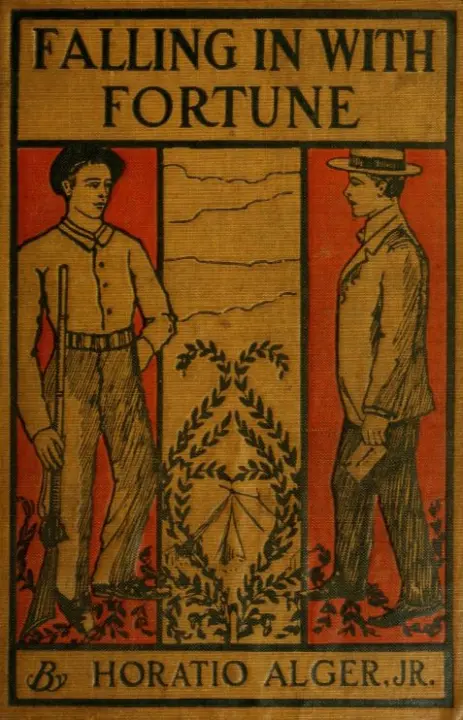
Horatio, Jr. Alger & Edward Stratemeyer
BEHIND THE BOOK
This eBook is for the use of anyone anywhere in the United States and most other parts of the world at no cost and with almost no restrictions whatsoever. You may copy it, give it away or re-use it under the terms of the Project Gutenberg License included with this eBook or online at www.gutenberg.org. If you are not located in the United States, you will have to check the laws of the country where you are located before using this eBook. Read the source licence.
The original source file, including credits and licence, is retained by this library. Request an original-format copy at no charge. Please include the book title and Project Gutenberg identifier #61348.
KEEP YOUR CURIOSITY GOING
Maurice Baring
W. B. (William Butler) Yeats
Edward Martyn

John Brougham & Charlotte Brontë
Marguerite Merington
Leonid Andreyev