
Life of Edwin Forrest, the American Tragedian. Volume 2 (of 2)
William Rounseville Alger & Horatio, Jr. Alger

THE CLASSIC COLLECTION · 1877
"Life of Edwin Forrest, the American Tragedian. Volume 1 (of 2)" by William Rounseville Alger is a biography written in the late 19th century. The book chronicles the life of Edwin Forrest, a prominent American actor, and provides insights into his contributions to the theater, his personality, and the influences that shaped his career. It seeks to not only narrate his experiences but also to explore the broader significance of his life within the narrative of American theater. The opening of the biography establishes the context for Edwin Forrest's life, highlighting his importance as a groundbreaking figure in American acting. Alger reflects on the motivations behind his work, emphasizing the value of detailing the life of someone who had a profound impact on the theatrical world. The initial chapters detail the background of Forrest's family, underscoring the virtues they instilled in him, and hint at the challenges he faced growing up in a struggling household. The author also discusses the societal prejudices against actors during Forrest's time, aiming to address misconceptions about the dramatic profession. Overall, the beginning sets a reflective and analytical tone, suggesting a deep exploration of Forrest's complex character and the tumultuous world of 19th-century American theater.
Introduction adapted from the source catalogue; source summaries may be automatically generated.
Free to read · English · 164,046 words · No account needed
MAKE TIME FOR A GOOD BOOK
On by default. Untick to stop anonymous reading totals. Each page counts after 10 seconds in view. How this works.
Anonymous counting is on unless you have switched it off.
Aylmere. Go to! thou speak'st not truth! Would Heaven, thou fool, Wrest nature from her throne, and tread in dust Millions of noble hearts, that worms like thee Might riot in their filthy joys untroubled? Heaven were not Heaven were such as ye its chosen."
The triumphant insurgents compel from the king the promise of a charter declaring the bondmen free. But, at the height of his success and glory, Cade is stabbed by a nobleman whom he has condemned to be executed for his insufferable crimes. As he lies in a dying state, a cry is heard without, declaring the proclamation of the charter. Mowbray rushes in, bearing it unrolled, and displaying the royal seal. Cade starts up with a wild burst of joy, seizes the charter, kisses it, clasps it to his bosom, sinks to the floor with one slow, expiring sigh,--and the curtain falls on the dead Liberator of the Bondmen of England.
It is a terrible play, full of the ravage of fearful passions, but it is also full of that truth and that justice which are attributes of God, and work their retributive results in hurricanes of hatred and battle, as well as sow their blessings in milder forms. The chronic political and social experience of mankind has always been terrible; and the drama, to be true to its full function, must sometimes teach terrible lessons terribly. The implacable animosity of Cade, his vendetta-hunt for revenge, his frenzied curse on the murderous noble who had mixed the blood and gray hairs of his mother with the ashes of her cottage, his gloating satiation of his vengeance at last, are not beautiful, but may be edifying. Provoked by such frightful wrongs as he had known, and enlarged by connection with a whole race similarly treated for ages, they appeal to the deepest instinct that sleeps in the crude blood of human nature,--the wild tooth-for-tooth and eye-for-eye justice of equivalent reprisals taken nakedly man to man. This indomitable basis of barbaric manhood, with all its dread traditions of even-handed retribution, was powerful in Forrest. He believed in it as a natural revelation of the divine justice, and he delighted in a part on the stage in which he could make its ominous signals blaze against those who could wrong the poor or trample on the weak; for thus he glorified the democrat he was by nature through the democrat he displayed in his art. It is obvious that such a performance must be extremely offensive to several classes of persons, and give rise to expressions of censure and disgust. And here is a key to considerable of the vindictive and contemptuous criticism levelled against Forrest. But all such criticism is incompetent and unfair, because springing from personal tastes and moods, and not from standard principles. Unquestionably, those types of man representing the moral ideals which tend to woo towards us the better future they prophesy, are more lovely and benignant than the types representing the real products and makers of history in the past, with all their merits and faults. But judgment must not be pronounced on the dramatic impersonation of a character from negative considerations of its æsthetic or ethical inferiority to other forms of character. It is to be rightly judged from its truth and power in its own kind and range; for that is all that the player professes to exhibit. And, furthermore, this is to be said in behalf of the moral influence of a character represented on the stage whose energies spurn hypocrisy and mean compromises, whose passions flame straight to their marks without cowardice or disguise,--that such a character is far more noble and wholesome than any of those common types of men who have no originality of nature, no spontaneous power, but are made up of timid imitations and a conventional worship of custom and appearance. One is often tempted to say, Better the free impulses of that stronger and franker time when the passions of men broke out through their muscles in deeds of genuine love, righteous wrath, and lurid crime, than the pale, envious, and sneaking vices that thrive under a civilization of money, law, and luxury. Better express a hostile feeling through its legitimate channels than secrete it to rankle in the soul. This was the thought of Forrest; and there is, no doubt, some truth in it. But it is to be said, on the other side, that the cultivated suppression of antipathies weakens them, and it is by this method chiefly that the world moves in its slow progress from the barbarisms of revenge to the refinements of forgiveness.
Your reading position is saved on this browser. Take it to another device with a library code. Reading pages adapt to text, rather than matching a printed edition.
William Rounseville Alger & Horatio, Jr. Alger

Horatio, Jr. Alger

Horatio, Jr. Alger
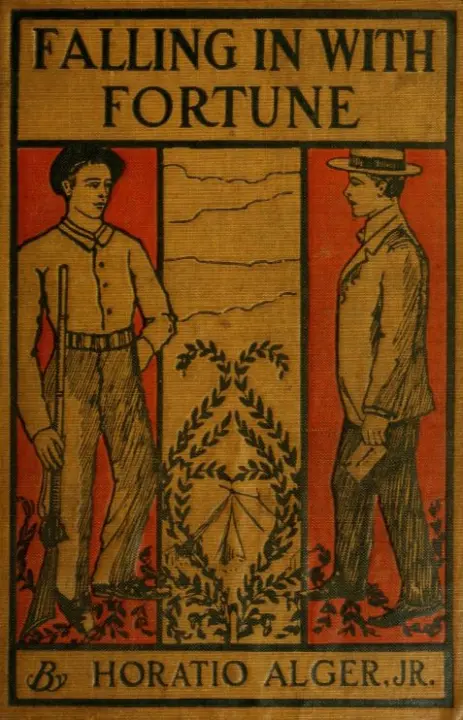
Horatio, Jr. Alger & Edward Stratemeyer
BEHIND THE BOOK
This eBook is for the use of anyone anywhere in the United States and most other parts of the world at no cost and with almost no restrictions whatsoever. You may copy it, give it away or re-use it under the terms of the Project Gutenberg License included with this eBook or online at www.gutenberg.org. If you are not located in the United States, you will have to check the laws of the country where you are located before using this eBook. Read the source licence.
The original source file, including credits and licence, is retained by this library. Request an original-format copy at no charge. Please include the book title and Project Gutenberg identifier #61348.
KEEP YOUR CURIOSITY GOING
Maurice Baring
W. B. (William Butler) Yeats
Edward Martyn

John Brougham & Charlotte Brontë
Marguerite Merington
Leonid Andreyev