
Life of Edwin Forrest, the American Tragedian. Volume 2 (of 2)
William Rounseville Alger & Horatio, Jr. Alger

THE CLASSIC COLLECTION · 1877
"Life of Edwin Forrest, the American Tragedian. Volume 1 (of 2)" by William Rounseville Alger is a biography written in the late 19th century. The book chronicles the life of Edwin Forrest, a prominent American actor, and provides insights into his contributions to the theater, his personality, and the influences that shaped his career. It seeks to not only narrate his experiences but also to explore the broader significance of his life within the narrative of American theater. The opening of the biography establishes the context for Edwin Forrest's life, highlighting his importance as a groundbreaking figure in American acting. Alger reflects on the motivations behind his work, emphasizing the value of detailing the life of someone who had a profound impact on the theatrical world. The initial chapters detail the background of Forrest's family, underscoring the virtues they instilled in him, and hint at the challenges he faced growing up in a struggling household. The author also discusses the societal prejudices against actors during Forrest's time, aiming to address misconceptions about the dramatic profession. Overall, the beginning sets a reflective and analytical tone, suggesting a deep exploration of Forrest's complex character and the tumultuous world of 19th-century American theater.
Introduction adapted from the source catalogue; source summaries may be automatically generated.
Free to read · English · 164,046 words · No account needed
MAKE TIME FOR A GOOD BOOK
On by default. Untick to stop anonymous reading totals. Each page counts after 10 seconds in view. How this works.
Anonymous counting is on unless you have switched it off.
Richard Penn Smith responded to a toast with much felicity. He said "he recalled with pleasure his intercourse with Mr. Forrest, for whom he wrote his tragedy entitled Caius Marius, but regretted that even the transcendent talents of his friend could not save his hero from perishing among the ruins of Carthage."
Mr. Smith said that "on such an occasion it would be unpardonable to overlook one who stood foremost in the ranks of our dramatic writers,--a gentleman who had distinguished himself by his various talents as an artist and an author, and whose dramatic works would ultimately secure him an enviable fame." He referred to Wm. Dunlap, of New York, and read the following letter:
"NEW YORK, December 11th, 1837.
"GENTLEMEN,--I received, on the evening of the 9th instant, your polite letter, doing me the honor of requesting my presence at a public dinner to be given to Edwin Forrest on the 15th instant. Nothing but the progress of winter, which I see around me, and feel within, could prevent my testifying in person how highly I appreciate the invitation of the committee and the gentleman to whom the public mark of esteem is to be given. Permit me to offer a toast:
"The American Actor, who, both in public and private life, upholds the honor of his country,--Edwin Forrest.
"Mr. President," said Mr. Smith, "I will offer you a toast, which I have no doubt will be cordially responded to,--
"William Dunlap--The Nestor of the American Drama. May he live to see the edifice become what his foundation promised!"
The President called upon Mr. Charles Ingersoll, chairman of the
Committee of Invitation, for a sentiment, to which Mr. Ingersoll
responded:
"MR. CHAIRMAN,--I have been desired by the committee to propose the health of a gentleman who is among us,--a friend of our immediate guest,--who has left his business in a sister city to comply with their invitation to give us his presence to-day,--a gentleman well known in the department of letters, as our guest upon your right is in that of the drama, as peculiarly and characteristically American. We are met to congratulate upon his successes a man radically American. The occasion is, therefore, appropriate to the cultivation of nationality,--a virtue which, though it is said to have grown into a weed in our political and individual relations, we have never been accused of fostering overmuch in literature and the arts; and he who cultivates it there deserves our signal approbation. Short of that illiberality which impedes the march of improvement, let us cherish a partiality, an honest, homely prejudice, for what is our own. To know ourselves is not the whole circle of wisdom; we must love ourselves too. Who sees an American audience crowd to an American play and turn from Shakspeare to call for Metamora and the Gladiator, and does not acknowledge in this fond prejudice the germ of excellence? Patriotism itself is a blind preference of our own earth; and shall there be no patriotism in letters? Take from Walter Scott his local prepossessions,--his Scotch kings, Scotch hills, Scotchmen, and the round of characters that he carries with him to all times and all places wherever his scene be laid,--deprive him, in a word, of his nationality, and what is he? Cut from his harp his own strings, and where is his music? There is no virtue without excess; such is human imperfection. Give us, then, nationality, which is but a phase of patriotic feeling; give us excess of it. Let us love the yet barren hills of our own literature, and we shall learn to make them wave and smile with harvests. Let our authors, like the gentleman we are about to drink to, strike their roots into their native soil and spread themselves to their native sun, and, like him, they will flourish. I propose
Your reading position is saved on this browser. Take it to another device with a library code. Reading pages adapt to text, rather than matching a printed edition.
William Rounseville Alger & Horatio, Jr. Alger

Horatio, Jr. Alger

Horatio, Jr. Alger
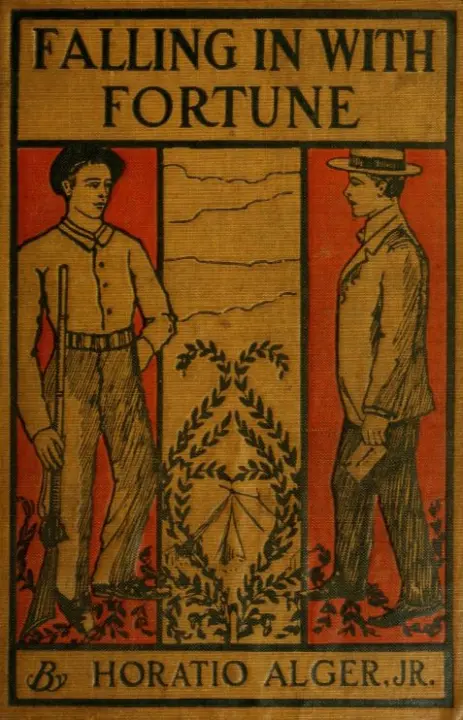
Horatio, Jr. Alger & Edward Stratemeyer
BEHIND THE BOOK
This eBook is for the use of anyone anywhere in the United States and most other parts of the world at no cost and with almost no restrictions whatsoever. You may copy it, give it away or re-use it under the terms of the Project Gutenberg License included with this eBook or online at www.gutenberg.org. If you are not located in the United States, you will have to check the laws of the country where you are located before using this eBook. Read the source licence.
The original source file, including credits and licence, is retained by this library. Request an original-format copy at no charge. Please include the book title and Project Gutenberg identifier #61348.
KEEP YOUR CURIOSITY GOING
Maurice Baring
W. B. (William Butler) Yeats
Edward Martyn

John Brougham & Charlotte Brontë
Marguerite Merington
Leonid Andreyev