
Life of Edwin Forrest, the American Tragedian. Volume 2 (of 2)
William Rounseville Alger & Horatio, Jr. Alger

THE CLASSIC COLLECTION · 1877
"Life of Edwin Forrest, the American Tragedian. Volume 1 (of 2)" by William Rounseville Alger is a biography written in the late 19th century. The book chronicles the life of Edwin Forrest, a prominent American actor, and provides insights into his contributions to the theater, his personality, and the influences that shaped his career. It seeks to not only narrate his experiences but also to explore the broader significance of his life within the narrative of American theater. The opening of the biography establishes the context for Edwin Forrest's life, highlighting his importance as a groundbreaking figure in American acting. Alger reflects on the motivations behind his work, emphasizing the value of detailing the life of someone who had a profound impact on the theatrical world. The initial chapters detail the background of Forrest's family, underscoring the virtues they instilled in him, and hint at the challenges he faced growing up in a struggling household. The author also discusses the societal prejudices against actors during Forrest's time, aiming to address misconceptions about the dramatic profession. Overall, the beginning sets a reflective and analytical tone, suggesting a deep exploration of Forrest's complex character and the tumultuous world of 19th-century American theater.
Introduction adapted from the source catalogue; source summaries may be automatically generated.
Free to read · English · 164,046 words · No account needed
MAKE TIME FOR A GOOD BOOK
On by default. Untick to stop anonymous reading totals. Each page counts after 10 seconds in view. How this works.
Anonymous counting is on unless you have switched it off.
Mr. Forrest was much esteemed for his good sense, his dignified sobriety of demeanor, his strict probity, his modesty and industry. Reserved and taciturn in manners, tall, straight, and slender in person, he was a hard-working, care-worn, devout, and honest man, who strove to be just and true in every relation. He had a pale and sombre face, with regular features, which lighted up with strong expressiveness when he was pleased or earnestly interested. He was somewhat disposed to melancholy, though not at all morose, his depression and reserve being attributable rather to weariness under his enforced struggle with unfavorable conditions than to any native gloom of temper or social antipathy.
Edwin, in his own later years, dwelt with veneration on the memory of his father, and was fond of recalling his early recollections of him, deeply regretting that there was no portrait or daguerreotype of him in existence. He was wont to say that among the sweetest memories that remained to him from his childhood were the rich and musical though plaintive tones of his father's voice, the ringing and honest heartiness of his occasional laugh, and the singular charm of his smile. He said, "I used to think, when my father smiled, the light bursting over his dark and sad countenance,--its very rarity lending it a double lustre,--I used to think I never saw anything so beautiful." The light of love and joy broke over his sombre features like sunshine suddenly gilding a gray crag.
The unobtrusive, toilsome life of this worthy man, unmarked by any salient points possessing general interest for the public, glided on in even course to the close, darkened by the shadows of material adversity, but brightened by the serene lights of domestic happiness and self-respect. In his poverty he knew many mortifications, many hardships of self-denial and anxious forethought. But in his upright character and blameless conduct, in his retiring and religious disposition, in the kind and respectful regard of all who knew him, he experienced the supports and consolations deserved by such a type of man,--a type common in the middle walks of American society, and as full of merit as it is free from all that is noisy or meretricious. He was not an educated man, not disciplined and adorned by the arts of literary and social culture. But his virtues made him eminently respectable in himself and in his sphere. He came of a good stock, with noble traditions in its veins, endowed with sound judgment, refined nervous fibre, a grave moral tone, and persevering self-reliance. He died of consumption, in 1819, in the sixty-second year of his age. In the death of his youngest son his blood was extinguished, and the fire went out on his family hearth. No member of his lineage remains on earth. The recollections of him, now dim threads in the minds of a few survivors, will soon fall into the unremembering maw of the past. Herein his life and fate have this interest for all, that they so closely resemble those of the great majority of our race. Few can escape this common lot of obscurity and oblivion. Nor should one care much to escape it. It is not possible for all to be conspicuous, famous, envied. Neither is it desirable. The genuine end for all is to be true and good, obedient to their duty, and useful and pleasant to their kind. If they can also be happy, why then, that is another blessing for which to thank God. Beyond a question the most illustrious favorites of fortune, amidst all the glitter and hurrah of their lot, are often less contented in themselves and less loved by their associates than those members of the average condition who attract so little attention while they stay and are forgotten so soon when they have gone. And, mortal limits once passed, what matters all this to the immortal soul? The rank of a man in the sight of God and his fate in eternity--which are the essential things alike for the loftiest and the lowliest--depend on considerations very different from the tinsel of his station or the noise of his career. One may be poor, weak, obscure, unfortunate, yet be a truly good and happy man. That is the essential victory. Another may be rich, powerful, renowned, enveloped in the luxuries of the earth. If his soul is adjusted to its conditions and wisely uses them, this is a boon still more to be desired; for he too has the essential victory. The real end and aim of life always lie within the soul, not in any exterior prize: still, the best outward conditions may well be the most coveted, although there is no lot which does not yield full compensations, if the occupant of that lot is what he ought to be.
Your reading position is saved on this browser. Take it to another device with a library code. Reading pages adapt to text, rather than matching a printed edition.
William Rounseville Alger & Horatio, Jr. Alger

Horatio, Jr. Alger

Horatio, Jr. Alger
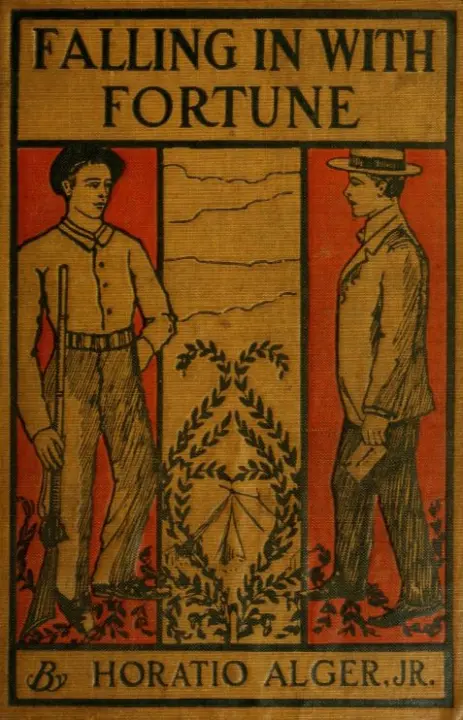
Horatio, Jr. Alger & Edward Stratemeyer
BEHIND THE BOOK
This eBook is for the use of anyone anywhere in the United States and most other parts of the world at no cost and with almost no restrictions whatsoever. You may copy it, give it away or re-use it under the terms of the Project Gutenberg License included with this eBook or online at www.gutenberg.org. If you are not located in the United States, you will have to check the laws of the country where you are located before using this eBook. Read the source licence.
The original source file, including credits and licence, is retained by this library. Request an original-format copy at no charge. Please include the book title and Project Gutenberg identifier #61348.
KEEP YOUR CURIOSITY GOING
Maurice Baring
W. B. (William Butler) Yeats
Edward Martyn

John Brougham & Charlotte Brontë
Marguerite Merington
Leonid Andreyev