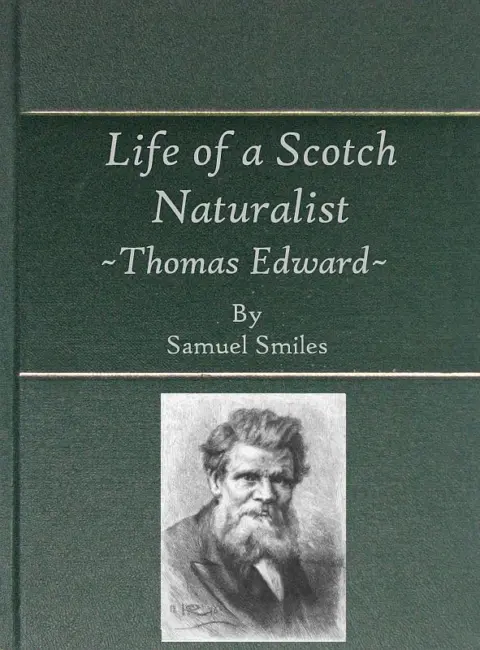
Life of a Scotch Naturalist: Thomas Edward, Associate of the Linnean Society. Fourth Edition
I am only aware of one specimen of this pretty and rare bird being obtained in our county; it was a splendid specimen killed on the hills of Boyndie.
MEROPS APIASTER [Bee-Eater].
I give this species a place here from having heard that a greenish bird, somewhat less than a thrush, with a longish bent bill, and with two feathers of the tail longer than the rest, was killed in a garden between Huntly and Dufftown, about seven years ago. It has since been found at the hills of Boyndie, about two miles from Banff.
ALCEDO ISPIDA [Kingfisher].
Several of these sparkling gems have been taken here at
different times. (See p. 52.)
HIRUNDO RUSTICA [Swallow], and
HIRUNDO RIPARIA [Martin].
These birds are in about equal numbers. The latter generally nestles in the corners of windows, the former in barns, etc.; they also breed along the sea-shore wherever there is a cave or projecting rock suitable. White and cream-coloured varieties are sometimes met with.
HIRUNDO URBICA [Sand Martin].
Wherever there is a bank of any height and not too hard, whether along the sea-shore or river-side, or a quarry or sand-hole, a colony of these active little creatures are almost sure to be met with during summer. It is surprising to see how they perforate these places, and the depth to which they will sometimes go, especially when we consider the remarkably feeble instruments with which they do it—namely, a very small and slender bill, and feet equally small and tender.
CYPSELUS APUS [Swift].
Of all our migratory species this is generally the last to arrive, and the first to depart. Next to the skylark, the swift appears to ascend highest in his aerial flights; and a very beautiful sight it is to see it, on a clear, still evening, gambolling about so far above the earth, and, it may be, screaming its farewell requiem to the departing sun. The swift is the first to depart, towards the end of August or beginning of September, and it returns about the middle of May; the sand martin next, or about the second or third week in September, and it usually returns about the third week in April; and the swallow and house martin commonly about the first week or middle of October, and it reappears about the 1st of May. Before I part with this interesting tribe I must become a little arithmetical. We are frequently told, and justly, of the great benefit swallows and other insect-feeders do, by the countless herds of noxious creatures which they destroy. I will relate an instance of my own experience in this respect. Picking up a swallow which had been shot by a friend, I found that its mouth was crammed with gnats and flies. Some of them were alive. They all seemed attached to the mouth by a glutinous fluid. The bird had apparently been catering for its young. Being desirous of making a further examination, I wrapped it in paper and put it in my pocket. On reaching home I opened the paper, when a number of the gnats buzzed out into my face, much to my regret; but I succeeded in counting upwards of 70, and I am quite sure there were more than 100 in all. Now it is a well-known fact that both birds assist in rearing their young. Well, say that they visit the nest every ten minutes (which is under the mark), and that every time of doing so, each bird conveys 70 insects; this in an hour amounts to 840; in a day of twelve hours, which is but a short day for a swallow at that season of the year, to 10,080; in a week of seven days, to 70,560; and in a fortnight, to 141,120. But if we carry the calculation a little further, by supposing that the birds rear two broods in a season, although the number is often three, we have, at the ratio at which we have been counting, a total of 282,240 insects destroyed in one year by two birds alone, while rearing their two broods!