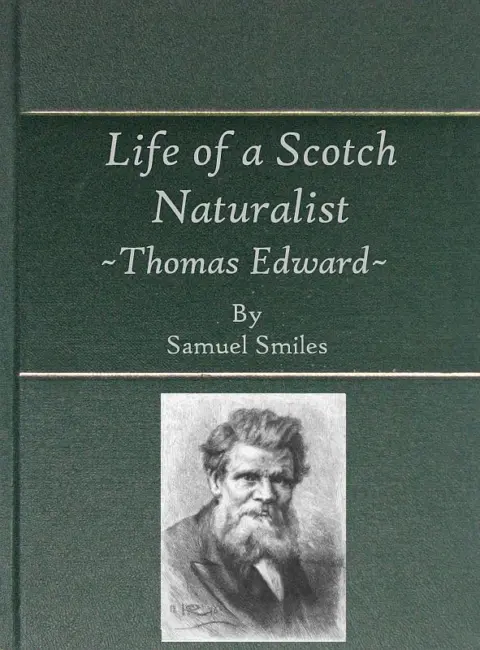
Life of a Scotch Naturalist: Thomas Edward, Associate of the Linnean Society. Fourth Edition
[61] We are sorry to observe that the late Mr. Jonathan Couch, for whom Edward made so many of his researches at Banff, died in reduced circumstances,—rendering it necessary for his daughters to go out in search of employment.
THE FAUNA OF BANFFSHIRE.
[Only a selection of the Fauna is given in the following pages. Had the Insects, Reptiles, Starfishes, Zoophytes, Molluscs, Plants, etc., which Edward found in Banffshire, been given, it would have more than filled the present volume.]
SELECTIONS FROM THE FAUNA OF BANFFSHIRE,
BY THOMAS EDWARD, A.L.S.
MAMMALS.
MELES TAXUS [Badger or Brock]. See p. 102.
Sparingly met with in our wooded districts.
MUSTELA MARTES [Pine Marten].
Found chiefly in the higher parts of the county. One was observed, in 1848, to descend from a tree in the hills of Boyndie, and go into a rabbit’s hole. The hole was stopped up, and a spade was brought to dig the animal out. It had, however, escaped by another outlet from the burrow.
MUSTELA PUTORIUS [Polecat or Fumart].
See page 116.
MUSTELA VULGARIS [Weasel or Whitret].
More frequent than the polecat. Whilst the latter would seem to delight more in plantations and whins, the other would appear to think more of old dykes, grassy hillocks, and small cairns of stones. Both are very destructive, killing much more than they devour. See p. 111.
MUSTELA ERMINEA [Ermine or Stoat].
This species is often mistaken for the weasel. They are very similar during summer, their colours being then the same. In winter, however, the ermine changes to a pure white, excepting in a portion of the tail, which is always black. In this state they are all but universally called “White,” or rather “Fite Futrates.” The true weasel never changes.
LUTRA VULGARIS [Otter].
Often met with in suitable localities along the
sea-shore, as well as by many of our streams and
streamlets. See p. 115.
CANIS VULPES [Fox, Tod Lowric, or Reynard].
A well-known animal, especially in the country
districts. See pp. 109, 219.
FELIS CATIS [Common Wild Cat].
The wild cat is now, perhaps, extinct with us, though at one time it was frequently found in the woods and rocky glens of the more alpine portions of the interior. One which I had the pleasure of seeing, and which was killed in Glen Avon, measured over four feet in length, and was well proportioned in every other respect. It was altogether a very formidable looking animal.
TALPA EUROPÆA [Mole or Mowdiewort].
This harmless creature is often met with. It is very useful to agriculturists by turning up the fertile soil, yet they constantly wage war against it. Pure white varieties are sometimes met with.
ERINACEUS EUROPÆUS [Hedgehog].