Upper Canada Sketches
Thomas Conant
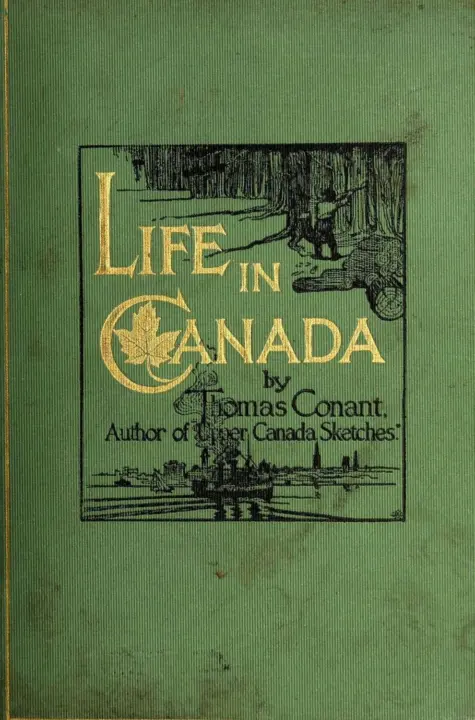
THE CLASSIC COLLECTION · 1903
"Life in Canada" by Thomas Conant is a historical account written in the early 20th century. The work explores the history and customs of Canada, particularly focusing on the author's ancestors, beginning with his great-grandfather, Roger Conant, who immigrated to Upper Canada as a United Empire Loyalist. The book is likely to appeal to those interested in Canadian history, particularly the experiences of early settlers and their contributions to the development of the region. At the start of the narrative, Thomas Conant introduces his ancestor Roger, detailing his background in Massachusetts and the events leading up to his emigration to Canada in 1792. The text outlines Roger's experiences in the early days of settlement, including his life as a fur trader and farmer, amidst the challenges posed by a largely undeveloped land. The author emphasizes Roger's contributions, character, and the hardships faced by the early settlers, setting the stage for a deeper exploration of the significance of these experiences in shaping Canada's history and identity.
Introduction adapted from the source catalogue; source summaries may be automatically generated.
Free to read · English · 75,973 words · No account needed
MAKE TIME FOR A GOOD BOOK
On by default. Untick to stop anonymous reading totals. Each page counts after 10 seconds in view. How this works.
Anonymous counting is on unless you have switched it off.
The earth all light and loveliness, in summer’s golden hours, Smiles, in her bridal vesture clad, and crown’d with festal flowers; So radiantly beautiful, so like to heaven above, We scarce can deem more fair that world of perfect bliss and love.
Turn the eye southward, from the town, with its noise, bustle and smoke, and look with me over my daily horizon, which indeed bounds a landscape which my eyes have feasted upon all my days, for the past half-century, save and except the years at college and years of foreign travel. Manifestly at the first, the very first, in fact, the eye catches the more conspicuous objects. And it is, in this instance, a great dead but standing hemlock tree, denuded, it is true, of its foliage, but yet bearing its limbs quite in detail. Like great men, it has died at the top, and its impression upon my retina is always associated with the crows’ congress which I saw in its foliage-less branches last fall. The crow, you know, only partially leaves us hereabout for the winter. Many of them do migrate, it is true, but here along the Lake Ontario shore dead fish are always thrown up by the waves, and he can feed at any time; consequently, he does not leave us. So, upon this elevated, dead tree-top, I saw thousands of them gather, and heard one after another deliver his speech in regular order. Oratory they must have, for their voices were plaintive, defiant and grave, in turn, and I dare not deny them intelligent utterance. Close beside this site of the crows’ congress are a few great, large, sweeping elms, whose branches alone would each make very respectable trees. Always their greenness is visible to me, and the quiet contentment of pose of their branches and leaves is always a pleasure. Great blue-crested herons find convenient resting-places on their highest limbs. Stork-like, these great, gaunt birds stand upon one foot, and turn their heads side-wise, and so wise-like, that one feels so near nature when beholding them that it is uncanny to disturb them. I let the eye wander beyond the high elm limbs, and Ontario’s ultra-marine blue waters are before me, upon the far horizon, beyond my extreme range of vision. And when Old Sol rose this morning from out of Ontario’s waters, he heralded his appearance by throwing up into the sky shafts of light of various colors. Some, indeed, were pure violet for a few moments, and others red, and yellow, and blue, but not the blue of Ontario, so that the contrast may be marked for us. He is coming up swiftly, and in a few moments the colors have all changed, and almost before I can turn my head yellow has suffused the whole in the immediate locality of old submerged Sol. Again, the top of a wheel of fire we see upon the water, and now it is all red about. Old Sol has risen, and a globe of fire is sailing upon the waters’ surface. Could any facile brush only put upon canvas for us these phantasmagorial colors, no one would believe the artist, but accuse him of outdoing nature. And now he shines between me and a high hill upon the lake’s bank, surmounted by trees, green at the top and golden yellow along its sides with ripening grain. Our-red men discovered the very striking beauty of this eminence before Cartier ever sailed up the St. Lawrence, and even before the Indian population moved backward and northward upon those backwater chains, and away from Lake Ontario. To establish this fact most indisputably, we have only to look at the many skulls, and larger human bones, generally, which the ploughshare turns out. Then the red man enjoyed his pagan rites without the intermeddling of the expectant Jesuit missionary, who only came ages and ages after; for, among the bones, we find his flints, skinning stones, and stone tomahawks, but no articles of iron, because the Frenchman, who first came here, had not then given him tomahawks of iron and old flint guns. Imitative whites, whose eyes travelled about the horizon, as did the Indians’, drank in the beauty of the scene inceptively, and they in their turn made it their place of sepulture, and to-day it is the white man’s burial ground, embosomed among the evergreen trees, which Old Sol’s rays are penetrating for me. While I stand and worship at Nature’s shrine in the early summer morn, with the sun’s advent a gentle breeze has risen. God has been specially good to us in giving this sublimely beautiful vision:
Your reading position is saved on this browser. Take it to another device with a library code. Reading pages adapt to text, rather than matching a printed edition.
Thomas Conant
BEHIND THE BOOK
This eBook is for the use of anyone anywhere in the United States and most other parts of the world at no cost and with almost no restrictions whatsoever. You may copy it, give it away or re-use it under the terms of the Project Gutenberg License included with this eBook or online at www.gutenberg.org. If you are not located in the United States, you will have to check the laws of the country where you are located before using this eBook. Read the source licence.
The original source file, including credits and licence, is retained by this library. Request an original-format copy at no charge. Please include the book title and Project Gutenberg identifier #65750.
KEEP YOUR CURIOSITY GOING
Wilfrid Scawen Blunt
Wilfrid Scawen Blunt

E. W. (Edgar Watson) Howe
Cécile Tormay

Moritz Busch
John L. Ransom