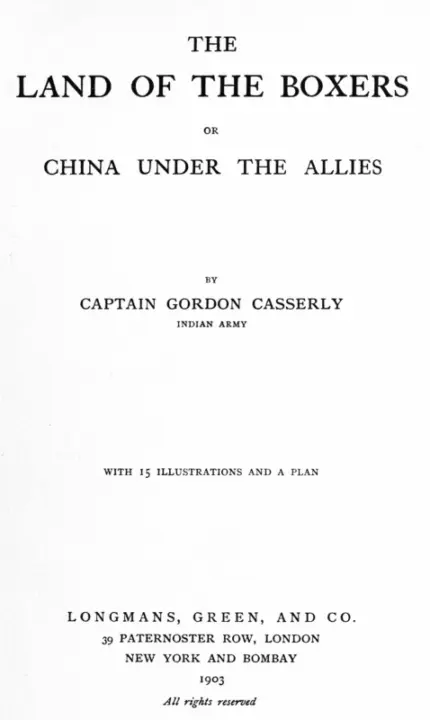
The Land of the Boxers; or, China under the Allies
Gordon Casserly

THE CLASSIC COLLECTION · 1914
"Life in an Indian Outpost" by Major Gordon Casserly is a memoir of military life in a remote Indian post, written in the early 20th century. The book recounts the author's experiences as an officer stationed at Buxa Duar, a fort near the Himalayas, reflecting on the challenges and daily routines encountered in this isolated setting. Casserly provides vivid descriptions of the local landscape, wildlife, and interactions with soldiers and villagers, capturing both the beauty and hardships of frontier life. The opening of the memoir sets the scene as the author and his regiment journey across India via troop trains, filled with anticipation and curiosity about their new post in the wilderness. Upon arrival, they are greeted with a less-than-rosy assessment of Buxa Duar from the departing officers, who describe it as an undesirable location filled with dangers such as wild animals and disease. Despite initial disappointment and fears of isolation, Major Casserly begins to find his footing in this remote outpost, detailing the picturesque surroundings and his duties as an officer. The early passages paint a picture of military life marked by camaraderie, the trials of solitude, and an emerging appreciation for the region's natural beauty.
Introduction adapted from the source catalogue; source summaries may be automatically generated.
Free to read · English · 94,598 words · No account needed
MAKE TIME FOR A GOOD BOOK
On by default. Untick to stop anonymous reading totals. Each page counts after 10 seconds in view. How this works.
Anonymous counting is on unless you have switched it off.
Around Buxa the Bhuttia inhabitants build, high upon the steepest hills, villages of wooden, palm-thatched huts supported on poles which raise them well off the ground. Their household utensils and drinking vessels are usually made of the useful bamboo. Around their houses they scratch up the ground and plant a little; but their chief employment is as porters or as woodcutters in the Government forests. They never seek for work in the tea gardens near; though on these the coolies are well paid and have to be brought from a long distance away in India. But the Bhuttia is essentially a hill-man; and life in the steamy heat of the Bengal plains would be unendurable to him.
A thousand feet above Buxa, on the slopes of Sinchula, stood a hamlet of a dozen huts. Learning that the inhabitants were celebrating a yearly festival, Smith and I, accompanied by a native officer, set off to visit it. As we climbed the steep hill-side we heard fiendish yells and shrieks, and conjectured that we were coming upon a devil-dance at least. But we only found the men of the village engaged in an archery contest. Two targets were placed about a couple of hundred yards apart; and a party at either end shot at them. The small marks were rarely hit, even when we placed rupees on them to stimulate the competitors; but most of the arrows fell very close to them. A good shot was hailed with vociferous applause by the marksman's team, a bad one by the shrieks, groans and derisive laughter we had heard. When the contest was over we were invited to try our skill and luckily did not disgrace ourselves. Then the bows of the contestants were stacked together on the ground and hung with garlands and leafy branches. The men sat down in two lines forming a lane to the bows; and each drew out from the breast of his kimono a small wooden or metal cup. Several women appeared from the village, bearing food and drink in cane baskets or gaily decorated vessels made of bamboo. We learned that the feast lasted six days and that each one of the principal villagers acted as host and provided the provender a day in turn and his womenfolk dispensed his hospitality. To-day's entertainer began the proceedings by filling his own cup, advancing to the pile of bows, bowing profoundly before it several times and pouring the contents of his cup on the ground. As he did so he muttered some words. Then he turned about and walked back. The other men, as they sat cross-legged on the ground, shouted out a long utterance which I took to be a form of grace before meals, and ended with a series of ear-piercing yells which would have done credit to a pack of mad jackals. The effect of the contrast between the fiendish noises they made and their beaming countenances was comical. Then the hostesses passed down the lines of men, handed them platters and heaped rice and other food on them. The cups were filled first with the vile-smelling and worse-tasting native liquor, and afterwards, when emptied several times, with tea. Undisturbed by our presence the guests made a hearty meal, the host walking up and down the lines and encouraging them to enjoy themselves, while his women brought fresh relays of victuals. But at last their appetites were satisfied. Then the ladies of the hamlet who had been watching their lords and masters from a respectful distance came forward. In addition to their ordinary garments they wore capes of black velveteen, only donned on occasions of ceremony; and their necks were hung with chains of imitation turquoises and large, coloured stone beads. To the monotonous accompaniment of two tiny hand-drums, beaten by men, they performed a mournful and exceedingly proper dance. This the men applauded languidly. Among the women I was struck by the European-like features of the very ugliest of them. She was fair-haired, high-cheek-boned and long-nosed. She contrasted strongly with the Tartar type of features of those around her. I learned that she was the illegitimate daughter of a Scotch military surgeon who had formerly been quartered in Buxa. She was married to a Bhuttia, and, judging from her silver ornaments, was quite a person of importance in the hamlet. But as I saw her afterwards working as a coolie and passing with heavy loads up and down through Buxa, it was evident that her economical father had not left her beyond the necessity of toiling for her daily rice.
Your reading position is saved on this browser. Take it to another device with a library code. Reading pages adapt to text, rather than matching a printed edition.
BEHIND THE BOOK
This eBook is for the use of anyone anywhere in the United States and most other parts of the world at no cost and with almost no restrictions whatsoever. You may copy it, give it away or re-use it under the terms of the Project Gutenberg License included with this eBook or online at www.gutenberg.org. If you are not located in the United States, you will have to check the laws of the country where you are located before using this eBook. Read the source licence.
The original source file, including credits and licence, is retained by this library. Request an original-format copy at no charge. Please include the book title and Project Gutenberg identifier #37782.
KEEP YOUR CURIOSITY GOING
Wilfrid Scawen Blunt
Wilfrid Scawen Blunt

E. W. (Edgar Watson) Howe
Cécile Tormay

Moritz Busch
John L. Ransom