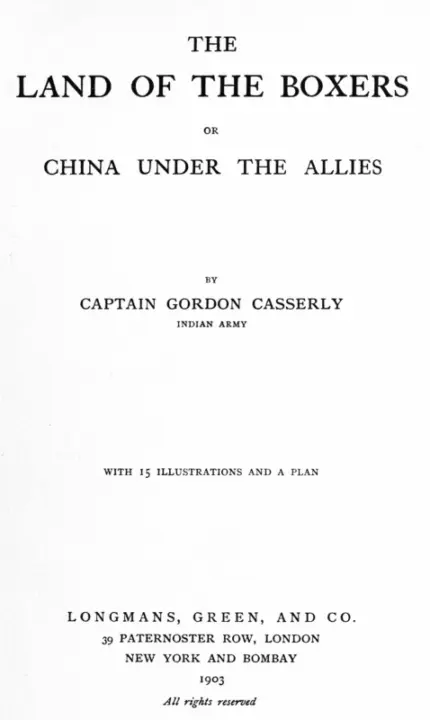
The Land of the Boxers; or, China under the Allies
Gordon Casserly

THE CLASSIC COLLECTION · 1914
"Life in an Indian Outpost" by Major Gordon Casserly is a memoir of military life in a remote Indian post, written in the early 20th century. The book recounts the author's experiences as an officer stationed at Buxa Duar, a fort near the Himalayas, reflecting on the challenges and daily routines encountered in this isolated setting. Casserly provides vivid descriptions of the local landscape, wildlife, and interactions with soldiers and villagers, capturing both the beauty and hardships of frontier life. The opening of the memoir sets the scene as the author and his regiment journey across India via troop trains, filled with anticipation and curiosity about their new post in the wilderness. Upon arrival, they are greeted with a less-than-rosy assessment of Buxa Duar from the departing officers, who describe it as an undesirable location filled with dangers such as wild animals and disease. Despite initial disappointment and fears of isolation, Major Casserly begins to find his footing in this remote outpost, detailing the picturesque surroundings and his duties as an officer. The early passages paint a picture of military life marked by camaraderie, the trials of solitude, and an emerging appreciation for the region's natural beauty.
Introduction adapted from the source catalogue; source summaries may be automatically generated.
Free to read · English · 94,598 words · No account needed
MAKE TIME FOR A GOOD BOOK
On by default. Untick to stop anonymous reading totals. Each page counts after 10 seconds in view. How this works.
Anonymous counting is on unless you have switched it off.
While we were thus engaged it seemed strange to see the mail train pass on the railway line not half a mile from us, driver, guard, and passengers leaning out to look at us. Leaving the nullah we ranged through the long grass on the level and put up a number of wild pigs, the Colonel shooting a fine old boar with long tusks as sharp as knives.
Having heard that a panther was supposed to be lying up in another nullah a couple of miles away, we took our elephants there and tried a beat for it. This time the howdah bearers advanced along the bank in line with the beaters, spaced across the nullah, which was fairly open, with patches of scrub here and there in it. We were unsuccessful in finding the panther but were afforded an excellent example of the terror with which elephants regard tiny, harmless animals. Over some bushes in front of me I caught a glimpse of a hare running through them down into the nullah. Its course brought it right across the line of beaters. Then these huge beasts, which had just faced a wounded tiger unmoved, went mad at the sight of it. All trumpeted shrilly, some planted their forefeet firmly and refused to advance, others turned and stampeded, despite the heavy blows showered on them with the iron ankus by the enraged mahouts. I saw Ainslie and the Colonel, unable to discover the cause of the disturbance, stand up in their howdah, clutching their rifles and looking everywhere for the charging panther, which they imagined must have scared the elephants.
One afternoon in Buxa I received a telegram from Ainslie telling me to be with him early next morning as a tiger had killed in his neighbourhood that day. As Alipur Duar was twenty-two miles away it behoved me to start at once and march through the night. So, filling my Thermos flask and putting a loaf of bread and a tin of preserved meat into my haversack, I shouldered my rifle and walked down the three miles of steep road to Santrabari. Here I found the mahouts and ordered them to get the two elephants ready, Jhansi still being a deserter. I bade them put the howdah on Dundora's back, as she was the steadier with a charging tiger. We started off at once; but before we reached the railway station at Buxa Road, darkness had fallen. My elephant stepped out briskly with the swaying stride that is particularly trying in a howdah, the occupant of which is shaken about like a pea on a drum. I kept slipping off the hard wooden seat; so I tried standing up, holding on to the front rail. This was almost worse; for if I forgot for a moment to brace myself up with stiffened arms I was thrown against the side. So for twenty-two miles I had to keep changing my position continually and found it tiring work. Through the forest we lumbered on without stopping. The night was dark. Fortunately, the road ran along beside the railway line clear of the trees, which would otherwise have swept the howdah off Dundora's back. Once or twice a wild elephant trumpeted in the jungle, much to the alarm of our tame ones; so I kept my rifle loaded, ready to drive off any we might meet. When I felt hungry I opened the tin of meat and, as we went along, made a frugal dinner, having to use my fingers as knife and fork, washing the food down with water from my flask. The long march was extremely fatiguing; but by daylight we were clear of the forest. Arrived at the dak bungalow at Alipur Duar I found one of the officers of my regiment, Major Burrard, who had come there on leave from headquarters at Dibrugarh in Assam for a shoot. The Ainslies could not accompany us that day, but had kindly lent us their four elephants. The kill was reported to be in a nullah about four miles away, close to the edge of the forest. Burrard and I started for it at once. Our way lay over open bare fields. Our elephants, as is their habit, persisted in tailing off in single file, though a hundred could have marched abreast. Each kept exactly in the footprints of the one in front of it. As we went along, I noticed half a mile to our left a nullah fringed with trees. In these, or circling overhead, were a number of vultures. I remarked that every now and then one would swoop down to the ground, only to rise again into the air like a rocketting pheasant without alighting. They indicated the presence of a dead animal; and I asked the mahouts if our kill was there. They answered that it was about a mile further on. I judged that another cow must have been killed in this nullah; and from the fact that the vultures did not dare to settle on it, I concluded that a tiger must be in the immediate vicinity. So I directed my elephant towards the spot. As we drew near I looked at the rows of bald-headed vultures, those repulsive-looking scavengers of India, sitting on the branches. Every few minutes one would fly down towards the ground and, without settling, hurriedly shoot up again into the air. Cautiously approaching the edge of the bank we found, as I expected, the carcass of a cow. We skirted the bank but could not see the tiger, which was probably asleep somewhere in the tangled scrub in the bottom of the nullah. So, marking the spot for a visit next day, we went on our way. Arrived at the place where the beat was to begin, we found another nullah filled with jungle, with bare, open ground stretching away on either side of it. We took up our positions in it on our two howdah elephants and put the beaters in farther down.
Your reading position is saved on this browser. Take it to another device with a library code. Reading pages adapt to text, rather than matching a printed edition.
BEHIND THE BOOK
This eBook is for the use of anyone anywhere in the United States and most other parts of the world at no cost and with almost no restrictions whatsoever. You may copy it, give it away or re-use it under the terms of the Project Gutenberg License included with this eBook or online at www.gutenberg.org. If you are not located in the United States, you will have to check the laws of the country where you are located before using this eBook. Read the source licence.
The original source file, including credits and licence, is retained by this library. Request an original-format copy at no charge. Please include the book title and Project Gutenberg identifier #37782.
KEEP YOUR CURIOSITY GOING
Wilfrid Scawen Blunt
Wilfrid Scawen Blunt

E. W. (Edgar Watson) Howe
Cécile Tormay

Moritz Busch
John L. Ransom