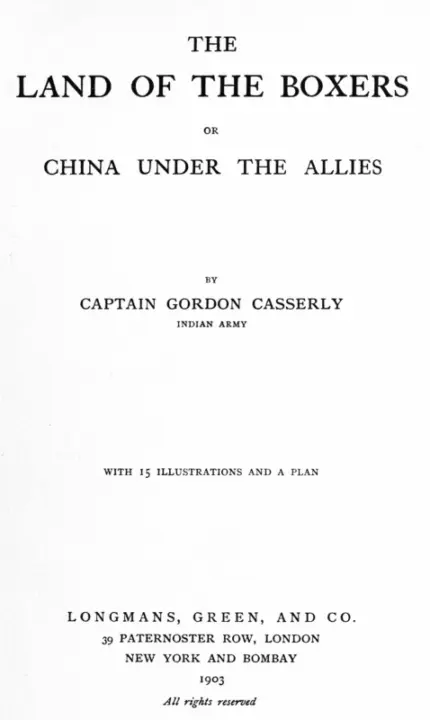
The Land of the Boxers; or, China under the Allies
Gordon Casserly

THE CLASSIC COLLECTION · 1914
"Life in an Indian Outpost" by Major Gordon Casserly is a memoir of military life in a remote Indian post, written in the early 20th century. The book recounts the author's experiences as an officer stationed at Buxa Duar, a fort near the Himalayas, reflecting on the challenges and daily routines encountered in this isolated setting. Casserly provides vivid descriptions of the local landscape, wildlife, and interactions with soldiers and villagers, capturing both the beauty and hardships of frontier life. The opening of the memoir sets the scene as the author and his regiment journey across India via troop trains, filled with anticipation and curiosity about their new post in the wilderness. Upon arrival, they are greeted with a less-than-rosy assessment of Buxa Duar from the departing officers, who describe it as an undesirable location filled with dangers such as wild animals and disease. Despite initial disappointment and fears of isolation, Major Casserly begins to find his footing in this remote outpost, detailing the picturesque surroundings and his duties as an officer. The early passages paint a picture of military life marked by camaraderie, the trials of solitude, and an emerging appreciation for the region's natural beauty.
Introduction adapted from the source catalogue; source summaries may be automatically generated.
Free to read · English · 94,598 words · No account needed
MAKE TIME FOR A GOOD BOOK
On by default. Untick to stop anonymous reading totals. Each page counts after 10 seconds in view. How this works.
Anonymous counting is on unless you have switched it off.
About eleven o'clock in the morning a sudden crash in the jungle a hundred yards ahead of us startled our elephants. Before the mahouts could stop them they swung round and stampeded. It was my first experience of being bolted with; and it was decidedly unpleasant. Dundora, which had been behind, was now leading, and dashed through the trees, followed closely by Khartoum. As the noise had apparently been caused by the rogue, I tried to turn round on the pad, ready to fire. And doing so, while at the same time endeavouring to hold on and dodge the boughs and creepers overhead, was no easy task. Over and over again I was nearly swept off. Luckily the mahouts soon got their elephants in hand and stopped them. Then we cautiously advanced again, expecting every moment that the rogue would charge out on us. But when we reached the spot whence the noise had proceeded we found by the trail that he had been lying down and, startled by our appearance, had risen and fled. We urged our elephants forward. The chase was becoming exciting. We followed as fast as we could go, hoping every minute to catch sight of the quarry. The jungle was growing more difficult and we made slow progress.
At last, after three hours, we heard him. He was concealed in a dense thicket of thorny undergrowth. We skirted cautiously round it, hoping to see him and get a shot. But, although we could hear him, he was completely hidden. At length my native officer said:
"Sahib, why should we men be afraid of an animal? Let us attack him on
foot."
The plucky old man had, in his own country and armed only with a sword, ridden at a tiger; but he did not realise that we were now facing a far more dangerous foe. His proposal was madness. The jungle was almost impenetrable, and we could not see five yards ahead in it. But before I could dissuade him the gallant old Rajput slid from Dundora's back, followed by his orderly, and walked towards the thicket. It was useless to try and stop him; so, cursing his foolhardiness, I dropped to the ground with Draj Khan. As I had the best rifle I pushed the others aside and got in front. But I had to reckon with the devotion of the native soldier for his British officer. They tried to prevent me from taking the post of danger and pulled me back. We had a ridiculous struggle for precedence, which was liable to be turned into a tragedy by the rogue's appearance at any moment. With difficulty I had my own way; though I certainly felt no desire to go first into what I knew was a mad undertaking. But it was only when I tried to force my way into the thicket that I fully realised our folly. The tangled vegetation was composed of thickly interlaced thorny bushes; I can only compare it to strong fishing-nets studded freely with hooks. Torn and bleeding from a dozen scratches I tried to worm my way in. Then to my horror I heard the rogue bursting through it at us. I was pinned down by the thorny branches, bound around by pliant creepers, unable to stand upright or even raise my rifle. I certainly thought that my last hour had come; for, securely pinioned by the cruel vegetation, I was helpless. The men behind me were in the same plight. But at that moment the mahouts saved us. Realising our extreme danger, they bravely urged their elephants into the thicket after us. The rogue at the sight of them stopped dead. Though he was not five yards from me, I could not distinguish him clearly, so dense was the undergrowth, but could only make out portions of his body through the tangle. He retreated a few paces, and we tried to scramble out. I could not turn; but shoving my legs out backwards, I tore myself free from the vicious thorns and retired face to the foe. My rifle was at full cock and I was afraid that the triggers might be caught by the twigs, but I dared not lower the hammers. Foot by foot I forced my way back slowly and painfully. When I reached the edge of the thicket, my men, who had extricated themselves, seized me and dragged me out. We looked at each other. I don't know what colour I was; but my men were as nearly pale as it is possible for a native to be. Even my brave old subhedar's courage was shaken. He had lost all desire to enter the thicket again, for the danger had been really great. Had the rogue not stopped of his own accord nothing could have saved me, and probably the others, from a most unpleasant death. Of course I ought never to have attempted to enter the undergrowth, as I had fully realised the foolhardiness of it; but I could not allow my sepoys to believe that I was afraid. However, everybody now had quite enough of the attack on foot and gladly mounted the elephants. We did so one by one, the others standing with rifles ready to repel an assault. We circled round the thicket cautiously, hoping to find an easier line of approach. Suddenly our vicious antagonist came charging through the dense undergrowth straight at Khartoum. I halted her ten yards from the edge of the covert. I could vaguely make out the rogue's vast bulk bursting through the tangle, and raised my rifle. Half his body was clear of the jungle, the head thrown up, the trunk curled and the single tusk pointed menacingly at me, when I fired straight at his forehead. The force of the blow drove him back on his haunches into the undergrowth; while the native officer and the two orderlies poured a volley into his side, one of the men getting in a second shot. I could not see him clearly enough to give him the other barrel, and I expected to hear him collapse at last. But, inconceivable as it seems, he recovered himself, swung about and bolted out of the other side of the thicket. I could hardly believe it; but we heard him plainly enough as he dashed off through the jungle. I began to think that it really was useless to waste lead on him; but we followed. He was lost to sight; but the trail was plain. I looked at my watch; it was two o'clock in the afternoon. From that hour until night fell we kept up the pursuit. Obliged to desist owing to the darkness, I determined to bivouac in the forest. We were now too far from the camp to return to it. So we made our way along a river-bed until, near the foot of the hills, we found water in it. Then dismounting we let our elephants drink and prepared for the night. As the tracks of wild animals abounded in the sand near the edge of the water, for the stream disappeared into the ground here and it was the last drinking-place for miles, I ordered fires to be lit around us; for, in the dark, wild elephants attracted by Dundora and Khartoum might rush over us, or a hungry tiger might be unable to resist the temptation of an easy meal provided by sleeping men. My companions ate the chupatties or flour cakes they carried with them; while I dined on my bread and preserved meat. Then, telling off one of our number to keep watch in turn, we rolled ourselves in our blankets and lay down to sleep. A chill wind blew down from the mountains and the damp sand made a cold bed; but in a few minutes everyone but the sentry and I was asleep. I heard our elephants chained on the bank tearing the branches from the trees near them. A sudden spurt of flame from the fires lit up their huge bodies, which were vague and shadowy in the flickering light. I looked at the stars overhead and the faint outline of the mountains towering over us, until at last fatigue overpowered me and I slept.
Your reading position is saved on this browser. Take it to another device with a library code. Reading pages adapt to text, rather than matching a printed edition.
BEHIND THE BOOK
This eBook is for the use of anyone anywhere in the United States and most other parts of the world at no cost and with almost no restrictions whatsoever. You may copy it, give it away or re-use it under the terms of the Project Gutenberg License included with this eBook or online at www.gutenberg.org. If you are not located in the United States, you will have to check the laws of the country where you are located before using this eBook. Read the source licence.
The original source file, including credits and licence, is retained by this library. Request an original-format copy at no charge. Please include the book title and Project Gutenberg identifier #37782.
KEEP YOUR CURIOSITY GOING
Wilfrid Scawen Blunt
Wilfrid Scawen Blunt

E. W. (Edgar Watson) Howe
Cécile Tormay

Moritz Busch
John L. Ransom