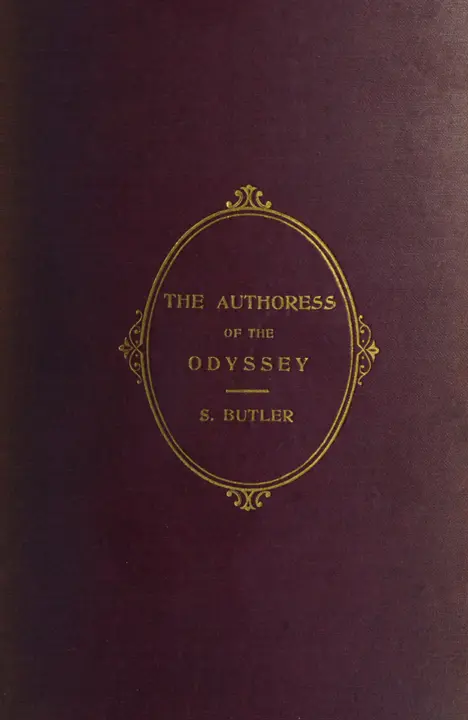
The Authoress of the Odyssey Where and when she wrote, who she was, the use she made of the Iliad, and how the poem grew under her hands
Samuel Butler
THE CLASSIC COLLECTION · 1878
"Life and Habit" by Samuel Butler is a philosophical treatise originally published in the late 19th century. The work delves into the intricacies of habit formation and the nature of conscious and unconscious actions. Butler explores how accumulated experiences shape human behavior, linking it to broader themes of evolution and instinct. At the start of "Life and Habit," the author sets the stage for a deep inquiry into how repetitive actions transform from conscious efforts into almost automatic behaviors. Butler uses examples like playing a musical instrument, writing, and talking to illustrate how conscious knowledge becomes latent as familiarity increases. He also reflects on the implications of this transformation for our understanding of inherited instincts, suggesting that even seemingly instinctual behaviors may be better understood through the lens of acquired habits developed over generations. The opening chapters challenge readers to consider the relationship between consciousness, knowledge, and action, positing that true mastery comes from an unconscious competence born out of extensive practice.
Introduction adapted from the source catalogue; source summaries may be automatically generated.
Free to read · English · 85,437 words · No account needed
MAKE TIME FOR A GOOD BOOK
On by default. Untick to stop anonymous reading totals. Each page counts after 10 seconds in view. How this works.
Anonymous counting is on unless you have switched it off.
I should be very sorry to pronounce any opinion upon the foregoing data; but a general impression is left upon my mind, that if the differences between an elephant and a tadpole-like fish have arisen from the accumulation of small variations that have had no direction given them by intelligence and sense of needs, then no time conceivable by man would suffice for their development. But grant “a little dose of reason and judgement,” even to animals low down in the scale of nature, and grant this, not only during their later life, but during their embryological existence, and see with what infinitely greater precision of aim and with what increased speed the variations would arise. Evolution entirely unaided by inherent intelligence must be a very slow, if not quite inconceivable, process. Evolution helped by intelligence would still be slow, but not so desperately slow. One can conceive that there has been sufficient time for the second, but one cannot conceive it for the first.
I find from Mr. Mivart that objection has been taken to Mr. Darwin’s views, on account of the great odds that exist against the appearance of any given variation at one and the same time, in a sufficient number of individuals, to prevent its being obliterated almost as soon as produced by the admixture of unvaried blood which would so greatly preponderate around it; and indeed the necessity for a nearly simultaneous and similar variation, or readiness so to vary on the part of many individuals, seems almost a postulate for evolution at all. On this subject Mr. Mivart writes:—
“The ‘North British Review’ (speaking of the supposition that species is changed by the survival of a few individuals in a century through a similar and favourable variation) says—
“‘It is very difficult to see how this can be accomplished, even when the variation is eminently favourable indeed; and still more, when the advantage gained is very slight, as must generally be the case. The advantage, whatever it may be, is utterly outbalanced by numerical inferiority. A million creatures are born; ten thousand survive to produce offspring. One of the million has twice as good a chance as any other of surviving, but the chances are fifty to one against the gifted individuals being one of the hundred survivors. No doubt the chances are twice as great against any other individual, but this does not prevent their being enormously in favour of some average individual. However slight the advantage may be, if it is shared by half the individuals produced, it will probably be present in at least fifty-one of the survivors, and in a larger proportion of their offspring; but the chances are against the preservation of any one “sport” (i.e., sudden marked variation) in a numerous tribe. The vague use of an imperfectly-understood doctrine of chance, has led Darwinian supporters, first, to confuse the two cases above distinguished, and secondly, to imagine that a very slight balance in favour of some individual sport must lead to its perpetuation. All that can be said is that in the above example the favoured sport would be preserved once in fifty times. Let us consider what will be its influence on the main stock when preserved. It will breed and have a progeny of say 100; now this progeny will, on the whole, be intermediate between the average individual and the sport. The odds in favour of one of this generation of the new breed will be, say one and a half to one, as compared with the average individual; the odds in their favour will, therefore, be less than that of their parents; but owing to their greater number the chances are that about one and a half of them would survive. Unless these breed together—a most improbable event—their progeny would again approach the average individual; there would be 150 of them, and their superiority would be, say in the ratio of one and a quarter to one; the probability would now be that nearly two of them would survive, and have 200 children with an eighth superiority. Rather more than two of these would survive; but the superiority would again dwindle; until after a few generations it would no longer be observed, and would count for no more in the struggle for life than any of the hundred trifling advantages which occur in the ordinary organs.
Your reading position is saved on this browser. Take it to another device with a library code. Reading pages adapt to text, rather than matching a printed edition.
Samuel Butler
Samuel Butler
Samuel Butler
Samuel Butler
BEHIND THE BOOK
This eBook is for the use of anyone anywhere in the United States and most other parts of the world at no cost and with almost no restrictions whatsoever. You may copy it, give it away or re-use it under the terms of the Project Gutenberg License included with this eBook or online at www.gutenberg.org. If you are not located in the United States, you will have to check the laws of the country where you are located before using this eBook. Read the source licence.
The original source file, including credits and licence, is retained by this library. Request an original-format copy at no charge. Please include the book title and Project Gutenberg identifier #6138.
KEEP YOUR CURIOSITY GOING

David Patterson (Spirit) Hatch
Coulson Kernahan

Ralph Waldo Emerson
Frances Wright

Edwin Abbott Abbott

Joseph Droz