
Through the Desert
Henryk Sienkiewicz
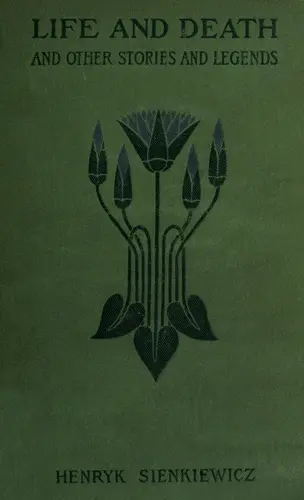
THE CLASSIC COLLECTION · 1897
"Life and Death, and Other Legends and Stories" by Henryk Sienkiewicz is a collection of short stories written in the late 19th century. This book delves into various themes, weaving together elements of mythical storytelling with moral and philosophical reflections, exploring the concepts of life, love, and mortality. Sienkiewicz, a renowned Polish author known for his historical novels, employs a poetic narrative style that adds depth to the legends presented. The collection opens with the titular tale, "Life and Death," which presents a Hindu legend where two realms—Life and Death—exist in parallel, governed by deities Vishnu and Siva. As humans navigate their existence filled with toil and weariness, they are drawn to the serene allure of Death. The dialogue between the gods reveals profound insights into the nature of happiness and suffering. Other stories, such as "Is He the Dearest One?" and "A Legend of the Sea," focus on familial love, sacrifice, and the struggle against nature’s forces. Through vivid imagery and rich symbolism, Sienkiewicz crafts a narrative that resonates with universal truths, showcasing the interplay between joy and sorrow, urging readers to contemplate their own experiences of life and death.
Introduction adapted from the source catalogue; source summaries may be automatically generated.
Free to read · English · 6,838 words · No account needed
MAKE TIME FOR A GOOD BOOK
On by default. Untick to stop anonymous reading totals. Each page counts after 10 seconds in view. How this works.
Anonymous counting is on unless you have switched it off.
Vishnu obeyed this command, and henceforward men ordered their own lives. From their good thoughts came joy, from their evil ones, sorrow; and they saw soon with wonder that life was not an unbroken rejoicing, but that with the life thread which Brahma had mentioned they wove out two webs as it were with two faces,--on one of these was a smile; there were tears in the eyes of the other.
They went then to the throne of Vishnu and made complaint to him:
"O Lord! life is grievous through sorrow."
"Let Love give you happiness," said Vishnu in answer.
At these words they went away quieted, for Love indeed scattered their sorrows, which, in view of the happiness given, seemed so insignificant as to be undeserving of notice.
But Love is also the mighty mother of life, hence, though the region which Vishnu ruled was enormous, it was soon insufficient for the myriads of people; soon there was not fruit enough upon trees there, nor berries enough upon bushes, nor honey enough from cliff bees.
Thereupon all the men who were wisest fell to cutting down forests for the clearing of land, for the sowing of seed, for the winning of harvests.
Thus Labor appeared among people. Soon all had to turn to it, and labor became not merely the basis of life, but life itself very nearly.
But from Labor came Toil, and Toil produced Weariness.
Great throngs of people appeared before Vishnu a second time.
"O Lord!" exclaimed they, stretching their hands to him, "toil has weakened our bodies, weariness spreads through our bones, we are yearning for rest, but Life drives us always to labor."
To this Vishnu answered:
"The great and all mighty Brahma has not allowed me to shape Life any further, but I am free to make that which will cause it to halt, and rest will come then to you."
And Vishnu made Sleep.
Men received this new gift with rejoicing, and very soon saw in it one of the greatest boons given by the deity thus far. In sleep vanished care and vexation, during sleep strength returned to the weary; sleep, like a cherishing mother, wiped away tears of sorrow and surrounded the heads of the slumbering with oblivion.
So people glorified sleep, and repeated:
"Be blessed, for thou art far better than life in our waking hours."
And they had one regret only, that it did not continue forever. After sleep came awakening, and after awakening came labor with fresh toil and weariness.
This thought began soon to torture all men so sorely, that for the third time they stood before Vishnu.
Your reading position is saved on this browser. Take it to another device with a library code. Reading pages adapt to text, rather than matching a printed edition.
Henryk Sienkiewicz

Henryk Sienkiewicz

Henryk Sienkiewicz
Henryk Sienkiewicz
BEHIND THE BOOK
This eBook is for the use of anyone anywhere in the United States and most other parts of the world at no cost and with almost no restrictions whatsoever. You may copy it, give it away or re-use it under the terms of the Project Gutenberg License included with this eBook or online at www.gutenberg.org. If you are not located in the United States, you will have to check the laws of the country where you are located before using this eBook. Read the source licence.
The original source file, including credits and licence, is retained by this library. Request an original-format copy at no charge. Please include the book title and Project Gutenberg identifier #35736.
KEEP YOUR CURIOSITY GOING
Coulson Kernahan

Maurice Baring
Frances Wright
Cécile Tormay
Francis Greenleaf Allinson & Anne C. E. (Anne Crosby Emery) Allinson

Frederic Jesup Stimson